Do Less: Delegate it to the Universe
Katrina Borthwick - 30th September 2026
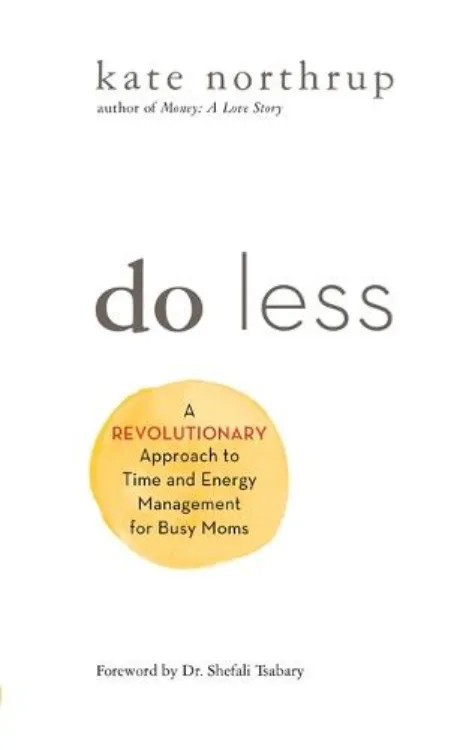
I downloaded Kate Northrup’s ‘Do Less’ book on audible, because the algorithm threw it at me. For context, I had recently read books like Flow State and Stolen Focus, both of which deal with attention and modern overload. So, when Do Less surfaced in my stream, it looked like it belonged in that same mental neighbourhood. A book about reclaiming attention. I just clicked ‘buy’ and let it run while I was doing some housework. Easy.
However, part way through streaming the audio book, or more precisely, just before 12.41pm on Sunday 13 September, I realised I had made a horrible mistake.
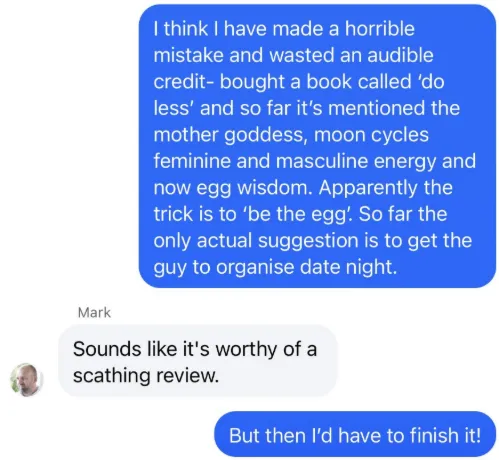
This was not simply a productivity book for Mums with a softer edge. It was a self-help book that mixed some useful ideas about rest and prioritisation with claims about lunar energy, menstrual-cycle symbolism, manifestation, astrology, ‘Egg Wisdom’, cosmic timing, and the universe helping with your ‘to do’ list. But, in the interests of scientific skepticism, I did finish it so you don’t have to.
Who is Kate Northrup
First up, a bit about the author. Kate Northrup is an entrepreneur, speaker, podcast host, and bestselling author of both Money: A Love Story and Do Less. Her public biography describes her as the creator of Relaxed Money, which she calls a neuroscience-based method for recalibrating power and wealth for high-functioners, and says her podcast Plenty ranks in the top 0.5% globally. She presents her work as being aimed particularly at ambitious women who want to succeed without burning themselves out.
Northrup has also described herself as a “professional freedom seeker” and “creative entrepreneur”. Whatever that means. Earlier biographical material says she graduated magna cum laude from Brown University, spent 2011 on a road trip called the ‘Freedom Tour’, and built a large network marketing organisation in her twenties, which she has credited with helping her create her own financial freedom. So I guess that’s solved the mystery of how she made her money.
Northrup’s work is steeped in the language of women’s empowerment, emotional and spiritual freedom, and the idea that changing one’s relationship with money and time can unlock a more purposeful life.
The general approach in Do Less
The core premise of Do Less is attractive. The idea is that women, especially mothers and entrepreneurs, are exhausted because culture has taught them that their worth is measured by their productivity. Instead of trying to fit more into every day, Northrup argues that women should simplify, ask for help, reduce unnecessary tasks, loosen their grip on control, and organise work around energy rather than around a rigid clock. None of these sound outlandish in themselves, but it’s not exactly groundbreaking stuff.
The book includes ‘Do Less Experiments’ designed to help readers simplify daily life and focus on what matters most. These include ideas like weekly rather than daily planning, reducing clutter, asking for help, setting boundaries, saying ‘no’, and paying attention to the body’s signals. At this practical level, some of the advice is unobjectionable and potentially helpful. If you are overloaded, it can help to identify non-essential commitments. If you are constantly reacting to other people’s demands, it can help to create boundaries. If you are exhausted, it can help to stop treating rest as laziness.
But the framework quickly expands beyond conventional time management. Northrup promotes ‘cyclical living’ - the idea that work and life should align with natural rhythms. Her model applies this to projects and business through four stages of the menstrual cycle (or the moon phases, for those who don’t have a cycle).

The woo in the book
Okay, so as you would have guessed, this is where Do Less moves from ‘maybe useful’ to ‘hang on, what?’. Or, in my case, a very undignified series of snort laughs. Seriously, don’t attempt to read or listen to this book while you are eating, you could choke.
Northrup proposes that the four lunar phases have distinct energetic signatures, and that readers should organise their work around them. The new moon is associated with rest, reflection, and intuition. The waxing moon is for initiating projects. The full moon is for visibility, communication, and collaboration. The waning moon is for completion, analysis, and bookkeeping. The idea here is to match activities to the strengths and weaknesses she says exists as each stage of the cycle. The stages are called the Fertile Void, Emergence, Visibility, and Culmination. These stages are presented as a sustainable rhythm of rest, planning, action, completion, and integration. Which all sounds lovely.
One of the book’s more dubious arguments is that the moon affects us because humans are mostly water, and the moon’s gravity moves ocean water. The problem with the water/moon theory is obvious. The fact that the moon affects tides does not automatically mean it produces meaningful physiological or psychological effects in human bodies.
Don’t get me wrong, there are real physiological changes across the menstrual cycle, and some people may find it useful to track symptoms, energy, mood, or attention over time. But that does not establish that menstrual phases have the same ‘energetic’ properties as lunar phases, or that the moon determines what kind of work a person should do. Northrup herself describes this as an “energetic practice”, where there is no objectively right or wrong way to do it - which is another way of saying it should not be confused with being useful.
The book also suggests that a menstrual period can function as a “monthly(ish) teacher”, whose circumstances can be interpreted to decode a message. It discusses the idea that menstruating around different moon phases has different meanings, including different kinds of ‘intuitive downloads’. Full-moon menstruation is associated with different material from new-moon menstruation, including possible themes of public leadership versus private life. As far as I can tell, this is some sort of reference to communal or mother goddess knowledge that magically gets bestowed at regular parts of the cycle. Fancy. The book also talks about those poor sods on ‘out of sync’ cycles - which she says is nature’s way of providing people to care for those who are menstruating at the usual time (where are all the men in this?). So, even though all the cycling is super important, don’t be sad if you aren’t, because it doesn’t actually matter - you’re still ok. Hmm.
Then there is astrology. Northrup recommends looking at where the new and full moons fall in your astrological chart to determine which area of life they are affecting. She recommends using the new moon to write intentions, goals, and desires, and the full moon to identify what you want to release. Elsewhere, her material describes lunar practices as ways to “magnetise your desires” and “manifest whatever you want.” In this vein, the book also includes “Egg Wisdom”, an energetic practice involving the feminine principle, and using one’s biological origins as a way of calling in desires.
At one point she likens women and men to the sperm and the egg. The egg just sits there, and all the sperm come running. So, if you are looking for a man, you should just be still, like an egg, and let those men come to you. This also applies to other things you want. Just be still and wait. I am super unsure how this ‘do nothing’ principle integrates with all the stuff that’s supposed to be ‘happening’ with the moon phases. Maybe if I act like a total egg, I figure the answer will most likely follow.
The broader spiritual posture is also important. Northrup encourages readers to let go of the need to control every outcome, and focus instead on their intentions as well as actions and responses. At its best, this can mean reducing micromanagement, as well as any habits of self-criticism, and to stop stressing. At its most woo, it becomes “delegate it to the universe”, make a cosmic checklist, stop gripping, stop trying to control things, and simply trust a greater force to handle what is outside of your control. She tells us in the book that she makes a point to delegate something on her checklist to the universe every week. She gives an example where she delegated finding childcare to the universe, and received a call from an early childhood centre the very next day. She then adds that she had actually waitlisted her kid with as many centres as possible, and that delegating it to the universe doesn’t actually mean you can get away with not doing anything.
Added to this, she frequently mentions the divine feminine, the ‘goddess’, and a few times throws in her belief in reincarnation. All of this is interweaved throughout the entire book. So you get the flavour.
What might be useful, and what is not scientifically supported
The useful parts of Do Less are mostly the parts that do not require believing in lunar energy. Reducing unnecessary tasks, planning weekly rather than daily, setting boundaries, saying no, asking for help, reducing clutter, noticing menstrual-cycle symptoms, and designing work around realistic energy levels are all potentially useful. They may not work equally well for everyone, especially people in precarious employment or without much support. But they are at least recognisable as practical strategies.
The unsupported parts are different. There is no good reason to treat moon phases as determining your energy or productivity. The moon’s gravity does not make your inbox easier to answer because you are mostly water. Menstrual phases are not the same thing as lunar phases. Full and new moons have not been shown to produce particular kinds of intuition. The moon’s phase is not a reliable way to decide what work you should do. Astrological houses do not reveal which area of your life the moon is affecting. Writing intentions at the new moon may be a meaningful ritual for some people, but there is no evidence that desires are being manifested by the moon. Deep breath.
The same caution applies to ‘Egg Wisdom’ and ‘Cosmic Checklist’ practices. A person can find a metaphor useful without pretending the metaphor is science. Many of the book’s ideas are best understood as symbolic prompts for reflection, rather than factual claims. But beware, some of them are just downright wrong.
How Kate Northrup makes her money
It is worth noting that Northrup’s business is best understood as a personal brand education business rather than simply a writing career. She makes money through books, digital courses, memberships, coaching type programmes, speaking and teaching, a podcast, and a media platform. Her shop has sold products such as the Do Less Planner and a Relaxed Money Blend. Her Relaxed Money 2026 programme sales page declares a price of US$3,000, with a programme that includes 13 money dates, live office hours, Q&As, nervous-system healing calls, community access, replays, bonuses, and other materials. Wait, back up… ‘nervous system healing calls’? I don’t even want to know.
The funnel is familiar. Free content, podcasts, email lists, and social media to create an audience. Then books and low cost products to introduce the worldview. Then courses and communities to deepen the relationship. Then premium programmes and alumni re-enrolment to provide higher-value revenue.
Northrup has also publicly discussed pre-selling digital courses before even creating them, including generating US$20,000 in one week. More recently, she has discussed the economics of her business in entrepreneurial blogs and podcasts (presumably with a different audience than her customers), saying how well she is doing and going on to discuss her strategies, including raising prices, increasing alumni revenue, and encouraging re-enrolment. This gives a window into a business that is intentionally designed around customer acquisition, conversion, recurring revenue, and repeat purchases.
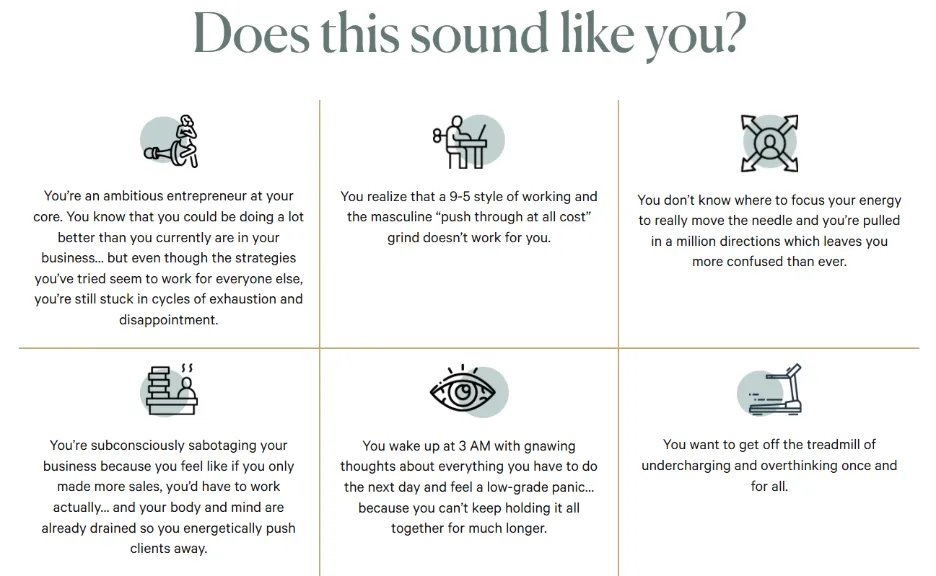
This kind of business model is not automatically exploitative. People are allowed to sell books, courses, coaching, and communities. Some customers may genuinely find value in the structure, support, language, or sense of permission her programmes offer. The ethical risk here is that she sells expensive solutions to potentially emotionally vulnerable people experiencing problems such as burnout, self-worth issues, financial insecurity, and the feeling that one is never doing enough.
That matters because much of the marketing frames financial and productivity problems as issues involving one’s relationship with money, money patterns, nervous-system responses, worthiness and emotional healing. These all become problems that ‘need to be healed’. And she has the solution. But she is not a financial adviser, therapist, accountant, lawyer, psychotherapist, business manager, or medical professional. Northrup’s own terms for at least one programme explicitly state that she is not providing any of those professional services.
Oh, yes, and you might have been wondering what she graduated Magne Cum Laude in? It took a while to track it down. My money was on marketing. But no, it was a degree in Art History. Magne Cum Laude is the second-highest honor, typically for the top 10% to 15% of a class. Just a regular degree then.
Conclusion
Do Less begins from a reasonable observation. That is that many people, and many women in particular, are exhausted by cultures of overwork, constant availability, and productivity-as-worth. Its best advice is simply to reduce what does not matter, ask for help, plan around actual capacity, pay attention to your body, and stop treating rest as failure.
But the book strays far from there very early on. It talks up the problem then wraps practical advice in a worldview of lunar energy, menstrual symbolism, manifestation, astrology, cosmic timing, and feminine energetic principles. Then she sells increasingly expensive products aimed at people who are tired, anxious, overwhelmed, or financially stressed.
So, the most generous reading is this. Do Less contains a few useful prompts buried inside a large amount of woo. The less generous reading is that the useful prompts provide the credibility, while the woo provides the brand. Either way, I did not end the book feeling that I had discovered a revolutionary approach to time and energy management. I ended it wishing the algorithm had stopped at Flow State and Stolen Focus.
Anyway, Mark forbade me from delegating this article to the universe. So here we are.