My first Book of Mormon Stories
Mark Honeychurch - 2nd March 2026
The current intrepid set of Mormon missionaries visiting me at my house have been very tenacious. Over the last month and a half or so, they have visited almost every week - and have also invited me on a tour of the local church in Titahi Bay. It’s been an interesting experience, not least because this current pair of young missionaries are joined by a man from Utah in his 70s - one of the post-retirement missionaries that are sent around the world, usually with their spouses, to take on leadership and administration roles in the church in the country they end up in. It certainly seems like a much nicer role than that of the younger missionaries, with more stability and creature comforts.
Over the last few weeks we’ve talked about the importance of evidence, and how science works. It’s been eye-opening to see just how ignorant these young missionaries are, but more so with the older missionary who, in 70 years of living has never taken the time to learn about evolution, the scientific method, particle physics, or just generally what we know about the universe and how we know it. Despite this ignorance of science, these missionaries have taken it upon themselves to try to teach me about science, with questions such as “how do we know that air exists if we can’t see it?”.
We’ve also delved into church finances, which has led me to look into some of the details of just how much money the church has. Current estimates put the church’s net worth at around US$300 billion. If we measure this against the market capitalisation of the largest companies in the world (basically the worth of all the company’s shares at the current share price - not a perfect way to figure out the worth of a company, but it’s probably good enough), this would put the Mormon Church at around 50th place globally, level with companies like Toyota, Nestlé, Morgan Stanley, Goldman Sachs and HSBC.
I learned that the church has so much money that it has had issues investing it all. Not only has the church bought huge swathes of farmland in places like the US, Canada, the UK and Australia, as well as many major secular commercial properties, but it has also created an investment company, Ensign Peak Advisors, which is responsible for the investment of $150 billion dollars of church money (~$50 billion in the US and another estimated $100 billion internationally). In 2022, when someone traced investments in the US, they figured out that just under $1 billion of that money had been invested in arms manufacturers - a weird choice for a peace-loving church.
A few years ago Ensign Peak Advisors was fined $5 million by the US Securities and Exchange Commission for hiding their investments, using a series of shell companies through which the money was invested. Their reasoning for doing this was that they wanted to avoid any negative publicity that may come from people learning that they have so much money, especially given that the church has officially told its members that “if a destitute family is faced with the decision of paying their tithing or eating, they should pay their tithing”.

My visiting Mormons’ response to this information, apart from saying that they’d never heard of Ensign Peak outside of knowing that it’s a hill on the outskirts of Salt Lake City, was to tell me that any money the church may be holding onto, rather than spending to help the needy, is a “rainy day fund”. I joked with them that this much excess cash could only be for the kind of rainy day not seen since Noah’s time, and that God promised back then he’d never make it rain that much again. They also told me that if people pay a tithe, God will pay them back ten-fold. This was a little surprising, hearing a Mormon try to push the idea of “prosperity gospel” - but I guess we live in surprising times.
One of the younger missionaries suggested the other day that I should listen to a podcast called Church History Matters, hosted by a couple of Mormon teachers. I went back to the early episodes and started listening to the most juicy ones, like the ones talking about Joseph Smith’s supposed translation of gold plates using seer stones in a hat, and several episodes trying to justify polygamy - including a valiant effort to explain that Joseph Smith didn’t really want 35 wives, he only wanted one and was disgusted by the thought of polygamy, but an angel with a sword threatened to kill him if he didn’t marry lots of women (and I guess have sex with them).
As with every set of missionaries, this group has been asking me to read parts of the Book of Mormon. By now, though, my standard response (which is true) is that I’ve had the Book of Mormon on my bedside table for years now, and every time I pick it up and try to read it I find myself unable to wade through its dense, artificially archaic language and find it really hard to comprehend what I’m reading. When I explained this to the visiting trio, and asked if maybe there was a simpler version of the text I could read, the old man of the group very politely and apologetically suggested that a children’s version might be more to my liking.
Far from being insulted by this suggestion, I loved it! I figure that most Mormons are brought up hearing stories from the Book of Mormon, and so when they finally try to actually read the Book of Mormon, much of what they’re readiing is already familiar to them. But with me, I don’t have this background. So I jumped at the chance, and told them that if they have a kids’ version of the book of Mormon, I’d love a copy. Sure enough, the next week they came round and gave me my very own copy of the “Book of Mormon Stories”. It has lots of pictures and, although it’s still pretty boring and repetitive (it’s more of a dry simplification of the stories than a story-telling interpretation), it’s still a much easier read than the official version.
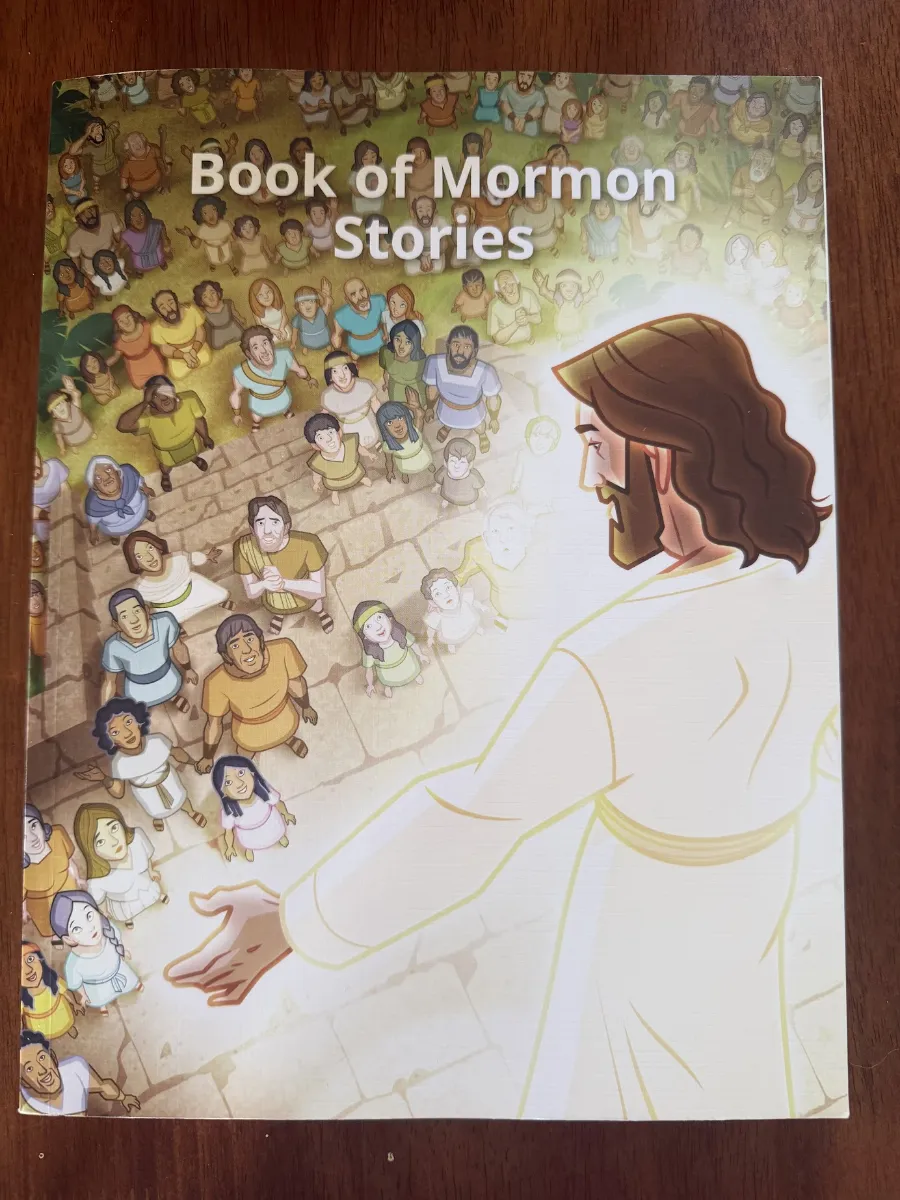
With any luck, I’ll finish reading this in the next few weeks. And, who knows, maybe then I’ll progress to reading the grown-up version of the book.