Pumped hydro storage
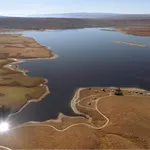
You probably remember a previous scheme for pumped hydro at Lake Onslow in central Otago, which was postulated by the previous government as being perhaps useful in New Zealand's low lake level dry years.
You probably remember a previous scheme for pumped hydro at Lake Onslow in central Otago, which was postulated by the previous government as being perhaps useful in New Zealand's low lake level dry years.
It was Wellington Day yesterday, so this newsletter is a day later than usual. It's been a very warm weekend here in Wellington, but I've spent most of the weekend inside, with the air conditioning on, working on our plagiarism project (no, we're not planning to plagiarise from elsewhere to fill our newsletter!). Between Dan Ryan and myself, we have enough coding skills to be able to write software tools that are making our job of detecting and displaying cases of plagiarism much quicker - so I've been spending the weekend writing software.

When we started the NZ Skeptics Calendar project last year, the first place Mark Honeychurch and I turned to was our own archive. Unfortunately, it wasn't nearly as fruitful as it could have been, as editors past had removed all references to dates and newspapers from the clippings published. Still, there was one story that intrigued me…
In my last newsletter, I put a call out for people to help with a project investigating pharmacies and the pseudoscientific products they had on their shelves. We got a good response, with several people coming on board to help with the project.
NZ Skeptics has been running a project that investigates products sold in pharmacies that are based on pseudoscience - you know the sort of stuff - homeopathy, and various herbal remedies with scant evidence of efficacy.

A couple of weeks ago I noticed a video from a YouTube channel I keep an eye on for its coverage of cryptocurrency scams that looked interesting - the tale of Pixelmon, an NFT project that had recently sold over 7,000 NFTs for a grand total of around NZ$100 million. By the end of the week, Stuff and 1News had covered the story. Why did this project make the news here in NZ? Because the NFTs had been unveiled, and they were abysmal. And why did this story pique my interest? Because the person in charge of the project had been “doxxed” (had their identity revealed), and a screenshot of their LinkedIn profile in the video I watched showed that he had recently graduated from the University of Waikato - so it appeared he was one of our own, a Kiwi.

I'm not a fan of cryptocurrencies. Bitcoin, the original and most "successful" of them, has not followed its creator's vision of being a decentralised currency that allows people to make payments to each other without having to go through traditional banking systems. Rather, instead of Bitcoin being used as a digital currency for purchasing online, people are using it as an investment, speculating on its price and hoping for “massive gains”. This is evidenced by both its high price per coin and its volatility. Hardly any Bitcoin transactions are actually involved in buying or selling goods, and the high price of Bitcoin these days means that the Proof of Work idea for securing the Blockchain (the shared list of transactions that records all transfers of Bitcoin) ends up using over 1,000kwh of electricity for each transaction. The promised decentralisation of Bitcoin is also mostly a myth these days. What Bitcoin has become is a way for greedy people to make money from other greedy people. Its creator, the enigmatic “Satoshi”, is probably despairing of what happened to his creation - if he's still alive.
The James Webb Space Telescope (JWST) has successfully launched!
The Australian Skeptics have spent the last few years working hard on an amazing project, led by Richard Saunders, to find and analyse as many psychic predictions as they could find.
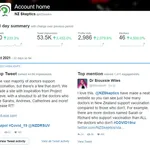
Late last week NZ Skeptics published a spoof website built (NZ Skeptics Secretary and past Chair, and alternating newsletter author).
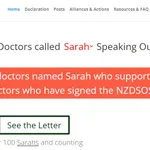
Welcome to the NZ Skeptics newsletter.
The amazing members of the GSoW (Guerrilla Skeptics on Wikipedia) group have struck again. In recent years the group have done some amazing work creating new Wikipedia articles and rewriting existing ones on topics of importance to skepticism, including quite a few that are related to New Zealand - including pages for skeptic Siouxsie Wiles, psychic Jeanette Wilson and even our organisation, the NZ Skeptics. We've also had Susan Gerbic, head of the project, come to New Zealand twice in the last few years to talk to us at our conferences about both the GSoW project and her work using sting operations to bust psychics.

Siouxsie is frequently to be found blogging or on the TV or radio, explaining in a down-to-earth manner current developments in science, or why she is skeptical of certain claims whenever they appear in the media. In 2016 alone she took on MPs, anti-vaxxers and Mike Hosking, as well as tackling topics such as e-cigarettes and the Zika virus. She regularly appears in the “Skeptical Thoughts” radio slot with Graeme Hill on Radio Live, and she also has a fortnightly slot on Radio New Zealand's "Nine to Noon" show, talking about science. She was nominated for the Denis Dutton award in recognition of her outstanding communication skills and sustained efforts to demonstrate critical thinking, skepticism and the scientific method.
I received an email earlier this week about a new Citizen Science Project called Planet 9.
The Wellington Astrology centre, a drop-in office in central Wellington, is struggling to make ends meet and has turned to Pledge Me to raise funds. It's been running since 2011, but now needs $3,000 to cover the next 3 months of bills.
Surprising results from a US study of the effectiveness of counselling on reducing juvenile crime.
by Howard Blum; Simon & Schuster 1990
By KINGSLEY FIELD and FIONA BARBER