8 December 2025 - Approx. 5 min read
Imagine coming home from a long day at work and you forgot the groceries and haven't got anything to cook. Just as you're about to panic-order some Uber Eats you remember you can just boot up your 3D printer, whack in some basic ingredients, and a little while later out pops a perfect burger! I know this sounds like something from Star Trek, where Captain Picard could dial up anything from lobster ravioli right through to a “tea, Earl Grey, hot”. But thanks to advances in food engineering, we might be closer than you think. 3D food printing is a rapidly developing technology that has attracted interest from engineers, chefs, health professionals and the occasional sci-fi nerd.
23 December 2024 - Approx. 10 min read
Okay, the title's a little crass, but it was suggested to me as something that would help to tie my article in with the Alien/Space theme of this week's newsletter, and I've not managed to think of anything smarter since.
5 August 2024 - Approx. 8 min read
Recently I was listening to the Inner Cosmos podcast, which explores the human brain from a neuroscience perspective. One of the episodes was about intuition, and the host was interviewing an Australian scientist, Joel Pearson, about intuition. During the interview, the scientist mentioned Intuitive Eating. This was a new term for me, so I thought I'd look it up and see what it was all about.
19 February 2024 - Approx. 2 min read
Previously I wrote about the Therapeutic Products Act which was due to replace the Medicines Act 1981 and the Dietary Supplements Regulations 1985. The NZ Skeptics Society made a written and oral submission.
30 January 2023 - Approx. 3 min read
This past week has been quite sad for me. We had to say goodbye to our dog Darwin. I hope you'll indulge me in some reflections on the experience.
13 June 2022 - Approx. 3 min read
Louise Wallace is a reality TV actor, most recently having appeared on The Real Housewives of Auckland - a show I've not seen, but the title of which puts me off immediately. She's also previously appeared on various current affairs shows, and also worked as host of The Weakest Link, a TV quiz show from the early 2000s..
1 May 2019 - Approx. 6 min read
Recently, I was in conversation with a couple of people here in Tutukaka. The topic was the local tourist map which I produce and pay for with a series of small advertisements. I was asking them to advertise their business. One of them said she was not happy to do so since the tourist map was not environmentally friendly. My eyebrows went up, and I pointed out that the map was on card board, which was biodegradable. She agreed, but said her problem was the ink which was full of chemicals. Again, my eyebrows went up, and I suggested that everything was full of chemicals, including the human body. She disagreed vociferously. Only synthetic evil products contained chemicals.
1 November 2017 - Approx. 3 min read
I decided to dip my spoon further into the benefits (or not) of turmeric after reading this issue's bio-blog by Alison Campbell and ended up learning about how food safety methods are being dropped due to consumer pressure based on unscientific thinking.
28 August 2016 - Approx. 1 min read
Julia Rucklidge from Canterbury University has suggested that processed food may be a cause of a mental illness epidemic.
14 February 2016 - Approx. 1 min read
A couple of stories about fast food that set off my skeptical alarm bells this week.
7 February 2016 - Approx. 1 min read
Research is coming to light that antioxidants in food and drinks are not useful to aid health, and may actually be damaging to us.
7 February 2016 - Approx. 1 min read
(Although we all know that fast food is not generally a great nutritional choice, there's a lot of nonsense out there about how bad fast food is. The most pernicious is about how fast food doesn't rot, and people have shown this by keeping McDonalds burgers for years, with only minimal breakdown of the food. Of course, it's been shown that in the same conditions where McDonalds burgers don't rot, organic home-made burgers don't rot either)
1 November 2015 - Approx. 3 min read
The internet is a seething pool of 'stuff ', and one of the challenges faced by those using it is to distinguish useful information from foolish fantasy. And there surely is a lot of the latter! Thus we find that...
1 February 2015 - Approx. 3 min read
Apparently 80% of people in the USA think so, according to a Washington Post article that's been all over Facebook in the last few days. That is, 80% of those polled in the regular Food Demand Survey (by Oklahoma State University's Department of Agricultural Economics) agreed with the proposition that all food containing DNA should be labelled. (To put this in context, there is currently a heated debate in the US – driven by those opposing the incorporation of material from genetically-modified organisms into the food chain – over whether such foods should be labelled as such.)
1 February 2014 - Approx. 1 min read
Janelle Wallace reviews Salt Sugar Fat: How The Food Giants Hooked Us, by Michael Moss. Random House Publishing, 2013.
1 November 2010 - Approx. 3 min read
Alison Campbell finds some claims about raw foods hard to swallow.
1 August 2009 - Approx. 9 min read
Presenting numbers with excessive and artifical precision in product labels, newspaper articles and report tables does nothing for scientific credibility and sows confusion in the mind of the reader.
1 February 2009 - Approx. 8 min read
When the Sunday Star-Times decided to survey the nation on how superstitious New Zealanders are and about what, I got used as guinea pig. Having done a lot of survey design and analysis during the course of my hodge-podge of an academic career, I often end up writing more about the questions than answering them. Add to that the tendency for being, as Margaret Mahy once characterised our group, "a person in a state of terminal caution", and you can imagine the result.
1 May 2005 - Approx. 4 min read
The Green Party does not have a good record when it comes to scepticism. In 2002, party co-leader Jeanette Fitzsimons was an ungracious winner of our bent spoon award for her support of "etheralised cosmic-astral influences" as a means of eradicating possums.
1 February 2005 - Approx. 1 min read
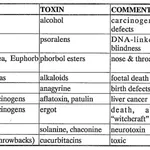
A Christchurch mother who fed her five-year-old son raw beans was surprised when he fell ill. Because they had not been sprayed, she reasoned they should be a natural, healthy snack. But natural, as Jay Mann makes clear in this highly entertaining guide to the contents of your dinner plate, doesn't necessarily mean safe. Beans for example contain lectins, which have no bad taste to warn unwary consumers, but destroy the lining of your small intestine. Alfalfa contains canavanine, which disrupts DNA and RNA metabolism, though you would need to eat a lot of alfalfa to be poisoned by it. Lots of common foods are laden with poisons, all perfectly natural of course, but best consumed in small doses only.
1 February 2003 - Approx. 5 min read
Insecurities about water quality have led to a boom in sales of bottled water. But the health benefits of the phenomenon are probably minimal.
1 August 2002 - Approx. 3 min read
John Riddell learns about some dangerous chemicals
1 May 2002 - Approx. 4 min read
Owen McShane examines last year's Great Soya Sauce Scare
1 November 2001 - Approx. 1 min read
Scientific studies suggest "organic" foods are neither healthier nor safer than genetically modified products or those grown conventionally.
1 May 2001 - Approx. 4 min read
Howard Bezar and Denis Curtain
1 February 2000 - Approx. 2 min read
Sceptics have put up $100,000 in a bid to make a controversial Australian spiritualist eat her words over claims she does not need food.
1 February 2000 - Approx. 12 min read
The Swedish chemist Berzelius coined the term "organic" for substances that could only be made by living organisms and not synthesised by humans. His German friend Wöhler synthesised urea in 1828 proving Berzelius wrong: there was no such distinction. Another brilliant German chemist, Liebig, then used "organic" to mean carbon-compound chemistry, extending this to include the chemistry of living organisms and so beginning biochemistry.
1 November 1999 - Approx. 5 min read
There are three types of people in this country. Those that can count and those that can't. It is common to blame the education system for this.
1 May 1998 - Approx. 10 min read
Jay Mann delivered this address with accompanying liquid refreshment (with and without MSG) at last year's conference.
1 February 1998 - Approx. 1 min read
I was recently reflecting on my career as a scientist, and realised that this year is the 50th anniversary of my first scientific paper.1
1 August 1991 - Approx. 6 min read
Is a high-fibre, cholesterol-free, non-dairy diet the answer to one's health problems? It may be for some, but for others it can pose a downright danger.
1 May 1991 - Approx. 14 min read
Despite recent claims that "natural" foods are safer, there is evidence that "natural" pesticides can be present at much higher concentrations than residues from synthetic pesticides. These "natural" chemicals are often untested and of unknown toxicity, with little evidence of health benefits.
1 November 1990 - Approx. 4 min read
Anabolic steroids were in the news during the Commonwealth Games and Dr Michael Kennedy has been studying their use by athletes for the past ten years. His conclusion is that "anabolic steroids have no effect on aerobic sports, such as running and swimming, but may lead to a small improvement in the performance of trained weightlifters." He quotes a 1972 study that showed when athletes were given placebo and told they were steroids, they got stronger and trained harder.
1 November 1990 - Approx. 1 min read
(From the London Sunday Times Supplement)