Randi and me, part 1 - the dowsing test
Lee Traynor - 23rd November 2026
When I turned a skeptic in 1988 and joined the German Skeptics (GWUP), one of the first things I did was to go to a World Skeptics Conference, which was held in the small Bavarian city of Bad Tölz in 1989. Randi was at the conference, showing off magic tricks (including his changing the time on a wristwatch by “psychokinetic” means) - and he also gave the keynote. I was very impressed.
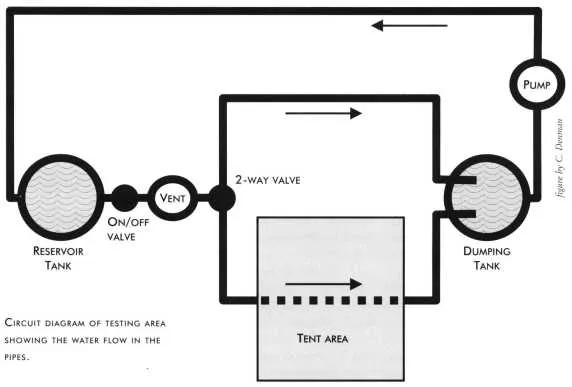
Later, in 1990, the GWUP organised a test of dowsers to be held on the grounds of the Hessian state broadcaster HR in Kassel, which was quite close to where I lived in Göttingen. The train trip was only 1½ hours – a far cry from the 20 minutes it ought to take nowadays, after the introduction of bullet trains and new tracks in 1991 – and I was able to participate in the preparations and the experiments themselves. We were testing all week long during a week in November. The Friday before, we had organised a digger to dig trenches along a rectangle. The idea was that two water containers would sit at the short edges of the rectangle, one initially holding water, the other receiving water that would flow down one of the two pipes that ran along the long sides of the rectangle. Dowsers positioned over the “test” pipe would then have to say whether the pipe beneath them was carrying water.
I had calculated the probability of the dowsers succeeding in at least 25 out of 30 trials, given the null hypothesis (i.e. that they were simply guessing), which would win them the opportunity to proceed to a further test which, if they passed again, would win them about NZ$30,000. I was interviewed by the accompanying camera team about the likelihood of one of the dowsers proceeding to the second round. It was atomically minimal.
I did, however, notice that the valve that the skeptics’ team had built into the pipe system was not the correct one. It ought to have been a valve that allowed all water flow to be switched off in between trials, and when switched off (in the neutral position) allowed only air into both test and control pipes. Then, after a random choice of test or control was made, switching the valve into an “active” state should have involved a single movement that was equivalent in its characteristics (time taken to switch, noise made) - the same whether the active position was “test” or “control”. This was to avoid inadvertently cuing the dowsers as to which position was currently active. I had done a final year project at university involving teaching rats to run electrified mazes, and we used switches with a neutral “off” position from where the active state – left or right – was arrived at by a single “click” of the switch, thus avoiding acoustically cuing the rats.
A major argument ensued. I was certain that the psychology professor who was one of the principal investigators (Robert König) would not be happy with the current valve, outlined what ought to be done, and let the engineers go find a solution. Meanwhile Randi in his impressive cape watched over the preparations. We even had a plumber present to make sure that the pipes were at the correct slope to allow all the water to empty out between trials.
The Saturday was spent filling in the trenches by hand, the digger having de-materialised. I’m not doing that again! The problem with the valve remained unsolved, and Professor König was due to make his inspection the next day.
I arrived at the grounds early on Sunday with my girlfriend, and was taken aside by another of the principal investigators, Amardeo Sarma. I thought to myself, “Oh, he’s just going to tell us to take the next train North because I’ve been making such a nuisance of myself with this stupid valve.” He ummed and ahhed a bit, and I gave him a “Get on with it!”. He said that since I spoke English, and that there wasn’t anything they needed me for that day, would I mind taking Randi and his friend (who we knew as Jose Alvarez) to a couple of museums to while away a rainy day.
I mean, there were people who would give their right arm for an opportunity like that! On the other hand, Amardeo had struck it lucky because, although he was born and grew up in Kassel, he couldn’t have known that I knew the Kassel art galleries well enough to be a reasonable host for this sort of thing. (Kassel itself hosts a major international art exhibition about twice a decade – the documenta – and I had spent a weekend being shown around the one that took place in the summer of 1982). Anyway, the four of us took off and spent a day at the museums, had dinner together, and we delivered the two of them back to their hotel at the end of the day.
The next morning I was given the task of being there early to collect the dowsers for their briefing prior to testing. Interestingly, one of the most asked questions in that phase of the operation was about where the toilets were. I would have thought that they could have used their dowsing powers to answer this, or simply apply some observational acuity to the problem. But, no, they had to be told.
Every day there were between six and eight dowsers who had made their way to the test – mainly men. Each dowser was to go through 30 consecutive trials, one dowser at a time. Before a dowser started their set, they were given an opportunity to “experience” water flowing down the pipe as well as test the empty pipe. Then the noose was laid on their shoulders, so to speak, and they were asked to sign a form that they had understood the test, had no further questions, and felt they were in a position to undertake the test successfully.
Parallel to the main water-divining test, there was also a boxes test which dowsers could choose to complete, if they felt that it was a good use of their time. Most chose to complete this test as well. We had ten plastic storage boxes (ca. 25 L) which had lids that were clipped on. These boxes were attached by double-sided sticky tape to a bench, so they couldn’t be moved, and the lids – which had the numbers 1-10 written on them – could only be attached in one way. In this test an object of the dowser’s choice – a gold Krugerrand, a silver coin, a piece of coal, or a loudspeaker magnet – would be hidden in one of the boxes, and the dowser would then try to find it. The success rate was set at 8 out of 10 correct, which carries a quantum mechanically small probability of happening by chance.
As it turned out, Randi was assigned to this second test, but with gold and silver involved, the investigators wanted someone slightly more trustworthy to handle these items - Randi would only make them disappear! And since I had gotten on well with Randi the day before, I was given custody of the precious metals.
Randomisation for both these tests was by ping-pong ball selection out of an opaque black cloth bag. The bags contained 10 balls (for the water test it was five marked with the letter “T” and five with the letter “C”, and for the boxes test the numbers 1-10), and for each trial one ball was removed, the letter or number would be recorded on live video (i.e shown to the camera), and then it would be placed back into the bag.
So, while the probabilities of a dowser succeeding at either or both of these tests were very small, there was some speculation among the investigators as to what might happen if they were successful. But that was the point of the test. Some people thought that a probability of 1 in 40,000 or whatever it was might turn up, although in my opinion if your tip for the Melbourne Cup has those odds on it, forget it. But now I had transformed a day at various museums into performing a skeptical investigation with Randi himself. It was an honour.
I also wanted to extend the protocol. In the boxes test, the dowser was given three initial trials where I demonstrated the selection procedure to them, including placing the ball back into the bag, placing the desired item into the chosen box, closing it and asking the dowser to find the item. After these three trials, which were invariably successful, the blinded ten trials took place. I would perform my selection procedure (filmed on video) with Randi and the dowser removed from the shed where this was taking place, then shout “Test”, when I would leave the shed by another exit, and Randi and the dowser would enter. The dowser would do their best to divine which box I had hidden the chosen substance in, and when a choice had been made Randi would shout “Next”, and they would leave the shed.
At the end of the blinded test, I would ask the dowser whether they would show me once again whatever it was they were doing when I was not present. I had to invent various excuses for this, such as that I was curious, or the camera might not have been working, and a couple of the dowsers clearly thought I was a bit short-changed in the top paddock, but they all complied. But at the end of the test I could clearly show that the dowsers could successfully divine an object on both sides of the blinded test when they weren’t blinded. No one said, “No, I’m exhausted from dowsing, I can’t do it any more. I’m tired, I need a rest.” So I was very curious to find out what the test results looked like.