Boo AM: Ghosts on the Air
Bronwyn Rideout - 12th October 2026
It will come as no surprise to regular readers that the various social media algorithms are delivering me the goods in the lead-up to Halloween. Both believers and debunkers of the supernatural are cranking out their haunted house/ghost hunting content, and it has been a hoot to watch all the ‘shocking’ evidence gathered which proves that ghosts float, or hover, amongst us. One piece of technology that always makes me groan a bit when it is pulled out is a modified radio called a Ghost Box or Spirit Box.
And, of course, things that annoy me are always great topics to do a deep dive on.
What is a ghost/spirit box
My favourite description comes from Grant Clauser’s 2024 review of popular ghost hunting technology that was published in the New York Times. Clauser called spirit boxes “…basically bad radios” that sweep across AM and FM frequencies. Your car radio does this when tuning it, but it will stop whenever it hits on a broadcast signal. The spirit box, however, couldn’t care less and will continue to sweep up through the frequencies. What you, the listener, will hear are snippets of speech, or even whole words, interspersed amongst white noise.
What you are hearing, and why you are hearing it, depends on the faction you are talking to. Enthusiasts believe that spirits are manipulating the scanner to find these snippets to create their responses. Skeptics argue that the devices and those who sell them rely upon the very human tendency towards auditory pareidolia, finding a pattern in nebulous stimuli.
MVP of EVPs?
Electronic Voice Phenomenon, or EVP, describes the capture of sounds or voices on video or audio recordings that are of unknown origin, and were supposedly not heard by anyone physically present during the original recording. Ghost boxes are not always categorised as an EVP, and instead the term Instrumental Trans-Communication, or ITC, is seen as more accurate. ITC describes the “… apparent communication with discarnate entities through the use of electronic devices or other technologies”, and the abbreviation does appear on the branding of some devices. The distinction is generally made that with the ghost box, you are hearing the ghost’s voice through their manipulation of the device, whereas the discovery of EVP happens only when the recording is reviewed. Still, both the Wikipedia page for EVP and Linguist/Skeptic Karen Stollznow include ghost boxes as a tool for capturing EVP. Maybe the fundamental difference between traditional EVP collection and ghostboxes is irrelevant when both rely on the listener’s pareidolia, and ghost hunters use both in concert as tools to compile evidence that is most convincing.
Loaded with extra features
Spirit boxes are a little like random number generators, but for sound. And, just like a random number generator, you can set parameters for the type of feedback you want. The speed at which the scanner moves through the frequencies typically ranges between 30 milliseconds and 350ms, depending on the model. Faster speeds like 30 to 50ms will scan about 20 frequencies a second, and return tiny sound fragments, while ‘slower’ speeds of 150ms or higher are more likely to return whole words.
Popular Ghost Box models like the SBox, SB7 and SB11 scan the standard AM and FM frequencies and, fortunately for New Zealanders, the radio bands for these Made in the USA products are the same as here. The more expensive models will scan AM and FM bands simultaneously, while the cheaper ones will let you manually toggle between them. If you have real dough to spend on the hobby and want to up the spookiness factor, you can buy devices that display the words it thinks are being garbled out by some unholy mix of NewsTalk, Hauraki, and Radio Rhema, and/or have EMF or temperature sensors to help find that ghostie hot (or cold) spot.
If you can’t afford to ship a ghost box from overseas, never fear! There is an app for that. Not only do you have more control over the audio input and output, some apps also utilise your phone’s built-in features like the gyroscope, magnetometer, and accelerometer to enhance your ghost detection experience.
https://www.instagram.com/reel/Dcv83UnOpTk/
https://www.youtube.com/shorts/tpvKLGsvMWw
The spirit box has become a ubiquitous tool in the ghost hunter’s arsenal, but no one has made it more famous than ex-Buzzfeed hosts Shane Madej and Ryan Bergara. The duo’s schtick for their Buzzfeed Unsolved: Supernatural show is that Shane is the skeptic and Ryan is far more suggestible to the idea of supernatural forces. The spirit box thus becomes the perfect foil for Ryan to get the shit scared out of him.
https://youtube.com/shorts/4Hg2F3kSS6M?si=OYzz64bpmQeAIlbX
Statistically speaking
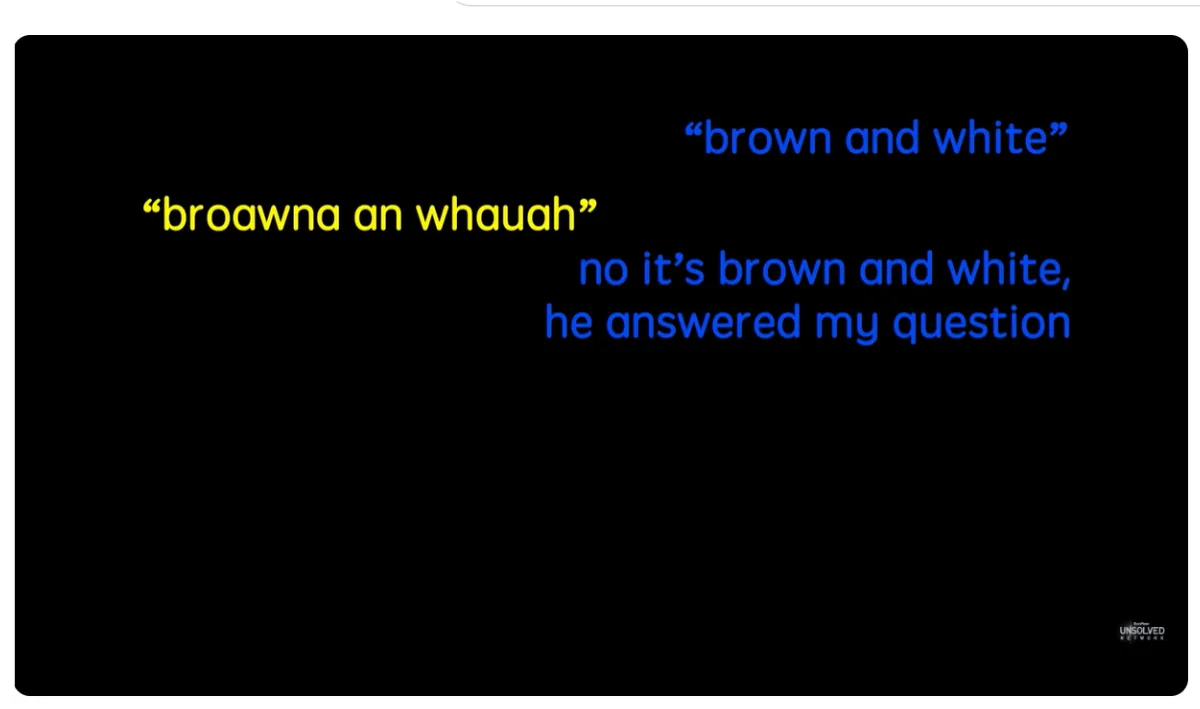
Almost a decade ago, Ashley Villar & Alex McCarthy were watching one such episode of Buzzfeed Unsolved: Supernatural where Ryan asked the spirits what colour jackets he and Shane were wearing, and received the answer “Brown and White”.
Villar and McCarthy wondered what the statistical likelihood was of Ryan getting that response was, and got to crunching some numbers. But first, they used Python to build a virtual spirit box. They estimated that the scanner used in the clip above was scanning at 1/5th of a second, which was sufficient to capture 2 phonemes on any single radio station. Their virtual box was admittedly not true to life because the model assumed that every scan landed on an active radio station that had a speaking segment; in real life, they noted, there could be music, static, or nothing. Using a phonetic dictionary as a guide, they went and put all the phonemes into pairs. When testing their virtual machine, they found that while a human could theoretically hear 120 words over 30 seconds, the simulation was identifying an average of 3 common words in that time frame.
So, getting one-word answers? Not surprising, and pretty par for the course. There was a 0.38% chance of hearing two words in a row, which Villar and McCarthy described as not statistically significant, while hearing 3 words was significant at 0.01%! And this is in a model where such events might happen more frequently because of the perfect conditions. But, as Shane and Ryan demonstrate themselves, “Brown and White” is in the ear of the beholder…
The radio stars that video didn’t kill
I’m always curious about when things were invented, or when humans started using a device differently from how it was intended. When I started researching the history of the ghost box, I was surprised to see that many cited Frank Sumption’s invention of the Frank’s Box in 2002 as the precursor. My surprise was mainly fueled by a) that radio scanner is fairly common technology, and b) a pop culture diet of sci-fi and horror films in which a misbehaving radio is the sign that something strange is about to happen, such as the arrival of a UFO.
The story of the Frank’s Box begins with a 1995 issue of the magazine Popular Electronics, with a cover that challenged readers to try some experiments to see if the disincarnate were trying to communicate:
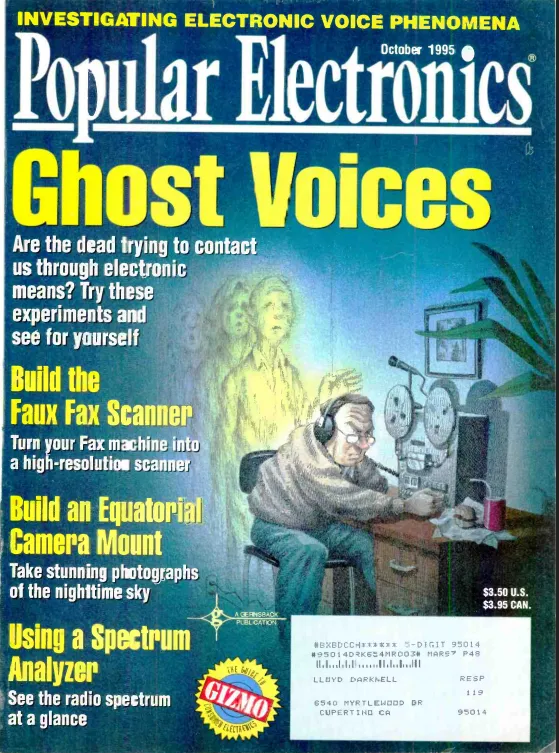
The author of this article is just Konstantinos, which may be in honour of the late parapsychologist and EVP researcher Konstantins Raudive. In any case, the article recalls experiments with traditional EVP recording in the mid-1900s, and presents readers with methods of EVP recording to try at home. The Radio Method described here advises the reader to use a radio with a tape recorder, find a channel that is nothing but white noise, and record that station for 5 minutes. While this method was preferred for the quality of voices recorded, the obvious critique was that the voices were just stray broadcasts from other channels. In any case, this use of the radio was more in line with traditional EVP methods than the ghost box of today.
The article captured the attention of Frank Sumption. According to a profile written by Tim Woolworth in 2010, Sumption was a ham radio hobbyist and Army veteran living in Littleton, Colorado with an interest in the paranormal. He initially tried the experiments suggested by the magazine, but had no success capturing EVPs. By all accounts, Frank was definitely eccentric, sometimes prickly, but is often fondly remembered by friends and family.

Frank tried again in 2000 and found that he was far more successful at getting EVP, but wanted to know why. He first came across the work of a researcher named Stein (the article does not indicate who this is, other than that he was Danish), who was experimenting with sweeping through the analog channels with his fingers to achieve communication. Sumption also started experimenting with a programme called EVP Maker. The classic version of this software is similar to what Villar and McCarthy programmed, in which normal recordings are spliced into phonemes, and those phonemes are played back in random order. In 2007, following the suggestion of a member on his web forum, Sumption started to design boxes that allowed for continuous sweeping - and it was this addition that continues to inspire the designs of today’s spirit boxes.
Sumption made each box by hand and, at the time of his death, it was believed that only 180 existed; each one given to someone Frank had thought worthy of having one. Still, Frank also truly believed in ITC research, and allowed others to have access to his schematics.
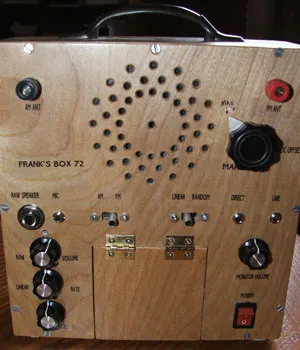
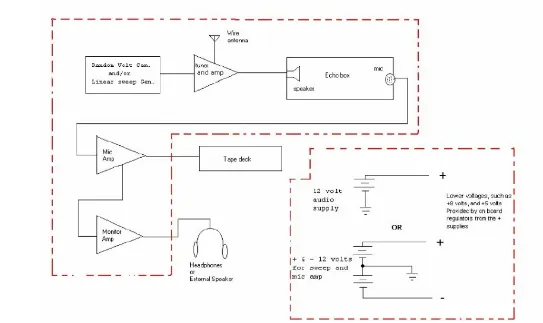
In Frank’s own words, the system uses “…white noise that is amplified, filtered, and rectified to provide a random voltage to tune a voltage-tunable radio receiver.” And then the radio sends random audio into the enclosure or echo box. Frank struggled to both describe or understand how his invention worked, suggesting that it was some kind of resonance happening at a quantum level. Each model is different. Some sets, like Box 72 above, do not work consistently, while ones made around 2010 contained crystals which were added at the behest of the spirits. The rationale for the crystals was not explained, nor are the crystals connected to the wiring in any meaningful way; the only comment Sumption would make was that they improved the audio quality of the voices.
Here is a video of how one Frank’s Box worked, and how one YouTuber interpreted the output:
I have seen comments that spirit boxes were invented in the American bible belt, and their success was ensured because of the large number of Christian radio shows on the airwaves. Colorado is not part of the bible belt per se, and a 2026 study by the Pew Research Center about religious radio in the US found that 19.2 % of radio stations in Colorado were religious (compare that with North Carolina, in which 35.9% of stations are religious). Roughly a quarter of all terrestrial radio stations (~4,000 stations) in the US were religious, with 98% of the American population living within range of at least 1 religious radio station. Their content tends to be mostly talk radio or broadcast of services or sermons, although 37% of channels primarily air music.
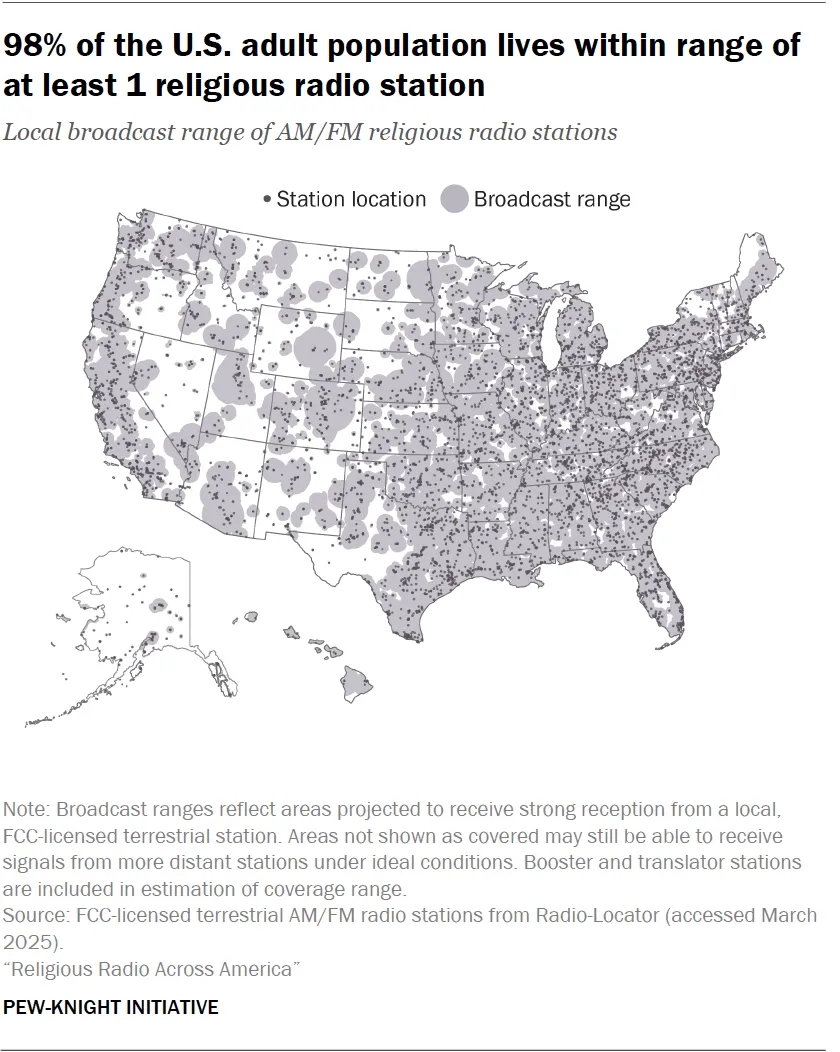
Frank’s advice to Stollznow, when she was given the opportunity to use a Frank’s Box, was to tune it to AM radio because it featured more speech than music. In many ways, that categorisation is true - The AM band is favoured for talk radio and news, and has a longer range, but the sound quality is lower and more prone to interference; the higher quality of sound on the FM band is preferred for music. Religious stations are distributed across both bands, but if you wanted to manipulate your spirit box experience, choosing an AM band may increase your chances of catching more fire-and-brimstone content. But hobbyists beware - AM radio is being phased out of domestic cars, meaning that vital stock for homemade spirit boxes may be depleting over the next decade.
So, who did Frank think he was talking to when his box started sending messages back to him?
While he doesn’t refer to them as aliens, Sumption told Karen Stollznow that he was in contact with higher-level spirits who dubbed him their “Purple Princess”. Sumption provided Stollznow with a couple of reasons for this moniker, which he warmly adopted in his everyday life and in his business. First, he said he received the name because he wore purple clothes and accessories and, according to the spirits, purple was the colour of royalty. Second, the spirits told him that he was a kidnapped Princess from the Pleiades, back when the Ancient Egyptians had space flight; he was then sent forward in time, and will be rescued when the current Earth cycle is finished. Third, other entities told him that they see him as a woman.
However, I then came upon this video, filmed over a decade ago at the Stanley Hotel (Yes, the same hotel from the 1970s The Shining and the current home of the Frozen Dead Guy). In this clip, he mentions that he sometimes talks to his son via the box.
Like many who get deep into the paranormal community, Frank suffered a major loss in 1989. Two of Sumption’s sons were victims of a violent crime spree in which the elder son, 16-year-old Frank Jr., was murdered. It is a tragedy that isn’t written about in relation to Sumption’s work. I am aware that this is addressed in his biography, but I have not been able to find an ebook version to reference and fully unpick the impact Frank Jr.’s death had in Frank Sr.’s ongoing work with the box.
If you’re interested in learning more about Sumption, and seeing a different version of his Frank’s Box, I recommend reading Karen Stollznow’s 2010 article for the Skeptical Inquirer.
Pretenders to the crown
Due to the difficulty of obtaining a genuine Frank’s Box, other ITC fans tried to find ways to build their own. Joe’s Box, designed by Steve Hultay and Joe Cioppi, is a plastic, walkie-talkie type device that swept AM frequencies only. It was manufactured and sold briefly from 2007. It was discontinued upon Joe’s death, making it a collector’s item in its own right. Hultay would develop his own Steve’s Boxes from 2010.
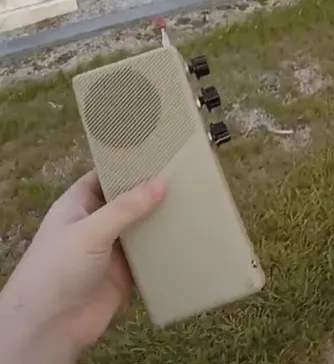
Joe’s Box
Another popular genre of spirit boxes are called Shack Hacks, so named because they are cheap, modified radios from the now defunct Radio Shack franchise. ITC researcher Bill Chappell is credited with discovering how to force these radios to continuously scan in 2007. It is a practice that continues for many ITC fans to this day.
In our next issue (or maybe the issue after next), I will look into the history of EVP’s and the evolution that brought us to spirit boxes in the first place - from Thomas Edison’s Necrophone to the Spiricom system.