Three Climate Change Snippets
Further to my previous articles on climate change, this week I will talk about several short topics from recent publications.
Further to my previous articles on climate change, this week I will talk about several short topics from recent publications.
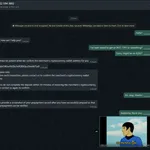
Over the last week or so I've been approached online by two scammers and, I guess because of the amount of free time I have now that I'm not attending Eastern Lightning fellowship meetings, I decided to play ball with both of them and see where the scam leads. Neither has reached the point yet where I've been asked to give them my money, but in both cases it didn't take long to see where the con would eventually come. Once we get to that point, which is likely to be in the next day or two for both, I will have a couple of fun articles to write - I've already been meticulously copy/pasting all of my chat sessions with the scammers in documents, so that I have a record of everything that goes on. As a taster, here's a fun preview of one of the incidental conversations I had with a “Customer Care” representative for a company I'm now apparently working for:
One of the most frequent questions I encounter, whether serious or not, is about driving an EV in the rain, or through a carwash. Of course, EVs are well built, and the normal expectation of driving is that they encounter wet weather all the time. Of what use would windscreen wipers be otherwise?
It's me again, Mark, for a third week running - as Craig is unavailable to do the newsletter again. This time it's COVID, and I can't blame him at all for not wanting to write a newsletter while getting over it.

There's a new convoy driving through the country at the moment, and this time it's heading not for parliament, but to Marsden Point. Yep, a bunch of cars (and, from what I can tell, no actual trucks) are heading to Marsden Point for Operation Gaslight. The last report in their Facebook group stated that they've amassed 16 cars, two horse floats and a motorbike.
In my last newsletter I wrote about the successful launch of the James Webb Space Telescope. Post launch there were many operations that it had to go through to be successfully deployed, the most major of which included its unfolding.
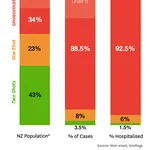
Back to COVID seriousness now. It's been a frustrating week where we've seen the Delta variant now escape Auckland and head out to other parts of the country.
This past week has seen the release of the IPCC's 6th assessment report on climate change. The report is issued every seven years. It's become increasingly obvious with successive reports, that the world is in danger of severe consequences of climate change, and it's increasingly certain (to the point of virtual certainty) that humans are the cause of it.
A few weeks ago I wrote about big cats reported sighted in Canterbury, and opined that what had been seen was likely a feral cat.
Creationism is what drew me into skepticism. Back in the 90s when I was lecturing in software development, I had a work colleague who was a young earth creationist. Seemingly rational in other areas of his life, and very intelligent, he was nevertheless hooked on “creation science”. It showed to me how even smart people can be taken in when they have an emotional stake in the topic.

At the start of each year, it's common for psychics and mediums to put out a bunch of predictions for the coming year. These predictions generally fall flat, although a common strategy for some psychics is to put out so many, often vaguely worded, so that there's a chance that some of them will actually come true, at which point they capitalise on this, claiming to be the World's Most Accurate Psychic™!
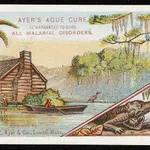
How to be a Global Warming Skeptic
I was having a flu jab the other day (because I believe in the amazing power of vaccines to prevent illness and protect vulnerable people in our community from infection) and told the nurse I was the editor of the NZ Skeptics (I know what a bragger!), and guess what, she assumed I didn't believe in vaccines. I soon cleared things up and she seemed genuinely relieved and shook my hand. It made me wonder what type of negative experiences she's had with people when they found out what her job is, and also if the idea of skepticism perhaps needs a bit of positive P.R.
These days, with modern technology, it only takes a matter of days after most tragic events before conspiracy theorists have converged on an "alternative narrative". For the Sandy Hook massacre, there are people who claim it was a "false flag" operation where no children were actually killed. For missing flight MH370, the aeroplane was apparently re-routed to a secret military base.
Otago University have defended their decision to allow a screening of Vaxxed, citing free speech and a need to controversial topics to be discussed.
After the Church of the Flying Spaghetti Monster successfully applied for the ability to register marriage celebrants last year, their first celebrant has now been approved. Karen Martyn is willing to travel to anywhere in the country to perform a pastafarian wedding ceremony.
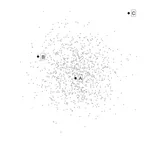
Most people are very bad at distinguishing genuine patterns from random noise, but fortunately there are statistical methods that can help. This article is adapted from a talk at the NZ Skeptics Conference, in Wellington, 7 September 2013.
The history of a word which is very familiar to skeptics carries some important lessons.
A 'natural' way to manage teething pain has no plausible mechanism.
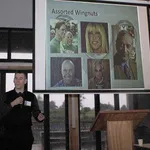
It's not a hopeless cause to engage with proponents of the irrational - but some ways of doing this are more effective than others. This article is based on a presentation to the 2010 NZ Skeptics conference.
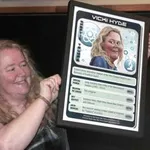
After 17 years as chair-entity of the NZ Skeptics, Vicki Hyde has stepped down. Annette Taylor talks to her about life, the universe and taniwhas.
Given that we're called the NZ Skeptics in virtually all instances-our website, journal, the flyers, the publicity posters etc-do we need to go through a formal change to the incorporated society's constitution to implement it?
www.pointofinquiry.org
I didn't wish to begin a debate about the issues surrounding religion in the 16th and 17th-century, nor would I ever wish to stop anyone from taking in interest in history. All I wanted to do was to point out that history is an academic discipline the same as any other, and it is dangerous to make pronouncements of such a dogmatic nature in the subject in which one has not been trained.
Lately -- my last few airline flights -- I've been listening to the in-flight comedy channels. This was how I discovered Bob Newhart and his monologues. These are things where he takes one side of a conversation and leaves you to imagine the rest. There's one that shows up quite often, where he takes one side of a conversation with Sir Walter Raleigh, who has just discovered tobacco and is sending eight tons of it over to England as an early sample.
Peter Lange mentions in his review a common creationist claim -- the lack of intermediate fossil forms. Someone whose name I've lost, recently wrote the following on sci.skeptic about the subject:
On open access computer bulletin boards, any entity with a theory can expound on it at length. Many do -- usually to a very unappreciative audience. A seemingly-large proportion of such expositions are surprisingly similar in style. The following scale (tentatively attributed to John Baez of Usenet sci.physics) will help readers establish just how crackpotted something is...
Can a cotton wristband and a plastic button alleviate seasickness? The British Consumer's Association thinks so, but scientific evidence indicates otherwise.
And there was the perhaps inevitable clairvoyant, offering to point out the location of the gold for a share of the spoils (he eventually told Kelly that he was looking miles away tom the right place). Kelly had never placed his faith in clairvoyants and he was not likely to now, but he allowed himself to be convinced that this one, a young African man, should be allowed a trial. In the event, all they got out of it was a memorably hilarious day.
Book Review of “Astrology; The Evidence of Science”, by Percy Seymour (Lennard Publishing, £12.95).
"Critical thinking" is the name given to a way of reasoning, in everyday language, which is a great benefit to everybody who uses it. It is a tool which can be used to improve our understanding of other people's arguments, to improve our own reasoning, to improve decision making, and to aid communication. It is especially useful for skeptics and debunkers. It is also a new idea, since in the past people have never been taught how to reason properly using everyday language, which is how most of us reason most of the time. Most of us could improve our thinking considerably by using critical thinking methods. I would like to see the Skeptics involved in the promotion of this subject.
Since ancient times, alternative healing methods have been used by medical practitioners and spiritual adepts to soothe the irritation of body and soul. Many people today are drawn towards the mystical and transcendental as alternatives to orthodox methods. Before people condemn these alternatives, they must look carefully at them, not shutting their eyes to the unsatisfactory and disastrous results that happen when they have ignorantly employed. For those wanting to channel their research into the area of alternative medicine, I give a list of practices currently being carried on in New Zealand.
I return this born-again spoon to you as a symbol of the power of the press. I assure you I have no knowledge of what sleight of hand unbent it. I only left it in the newsroom for a few moments, too.