2 September 2024 - Approx. 2 min read
We've had a bit of a changing of the guard over the last couple of weeks - Craig Shearer has decided to step back from his major responsibilities with the NZ Skeptics, as he plans to focus more on some of his other hobbies and endeavours. Craig will no longer be writing regular articles for us or hosting and editing our podcast, although he has said that he'll write something for us if and when he feels sufficiently impassioned by something annoyingly unskeptical, and he's planning to remain on the committee.
2 September 2024 - Approx. 5 min read
A recent paper on the overuse of spinal imaging (usually X-rays), titled “_An investigation into the chiropractic practice and communication of routine repetitive radiographic imaging for the location of postural misalignments_” and led by New Zealand researcher Brogan Williams (in collaboration with others from Australia and the US), has criticised the distributor of a chiropractic product called Denneroll. Denneroll is a US company, but their products are distributed in New Zealand and the contact given for distribution here is a Hawke's Bay Chiropractor – Rosina Walker.
22 July 2024 - Approx. 2 min read
From 7pm on Friday night we opened the first ever 24 hour Global Skeptics in the Pub, an online event in the run-up to the SkeptiCal conference, hosted online by skeptics in Northern California. The event coincided with our usual four-weekly Skeptics in Cyberspace meeting, so it lined up nicely.
22 July 2024 - Approx. 4 min read
In February it was announced by researchers that non-verified cell lines and misidentified nucleotide sequences were cited in hundreds of papers. This got picked up by the media in May:
27 November 2023 - Approx. 5 min read
In his introduction to the Newsletter in late July Craig mentioned the materials science news around the possibility of room temperature superconductivity, with a compound called LK-99 being announced out of a research team in South Korea. At the time there was a lot of skepticism about this claim.
21 August 2023 - Approx. 15 min read
Back in November last year, I wrote a critique of a Safe ICT questionnaire I picked up at the Go Green expo. We recently received a copy of Safe ICT's most recent newsletter where they responded to my criticisms. I'm not going to rebut their rebuttal, as this kind of to and fro rarely ends up being productive, but suffice it to say that Safe ICT's overly cautious advice for people using technology is not in alignment with our understanding of the science, and is not based on any scientific evidence of harm.
12 June 2023 - Approx. 2 min read
A few weeks back I published an item that reviewed the book A Manual for Creating Atheists, by Peter Boghossian.
14 November 2022 - Approx. 4 min read
As I am in the early- to middle-part of my COVID infection, I've decided that my contribution this week is essentially a redirection to a New York Times Opinion piece by Dr. Elisabeth Bik. Dr. Bik is a microbiologist at Stanford University and the Dutch National Institute for Health with a better-than-average ability to detect patterns. While the NYT article makes it seem that she is the sort who reads scientific papers for fun, her special talent has not made her popular with some of her peers. Her particular skill is identifying image manipulation, whereby photos of blots, agar plates, bacteria from one experiment are flipped, stretched, or cropped to give the appearance of a proven hypothesis or novel finding. Admittedly, Bik doesn't just rely on her eyes for this task. Like other sleuths she utilises software to do some of the work for her, specifically the freely available 29a.ch, but argues that human eyes are still needed to weed out the false positives.
25 July 2022 - Approx. 3 min read
Regular readers of our newsletter will have seen the “adverts” for our official podcast - Yeah... Nah!, which we record on a fortnightly basis. Mark, Bronwyn and I discuss recent skeptical topics, usually in a sort-of pub chat format. We enjoy recording it, and we hope that listeners enjoy hearing it.
30 May 2022 - Approx. 1 min read
I'd like to draw attention to the work done by Te Pūna Matatini. They have released an initial report on mis- and dis-information in Aotearoa New Zealand.
15 November 2021 - Approx. 1 min read
In a recent Nature article, some researchers of Chinese origin describe their research into the effects of stimulation at various acupuncture points on the induction of inflammation by bacterial endotoxins (toxic proteins released by some bacteria when they disintegrate). They found that this stimulation has beneficial effects at some acupuncture sites and not others. Despite the use of the word “electroacupuncture” in the title, their abstract in the Nature paper ends with “Our studies provide a neuroanatomical basis for the selectivity and specificity of acupoints in driving specific autonomic pathways.” a normal reading of which strongly suggests that the authors believe that acupuncture is a real phenomenon and is based upon specific neurological pathways which they are claiming to have identified.
4 October 2021 - Approx. 3 min read
When talking with people about skepticism, I've often used a convenient classification to separate what I see as two main camps of skeptics. In my oversimplified model there are a) those who are skeptical because they consider themselves to have read enough to be experts themselves on a wide range of topics, and b) those who defer to people who are the experts on any given topic - people who have relevant qualifications, decades of experience, and the respect of their peers and the wider academic community.
4 October 2021 - Approx. 3 min read
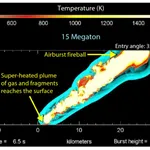
Thankfully there have been some who have been willing to critique this paper and its conclusions. Mark Boslough, who wrote a paper on asteroid air bursts that this Sodom paper references, had a lot to say about the legitimacy of this paper, especially as it's been published in a journal owned by the prestigious Nature.
26 July 2021 - Approx. 2 min read
Mahin Khatami looks at first blush to be a respectable scientist - she has a long history as a scientist spanning decades, she used to work for the NIH (National Institutes for Health) in the US as a program director, and has not only been published in respectable peer reviewed journals, but has also been a journal editor.
5 July 2021 - Approx. 1 min read
An anti-vax paper was published recently in the open access Vaccines journal. “The Safety of COVID-19 Vaccinations - We Should Rethink the Policy”. The paper has now been retracted, though just getting it published is likely to fuel anti-vax misinformation.
21 April 2021 - Approx. 2 min read
A friend sent me an article about a paper published recently in the Journal for the Scientific Study of Religion called:
21 December 2020 - Approx. 3 min read
Retraction Watch have written a nice summary of the year in retractions for The Scientist magazine. Unsurprisingly many of the scientific articles that have been retracted this year are on the topic of COVID-19, but there was one that caught my eye from the Open Access Macedonian Journal of Medical Sciences titled:
7 December 2020 - Approx. 1 min read
Understanding marketing tactics is a good way to learn how to be more skeptical about them. Knowledge can help you take off that wool you didn't know had been pulled over your eyes, and see the truth behind the lies, and hopefully be able to make a better decision about where and how to spend your hard earned cash.
9 November 2020 - Approx. 2 min read
The above title is my paraphrasing of a recent paper published in an Elsevier-owned scientific journal, Science of The Total Environment. The paper's actual title is:
1 May 2020 - Approx. 5 min read
In the last couple of days I've seen a lot of individuals and pages share links to a trailer for “Plandemic”. And I've had friends ask me what I think of it. They've commented that it looks and sounds pretty 'sciencey' but wanted another opinion. So, I had a look, and here goes.
1 November 2018 - Approx. 6 min read
There's a lot of rhetoric these days around educating students 'for the 21st century', and the need for '21st century skills', while (not always but often) disparaging what is currently taught & how it's delivered. Catherine Kelsey has a good op-ed. on this https://educationcentral.co.nz/response-catherine-kelsey-21st-century-skills-debate-unhelpful/ on the Education Central site, https://educationcentral.co.nz/ in which she comments on two other opinion pieces that I - like her - had found somewhat polarising in their approaches (see here https://educationcentral.co.nz/opinion-briar-lipson-could-the-route-to-skills-be-counterintuitive/ and here https://educationcentral.co.nz/response-steve-morris-in-defence-of-21st-century-skills-hogwash/), and says:
8 July 2018 - Approx. 2 min read
There have been promising results from a recent trial of an HIV vaccine. An effective vaccine would be a useful part of our fight against AIDS related deaths. The new vaccine needs further trials, but in the study showed an 80% immune response, which is much better than previous attempts to create a vaccine. In brief, as I'm sure everyone knows, the HIV virus causes AIDS - Acquired Immune Deficiency Syndrome - and it's this compromised immune system that can be fatal.
1 February 2016 - Approx. 5 min read
Retraction Watch is a great website. As the name implies, it focuses on a key aspect of quality control in science: the retraction of scientific papers that have already passed peer-review and were published when serious concerns about those papers come to light.
1 November 2014 - Approx. 4 min read
Siouxsie Wiles doesn't find too much humour in a supposedly satirical paper.
1 May 2013 - Approx. 15 min read
Vitamin C is essential to human health, but our understanding of its role has been perverted by practitioners of 'alternative' medicine.
1 May 2011 - Approx. 22 min read
NZ Skeptic issues 96, 97 and 98 contained articles presenting different viewpoints on the 'Unfortunate Experiment' at National Women's Hospital and its aftermath. Wellington registered nurse and NZ Skeptics treasurer Michelle Coffey continues the discussion in this web-only special.
1 February 2011 - Approx. 9 min read
Linda Bryder responds to an article in our last issue.
1 August 2010 - Approx. 3 min read
While in the gym, Alison Campbell considers some health issues.
1 August 2010 - Approx. 12 min read
The 'Unfortunate Experiment' at National Women's Hospital has entered the national folklore as a notorious case of medical misconduct. But there is still disagreement about what actually happened.
1 May 2010 - Approx. 5 min read
Twelve years after it induced panic among parents world-wide, a paper linking the measles-mumps-rubella (MMR) vaccine to autism has been withdrawn (NZ Herald, 4 February).
1 August 2005 - Approx. 5 min read
Since I wrote my piece (NZ Skeptic 75) based on Bruce Flamm's article in Skeptical Inquirer concerning a research paper on the efficacy of prayer, Dr Flamm has reported 'significant development'. Lest you jump to the conclusion that the authors, journal and university have acknowledged their serious error and have retracted the paper, be at once disabused. The significance of these developments, to my mind, is their minuscule and peripheral nature; nothing has really changed. One could reasonably grant a significant development to Wirth; he pleaded guilty to a 46-page indictment and is in jail for five years. Concerning the 'lead' author, Lobo, the journal later printed, at the bottom of the back page, an Erratum, that this name had been included 'in error'. Young researchers often complain that senior colleagues insist on their names appearing on papers unjustifiably. In the topsy-turvy world of this journal, people find their names put unknowingly on papers they have had nothing to do with!
1 May 2005 - Approx. 6 min read
The Scottish border city of Carlisle says a stone artwork commissioned to mark the millennium has brought floods, pestilence and sporting humiliation, but an unlikely white knight is riding to their rescue (Dominion Post, 10 March). The Cursing Stone is a 14-tonne granite rock inscribed with an ancient curse against robbers, but since it was put in a city museum in 2001 the region has been plagued by foot and mouth disease, a devastating flood and factory closures. Perhaps worst of all, the Carlisle United soccer team has dropped a division.
1 May 2005 - Approx. 4 min read
A widely publicised trial which appeared to show prayer was effective in enhancing fertility now appears to have been fraudulent.
1 February 2005 - Approx. 5 min read
SCIENCE has not "progressed only by slow cautious steps" as Piers McLaren claims (Forum, Spring 2004), but by great bold ones. Scientists should resist new ideas but it is a myth that they do so irrationally. Contrary to Maclaren's letter, quantum theory rapidly won the day. Planck published in 1900, Einstein in 1905, in 1913 Bohr produced a quantum structure for an atom. By 1922 all three had won Nobel prizes for work on quantum theory.
1 November 2003 - Approx. 5 min read
Prior to attending the NZ Skeptics conference in Wellington this year, I read the discussion paper on the role of science in environmental policy and decision making, Illuminated or Blinded by Science, prepared by the Office of the Parliamentary Commissioner for the Environment. It seemed to me to be a reasonable document. It included a discussion of some of the issues which have to be considered by policy makers in the environmental area and pointed to some of the difficulties, institutional and procedural, in using science to form environmental policy. Following on from the request in the paper for comments from the public on how science could be better incorporated into environmental policy, the team leader for the discussion paper, Mr Bruce Taylor, gave a presentation to the Skeptics conference in which he introduced the paper and asked for views on it.
1 May 2002 - Approx. 3 min read
The best paper in New Zealand (Waikato Times, May 6 - and it's got nothing to do with the fact that I work there) reports that depressed patients tricked into thinking they are being treated have undergone healing brain changes.
1 May 2001 - Approx. 4 min read
Howard Bezar and Denis Curtain
1 May 2000 - Approx. 1 min read
Bob Metcalfe (Forum NZ Skeptic 54) seems to be calling for a change in editorial policy on footnotes and references. This has been consistent throughout the history of this society and any change would completely alter the character of this journal. What do members want? I thank him for his apology. Anything that increases feedback on articles in NZ Skeptic and the numbers of letters in Forum is to be welcomed.
1 November 1999 - Approx. 3 min read
THE 1999 Skeptics Conference in Auckland was a conference looking for a theme, and in the end none presented itself. We ended up with an eclectic mix of papers, ranging from "Reading Cats' Paws" (Ken Ring) to the paper on philosophical skepticism based on the work of David Hume (James Allan).
1 November 1997 - Approx. 3 min read
IT'S BEEN a quiet old time in the Waikato, these past few months. My cat hasn't channelled any past lives, nor has she been abducted by aliens.
1 May 1990 - Approx. 1 min read
Massey University Palmerston North August 17,18,19, 1990
1 February 1990 - Approx. 3 min read
Grant Duncan in his letter in the June 1989 N.Z. Skeptic has I feel been unfair to me in what I wrote about homeopathy; and he seems bent on being unfair to himself too.
1 November 1989 - Approx. 2 min read
And there was the perhaps inevitable clairvoyant, offering to point out the location of the gold for a share of the spoils (he eventually told Kelly that he was looking miles away tom the right place). Kelly had never placed his faith in clairvoyants and he was not likely to now, but he allowed himself to be convinced that this one, a young African man, should be allowed a trial. In the event, all they got out of it was a memorably hilarious day.
1 November 1988 - Approx. 2 min read
When the local paper carried a new advertisement, for 'Esoteric Astrology,' I had to reply to the number given. 'Esoteric,' of course, means 'intelligible only to the initiated' and the account given by its exponent laid her open to prosecution under the trades description act since it was clear that she, at least, had no idea what she was talking about. She said that her kind of astrology made no attempt to foretell the future, but that she used the predictions obtained to counsel people who were worried and perplexed. When I asked her what was the connection between the movement of the planets and the personal problems of people in New Plymouth, she replied in the pitying tones of a teacher talking to a backward five year old, "Well, you know that the moon is responsible for the tides." The following dialogue then ensued.