Life not as we know it
Katrina Borthwick - 23rd November 2026
It’s been a while since I delved into the area of non-carbon-based life. It used to be all the rage, with theories around what silicon-based life forms might look like and, if we encountered alien creatures, whether they would be carbon-based (like life on earth) or something else entirely. There was concern that we may overlook an alien life entirely if we didn’t recognise it. Today, when I talk about silicon-based life, I imagine most people’s brains immediately jump to computers and artificial intelligence - but that wasn’t always the case.
On earth, life is built on carbon, hydrogen, nitrogen, oxygen, phosphorus and sulfur, with carbon being the base. Trace amounts of other elements such as potassium are also used.
Silicon based life is a top candidate for a non-carbon-based life form because silicon sits directly below carbon on the periodic table, and like carbon can also form four chemical bonds. Lots of bonds are needed to build complex arrangements, like the DNA and proteins that make up life as we know it.
Because silicon can form four chemical bonds, it could theoretically serve as the backbone for complex molecules analogous to proteins or genetic polymers. Some scientists have speculated about organisms built from silicon-containing compounds, perhaps using silicon-oxygen or silicon-carbon chains instead of the carbon-rich molecules found in terrestrial biology.
If silicon-based life exists, it would likely be very different from life on Earth. A hypothetical silicon organism might grow more like a self-assembling mineral than a terrestrial plant or animal. Its ‘cells’ could be based on silicon-rich polymers, its metabolism might use reactions involving silanes, silicates, sulphur compounds, or other inorganic chemicals, and its waste products could differ dramatically from those produced by carbon-based life. Some speculative models even envision slow growing, highly heat-resistant organisms adapted to environments that would be hostile to Earth life. I asked CoPilot to show me what a silicon-based kiwi might look like, and it didn’t do too bad of a job. It looks a bit like a pangolin.
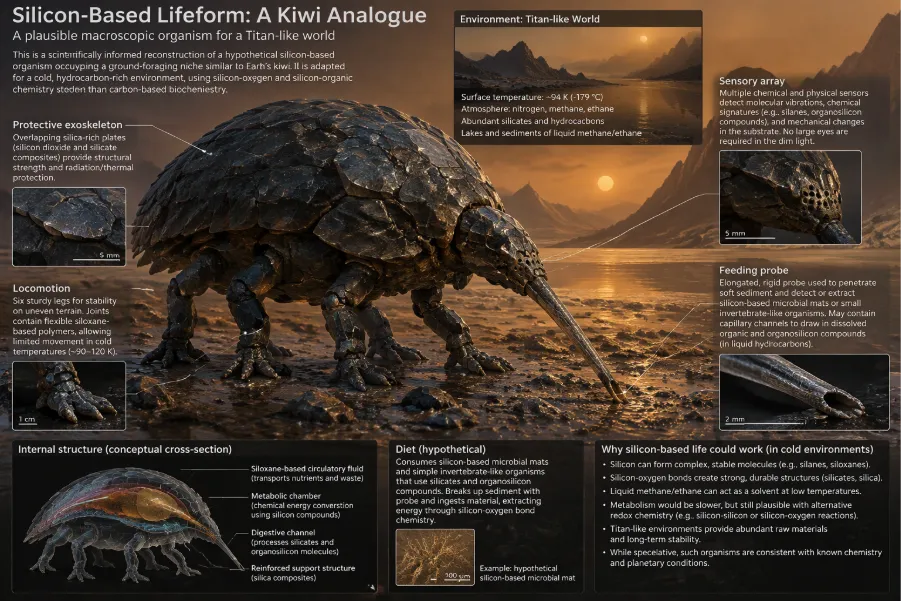
The problem is, silicon chemistry behaves differently from carbon chemistry. In water-rich environments, silicon tends to form stable minerals such as silica rather than the diverse, flexible molecules needed for biology, making Earth-like silicon life unlikely. Researchers have therefore suggested that silicon-based organisms, if they do exist, might inhabit environments unlike Earth, such as extremely cold worlds, dry planetary surfaces, or even sulfuric acid rich environments where a wider variety of silicon compounds could remain chemically active.
The issue with silicon is that silicon-oxygen bonds are very rigid, and don’t have the flexibility of long chain polymers that carbon does. That means silicon doesn’t make a great building block for life, or for anything that needs to move around - but it could contribute to some other primary building block alongside carbon. The sense is that if both emerged on a world, carbon would race ahead to dominate, while silicon would quite literally be frozen in stone.
A 2022 computational study by Gobato et al. examined the structures and charge distributions of hypothetical silicon analogues of nucleic-acid building blocks, using ab initio Hartree-Fock methods. That method enables researchers to evaluate hypothetical compounds computationally before they are made in the real world. Their results suggest that silicon-based molecular structures with some similarities to carbon-based biological building blocks are theoretically possible, but the study doesn’t go so far as to demonstrate a functional silicon-based biochemistry that could form the basis for life.
Beyond silicon
But silicon isn’t the only possibility. Astrobiologists are also thinking about elements common on other worlds, such as sulphur and boron. We can see iron and sulphur clusters, as well as boron, in earth biology today, so it follows that they may be important for the emergence of life. Sulphur is common on Venus, and so this poses the question of whether sulphur-based life can exist. A study published in 2025, again using quantum chemical computer modelling, found that hypothetical sulphur-phosphorus heteropolymers could form through reactions, and may be stable enough to persist in Venusian cloud conditions. A 2024 study argues that sulphuric acid, known to be hostile to life, could potentially serve as a solvent for unconventional chemistry, and that complex, life-relevant molecular structures might not require carbon as their primary backbone - although replacing water as a solvent does not itself mean replacing carbon-based biology. More on alternative solvents later.
Sulphur’s not the only lethal compound being considered. A 2010 study claimed a bacterium named GFAJ-1 could substitute arsenic for phosphorus in its DNA. Arsenic became a candidate for alternative biochemistry because it sits directly below phosphorus in the periodic table, and therefore has similar chemical properties. Phosphorus is essential to known life because it forms the backbone of DNA and RNA, helps store energy in cells, and is a key component of cell membranes. Since arsenic can form many of the same types of chemical bonds, scientists wondered whether a life form in a phosphorus-poor environment might be able to use arsenic instead. Independent replication studies later found no evidence of arsenic integration, and Science officially retracted the 2010 study.
DIY inorganic cells
Chemists like Lee Cronin at the University of Glasgow have explored building inorganic “cells” using polyoxometalates (metal-oxide cluster building blocks) that can mimic behaviours of life such as replication, assembly, and competition. The research demonstrates that highly complex, self-assembling, catalytically active structures can emerge from inorganic metal-oxide chemistry. While not living systems, these materials suggest that some attributes associated with biological complexity may not be exclusive to carbon-based chemistry.
Different life in extreme environments
Scientists consider liquid ammonia and methane environments as candidates for life because life appears to require a liquid medium where molecules can move, interact, and undergo complex chemistry. Water is excellent for this on Earth, but it may not be the only possibility. Liquid ammonia shares some important properties with water. It is a polar solvent, meaning it can dissolve many substances and facilitate chemical reactions. It can participate in acid-based chemistry, and remains liquid at much colder temperatures than water. This makes ammonia a possibility for icy worlds where water would be frozen solid. In theory, organisms adapted to extremely cold conditions could use ammonia as their primary biological solvent. The challenge is that chemical reactions generally proceed more slowly in liquid ammonia than in liquid water, potentially making metabolism and evolution much slower.
Liquid methane is even more exotic. It exists naturally on Titan, Saturn’s largest moon, which has lakes and seas of liquid methane and ethane. Both methane and ammonia remain liquid at temperatures where water is completely frozen, and organic molecules can dissolve and interact within methane-rich environments. Titan is an entire world with an active methane cycle, analogous to Earth’s water cycle including methane clouds, rain, rivers, and lakes. The difficulty is that methane is non-polar, making it much less effective than water at dissolving complex charged molecules. Any methane-based life would likely require very different biochemistry to our DNA, proteins, and cell membranes.
Researchers have proposed theoretical methane-compatible membrane structures called “azotosomes”, built from small nitrogen-containing organic molecules. Their calculations suggested that such membranes could remain stable and flexible in liquid methane at Titan’s extremely low temperatures, with mechanical properties comparable to biological membranes in liquid water.
Chemical reactions associated with life’s origins appear to be far more common and chemically diverse than previously thought. In 2023 researchers identified about 270 autocatalytic reaction cycles, many of which do not involve organic (carbon-based) compounds, and instead use unusual elements such as mercury, thorium, or even noble gases under specific conditions. Since autocatalysis allows reactions to generate products that promote their own continuation, it is considered a key prerequisite for reproduction and the emergence of life. The findings suggest that life-like chemical systems could potentially arise from a much wider range of chemistries and planetary environments than those found on Earth, expanding the possibilities for alien life beyond traditional carbon-based models.
What stays with me is how much our thinking about life is shaped by the only example we know. I find that both humbling and exciting. I may never see the answer, and the research so far doesn’t seem to be fruitful, but I’m glad the question isn’t fully closed. I hope we’re curious enough to recognise alien life when we meet it.
2026-11-23