The Childless Cat Lady Myth
Katrina Borthwick - 9th November 2026
Last night I was watching the first episode of a 2024 TV legal drama called ‘Matlock’. For those who are old enough to recognise that name - it isn’t a remake of the detective show. Anyway, what caught my ear in this show was when the main character Madeleine Matlock (played by Kathy Bates) said she had managed to get past law firm security and stand unnoticed in a partners’ meeting because older women are ‘invisible’.

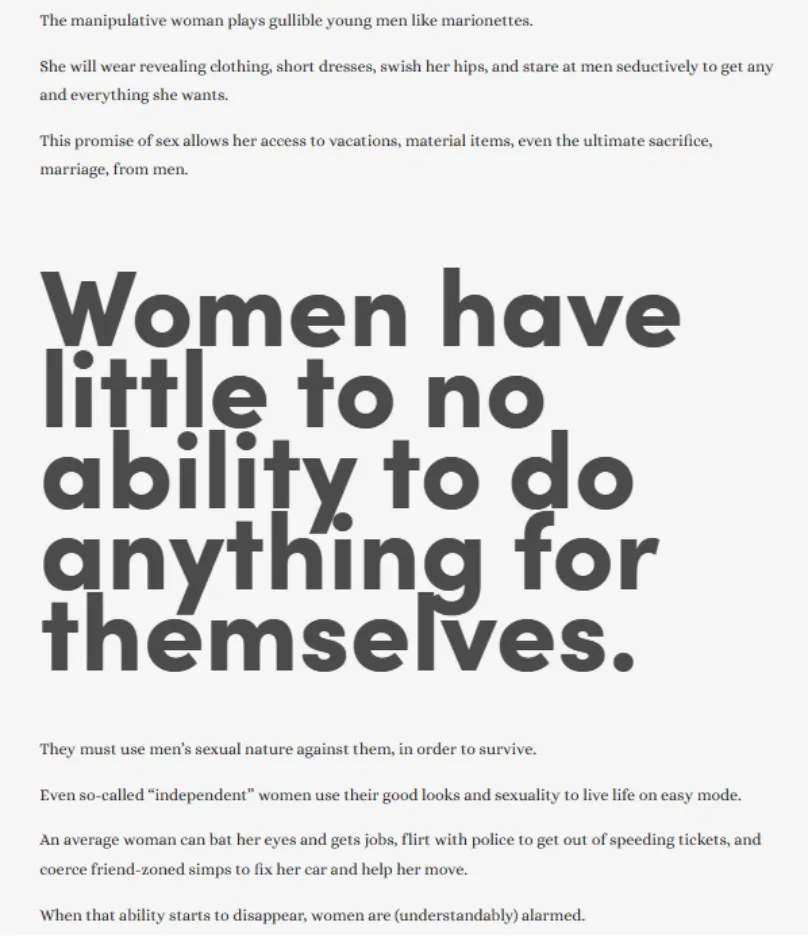
Recently I’ve found myself repeatedly hearing that particular claim, and also the claim that older unmarried or childless women are hopelessly unhappy. Unsurprisingly, some of this is coming from the manosphere direction. This narrative exists, and it’s not subtle. Just google “women hitting the wall” if you want to get angry. And then there is this guy:
This all sounded weird to me, so I wondered if there is any scientific basis to either of these claims.
It turns out that happiness is complicated. One of the most significant findings in the literature is that parenthood does not have a straightforward relationship with happiness.
A recent qualitative study noted that research on parenthood and wellbeing has produced mixed, and sometimes contradictory, findings, with outcomes varying considerably depending on factors such as age, gender, social support and cultural environment.
Researchers from the Survey of Health, Ageing and Retirement in Europe (SHARE) examined whether parenthood affects life satisfaction in later life. Their findings were that parenthood itself was not a guarantee of greater wellbeing. Family relationships, social support and other life circumstances appeared to matter at least as much as simply having children.
Similarly, a 2024 study found that the relationship between parenthood and life satisfaction in later life is highly complex, and influenced by factors including family dynamics, gender and broader social circumstances, rather than parenthood alone.
A qualitative study, titled Lived Experiences and Life Satisfaction of Childfree Women in Late Life, published in 2020, explored the experiences of older women without children. Rather than uncovering universal regret, the study found a much more varied picture. Many participants reported satisfying and meaningful lives, with rich social connections and a strong sense of autonomy.
Likewise, thesis research undertaken at Massey University by Jacqueline Wootton in 2024 examining voluntary childlessness found that women without children often developed identities, relationships and sources of fulfilment outside traditional motherhood roles.
None of this suggests that childlessness is always easy. Rather, it challenges the assumption that motherhood is the only route to a meaningful later life. Having children is not a magic formula for wellbeing, nor is not having children a recipe for misery.
The role of social networks
A recurring theme across ageing research is that wellbeing is predicted less by parental status and more by the quality of an individual’s relationships. People with strong friendship networks, supportive relatives, community involvement and meaningful social connections generally report higher levels of wellbeing than socially isolated individuals.
The relevant variable seems not to be someone’s parental status, but how socially connected they are. Some parents are closely connected to adult children and grandchildren. Others are estranged. Similarly, some childfree adults maintain extensive friendship networks and community ties throughout life. A simplistic narrative ignores this complexity.

But what about women becoming “invisible”?
Interestingly, this claim does have some support in the academic literature.
Research by Sue Westwood on older women’s experiences of ageing found that many women reported feeling overlooked in public life, underrepresented in media, and subjected to ageist assumptions. Participants described experiences of being ignored, patronised or treated as less competent as they aged.
So, perhaps unsurprisingly, ageism is real, and sexism is real. Many older women clearly experience both. However, this finding is often stretched beyond what the research actually shows.
Experiencing ageism is not the same as being unhappy. Nor does it demonstrate that childless women are particularly vulnerable. The evidence supports the existence of age-related prejudice and invisibility experienced by many older women. However, studies of life satisfaction and wellbeing do not support the claim that older women, or older childfree women specifically, are uniformly unhappy or dissatisfied with their lives.
What about men?
One notable feature of manosphere discussions is that they frequently present ageing as a uniquely female problem. The reality appears more complicated.
Research suggests that men and women often navigate social relationships differently in later life. Studies of widowhood and ageing have found that widowed men usually have smaller networks of friends, and get less social support than women, leaving them at greater risk of social isolation following bereavement. A large Australian longitudinal study found that widowhood increased loneliness for both sexes, but widowed men were much more affected than women, and the effect persisted longer. Rather than showing that ageing is uniquely difficult for women, the evidence suggests that men and women face different risks. Women appear more vulnerable to age-related stigma and invisibility, whereas men appear more vulnerable to social isolation when close partner relationships are lost.
The scientific literature does not support the idea that ageing is automatically easier for men or harder for women. Rather, men and women appear to face different challenges.
Why does the myth persist?
Part of the answer may lie in how value is being defined. Much of the manosphere evaluates women primarily in terms of youth, beauty and reproductive potential. Under that framework, ageing inevitably looks like decline. Social scientists typically use broader measures.
When researchers assess wellbeing, they look at life satisfaction, social support, autonomy, purpose, health, community participation, and psychological wellbeing. Viewed through that lens, life is considerably more diverse.
Some childfree women are unhappy. Some mothers are unhappy. Some childfree women are thriving. Some mothers are thriving. Human lives rarely fit neatly into ideological narratives.
Conclusion
Current evidence suggests childlessness does not reliably predict unhappiness in later life. Parenthood does not guarantee happiness. Social support and relationship quality matter more than parental status alone. Many childfree women report high levels of life satisfaction. Older women do experience ageism, but ageism does not automatically translate into unhappiness.
The claim that older childless women inevitably become lonely, invisible and regretful makes for an effective internet talking point. But the reality of later life is far more variable than online stereotypes suggest.