More climate fringy stuff
Patrick Medlicott - 31st August 2026
There is a lot going on in the climate space at the present time.
There has been a letter from the World Scientists, which is their 3rd warning to humanity over the last 5 years. This has been signed by well over 100 scientists. The Executive Summary says it all:
Life on Earth is in a planetary emergency driven by escalating human pressures and the crossing of multiple planetary boundaries. Climate change, biodiversity loss, pollution, land degradation and resource depletion are intensifying and placing increasing strain on the natural systems that support life. These pressures are already affecting food, water, health, and economic stability in many parts of the world, most severely for those who contributed least to causing them. 7 of the planetary boundaries have already been exceeded and this continues. The amount of CO2 in the air continues to increase.
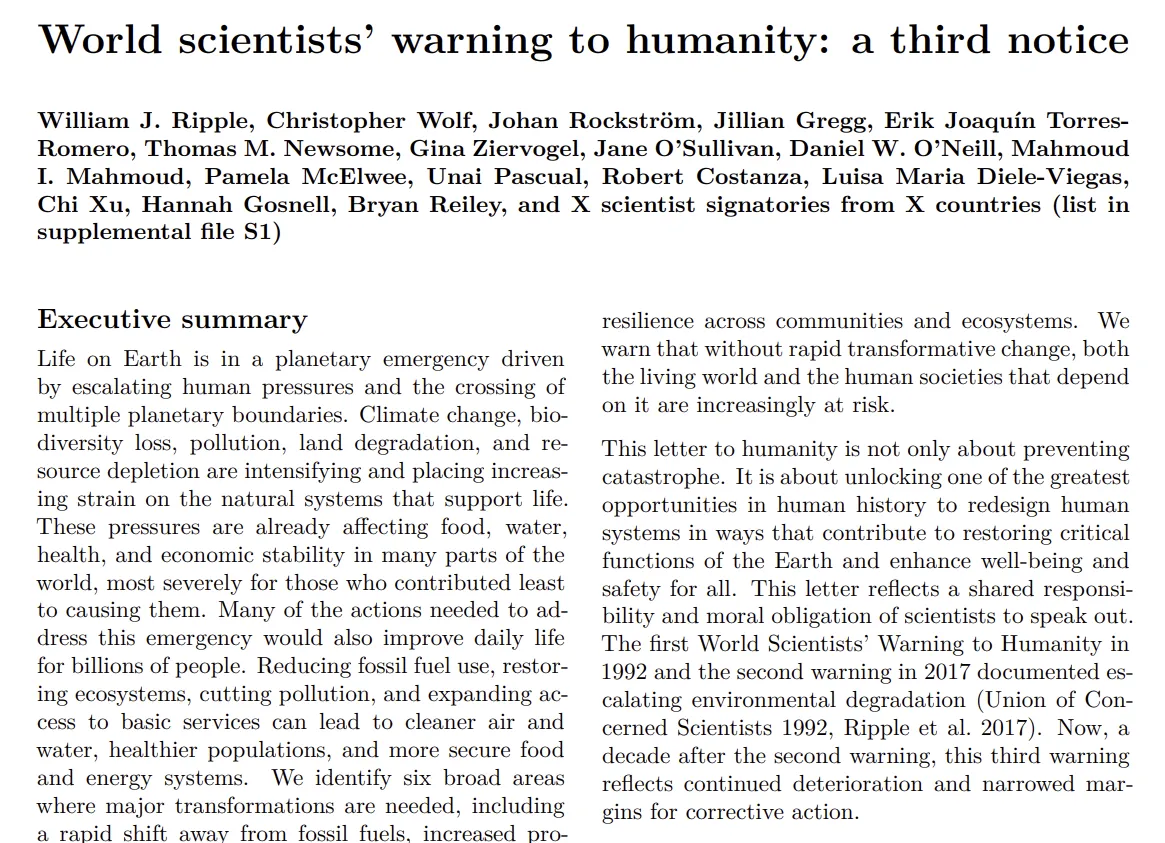
The letter has been submitted to the BioScience journal, and publication will occur soon after peer review. My comments would be that nothing has changed, and the problem is mainly a mix of political will and science denial, despite most of the people in developed countries believing there is a problem that needs urgent action.
A respected Climate commentator, Bill Mckibben, just published a blog called “Fun with Numbers”:
# 76.9 degrees Fahrenheit (he is American). That was the average temperature for the lowest 48 states in July, making it the hottest month in American history, 3.3 degrees hotter than the 20th century average. He quotes Andrew Dressler, a climatologist, concerning the “Dust Bowl” of the 1930s in the US. During the early 20th century, aggressive ploughing and the replacement of native grasses left Great Plains soils exposed. When drought conditions occurred, those degraded soils dried out quickly, reducing evaporation in soil moisture and reinforcing the heat. The “Dust Bowl” is often quoted by climate deniers as something that happened before climate change. This has been refuted, but is still quoted.
# 3.6 degrees Fahrenheit. That is how much temperatures have risen on average in Europe since the 1960s. This means that when you walk outside your home in Europe or the United States it’s three degrees hotter than it would have been a few decades ago. Europe and the Arctic are warming faster.
# 65 billion dollars. That is the windfall profit so far for the oil industry thanks to the Iran war, according to a new analysis from Oil Change International. That is equivalent to $400,000 per minute. Prices for people at the pump have increased for both gasoline and diesel in the United States by 30%, and up to 80% or more in Asia. It would of course make great sense to tax these windfall profits entirely on the back of dead Iranians and Americans. I, however, am not holding my breath!
# 4.8 percent of global energy related carbon emissions. This is the figure related to data centers. One commentator states that a data center might as well have an Oil Derrick on top. Big oil’s use of AI to produce oil and gas could create 3.3 to 13.3 times more climate pollution.
# 70 %. That has been the average growth in United States battery installations over the last three years, according to the US Energy Information Administration, and it is accelerating. (Some good news)!
# 44%. That’s how much you’d save in carbon emissions by retiring your internal combustion car and replacing it with an EV, even if it was only two years old, and considering the amount of energy used to build both vehicles.
# 20%. That’s how much of French nuclear capacity is offline due to low river levels with the summer heat and fierce drought. This has been exacerbated by a jellyfish invasion at a coastal plant caused by warming seas.
# 22%. That’s how much domestic airline emissions have fallen in Austria over the last three years, since the government banned short haul flights to domestic destinations that were served by trains; something similar happened in France, which passed a more limited version of the same law.
# 5.5 degrees Celsius versus 2 degrees Celsius. That comes from a new study on the collapse of the Atlantic Meridional Overturning currents. This is from an article in the Journal Nature, and refers to the difference between raising the ocean temperature fast - which we are doing now - and raising it slowly, over a more prolonged period of time.
From The Guardian, Thursday 13th August, climate change deniers often use a simplistic statement about the increase of carbon dioxide in the atmosphere. This is something like” There will be no problem as carbon dioxide is plant food”. Unfortunately this statement is not true, but it seems like “common sense”. A recent study recorded in the Guardian noted a study of 56-million-year-old fossil leaves from a period known as the Palaeocene-Eocene Thermal Maximum (PETM), at a time when the world heated up by as much as 8 degrees Centigrade. They showed that initially plant growth improved with increasing temperature and CO2, however the trees then died. The forests became denser initially, but then collapsed. The explanation for this is that after an initial period of increased growth, the forests struggled amid extreme temperatures and a lack of key nutrients, as well as exposure to more pests and diseases and wildfires (note what is happening in Canada and the United States and Europe at the present time). This led to the loss of the forested areas, and replacement by grasslands. “Once the climate becomes too warm plants aren’t able to handle it; It affects their physiology and their relationship with water and nutrients”.
“Smoke gets in your eyes”, and your lungs, your bloodstream, your brain, just about everywhere. This is from Andrew Dressler, from The Climate Brink Website. He makes the point “To be clear: Climate change is absolutely making these wildfires more severe - there should be zero doubt about that”. He notes wildfire smoke kills 24,000 Americans per year. It forces people to stay indoors, ruins vacations, drives people to spend money on air purifiers, and has many other effects. He quotes a study from a group of Stanford and Princeton economists writing in the journal Nature: “The climate driven smoke deaths result in economic damages that exceed existing estimates of climate driven damages from all other cases combined in the United States”.
A statement from the President of the United States that the problem with wildfires was due to the poor management of forests and their undergrowth has been quoted often. This again may sound like “common sense”, and may apply to some “managed” forestry plantations, however his complaints now about the Canadian forest fires do not stand up. The Canadian forests that are burning in the Far North are what is known as boreal forests, which are vast and have never been “managed” by mankind. They are burning due to episodes of increased rainfall (warmer air contains more water) followed by drought, and then increased temperature. All of which have some attribution to climate change. Zeke Hausfather from The Climate Brink website reported. “This smoke-pocalypse has renewed a long-standing debate online that these fires aren’t really about Climate change at all but about Forest mismanagement. We don’t log enough, thin enough, or do enough prescribed burning”. His answer is as above. (Most of Canada’s boreal forests have never been trodden by, or managed by, man, and are so vast they never will be) “Common Sense” can be facile and often wrong! H. L Menken said “There is always an easy solution to every human problem - neat, plausible and wrong”. Take note, sound-bite politicians!
The Guardian on Sunday 16th August talked about how from tourism to power generation and productivity, Europe is feeling the economic cost of heatwaves. Dutch Bank Triodos estimates a total of 180 million Euros could be wiped off the EU’s GDP by the recent heatwaves. Yet it is supposedly “too expensive” to deal with the consequences of climate change.