Making cents of charity: Child Sponsorship
Bronwyn Rideout - 31st August 2026
Many of us who grew up with access to a TV may remember long ads that flashed through scenes of shanty towns, dirt roads, dishevelled children, and emaciated infants too exhausted to respond to the flies landing on their faces. These edits are followed by a B- or C-list celebrity exhorting viewers to sponsor a child for as little as $1 a day. Sally Struthers’ long partnerships with the Christian Children’s Fund (formerly China’s Child Fund, now just ChildFund) and Save The Children (which officially discontinued their sponsorship programme in January 2026) come to mind:
Child sponsorship is one of the most polarising activities a charity can engage in, and they have long drawn criticism to the charities involved. There are frequent accusations of misrepresenting the sponsorship scheme and propping up harmful narratives by oversimplifying & overextending complex geopolitical and socioeconomic circumstances. Donors are also side-eyed for buying into the harmful narratives due to a white saviour complex, or their naïveté. Pop culture sometimes further skewers donors by questioning what they would actually do if said sponsored child (often African) did show up on their doorstep, as seen in the early South Park Episode Starvin’ Marvin, and Chris Lilley’s We Can Be Heroes:
What I plan to explore over the next two articles is the origins of contemporary child sponsorship, when the cracks first began to form, and whether the model is what it claims to be.
What is Child Sponsorship
Dr Brad Watson, a Salvation Army Officer and senior manager with the Australian Red Cross, has written a book and a thesis (in that order) on the history and challenges of child sponsorship, along with opportunities for change. Acknowledging that there was a lack of a formal definition, he suggested the following:
An international child sponsor is an individual or entity that pledges ongoing support for disadvantaged children or young adults in geographically or sociologically distant realms. [Child sponsorship] is identified as an act of regular, often long-term giving for the benefit of identifiable children, youth or their communities in an exchange-based relationship. CS [International Non-Governmental Organisations] are therefore organisations that facilitate links between donors and distant others, using individual children as the focal point of exchange.
Given the accusations and criticisms that appear later, it may be more accurate to say ‘promise to facilitate’ instead.
Hillary Kaell and the Early Origins of Child Sponsorship
This model of fundraising has a surprisingly long history. The standard story is that Save the Children kickstarted the practice in 1919, with Christian non-profits following in the 1950s. Hillary Kaell, writing in the journal Historical Research, argued that protestant charity schools of the late 17th to 19th centuries were an organic antecedent. Specifically, the beliefs of August Hermann Francke, who believed that personal salvation relied on one’s own devotion and spiritual nature. Francke founded multiple schools for orphans, boys and girls, because of his stance that even the youngest and poorest of children should receive the religious education necessary to save their immortal souls. The appeal of this doctrine, and the success of Francke’s school in Halle, spread through Anglican networks from Germany to England, and later to the US. For Kaell, this helps illustrate the appeal humanitarian works and child sponsorship have, and why they hold a particular foothold in Protestant culture. But more darkly, Kaell adds, developing children into Christian subjects “…dovetailed with another early modern concern: the search for more effective means by which emerging nation states could govern the lower classes at home and foreign people abroad.” This is evident in the creation of workhouses or missionary homes and schools in the United States, and across the Commonwealth, that local children were ‘sponsored’ to attend by wealthier congregations.
Kaell also contrasts the development of the child sponsor model within Protestantism with other belief systems. She surmises that its slow adoption within Catholicism is due to their beliefs in the mechanism of salvation (infant baptism) and that the responsibility of spiritual shepherding lay with priests and nuns, rather than the laity. The 1920s would see a brief rise of secular, or at least non-sectarian, approaches to child sponsorship, mainly driven by the rise in orphans and fatherless children post-World War 1, and the persecution of Armenians. One charity, Fatherless Children of France, sent two English women to the US to encourage sponsorships of $36.50/year to help fatherless children. Kaell reports that, by the end of 1920, 286,000 children were helped, with two-thirds having individual sponsors. Another organisation, Near East Relief, offered orphan adoption from 1917, at $60/year. For clarity, the adoption was figurative; this was a sponsorship programme in which foreign ‘foster parents’ provided funds to feed and clothe children who lived in orphanages. Both of these early initiatives collected millions of dollars in their brief periods of operation.
Save the Children, which is still in operation but as of 2026 no longer operates a child sponsorship programme, was begun in London in 1919 by sisters Eglantyne Jebb and Dorothy Buxton to provide aid to children in continental Europe after World War 1. As the organisation spread, international branches also focused on the needs of children in their own countries. According to Peter Ove’s thesis, it was Save the Children US that launched the organisation’s first sponsorship programme in 1938, with a programme to sponsor schools in Appalachia to provide students with meals, books, and sundries. However, it also appears that Save the Children supported organisations in other countries, like the Society of Friends in Austria, to initiate a child adoption/sponsorship scheme from 1920, referring to donors as ‘god parents’. Advertisements by the charity from the 1920s bring early use of statistics to convey how much is needed to feed a child each day:
Two shillings could feed a child for a week. £1 could feed and clothe a starving mite. £100 could feed a thousand children and a penny a day from each British worker for two months could save all the children of hungry Europe
However, these sponsorships were also intended to be temporary, and due to the time and cost of sending letters seemed to have lacked the correspondence element that is popular today. There were also early efforts to make matches that correlated to the sponsor’s wishes, as prospective god-parents could choose or suggest the desired nationality of the sponsored child. According to Watson, practical gifts of soap and linen were also encouraged.
Instead of claiming to make children good Christian soldiers, this new child sponsorship had more genuinely humanitarian aims of providing food, clothes, housing, education, and medical care. However, Kaell admits that the term secular in this context is not how many of us would understand it today. While The Red Cross could be seen as a genuinely secular charity, secular mainly referred to the lack of any specific denomination leading operations. This meant that, even in the 1950s, an explicitly evangelical organisation like World Vision would be described as secular. Such interdenominational frameworks were the source of early criticisms of early child sponsorship models outside of war relief, because they were seen as being unconnected to any church and thus uncontrollable.
Child Sponsorship from 1930s-1960s
Plan International
Of the charities operating today that still maintain a child sponsorship programme, Plan International’s programme has run the longest, since 1937, with ChildFund starting just one year later. Plan International started as “Foster Parents Plan for Children” during the Spanish Civil War, and was started by John Langdon-Davies and Eric Muggeridge.
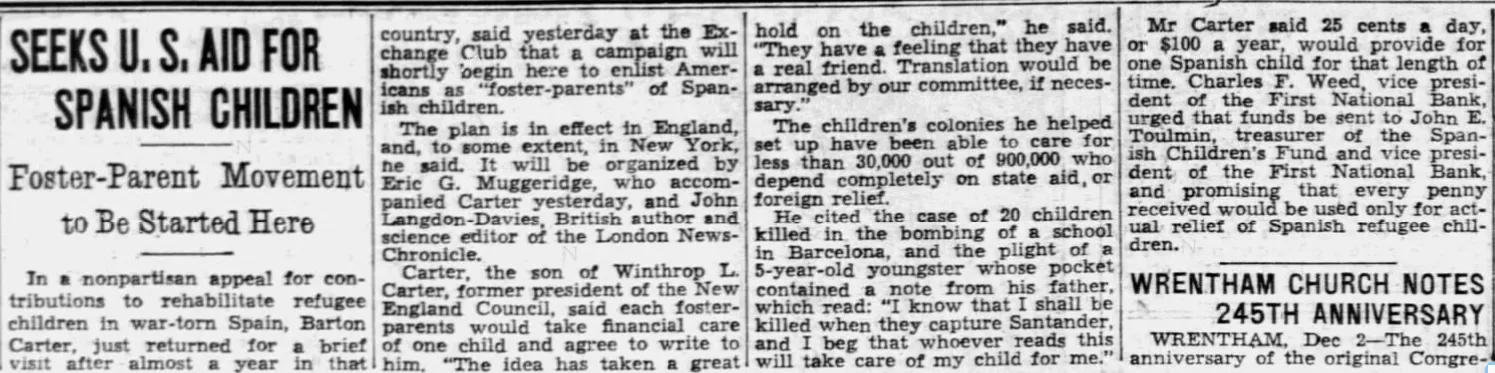
The apocryphal story is that while Langdon-Davies was working as a war correspondent during the Spanish Civil War, a child approached him with a note in his pocket that begged whoever found the child to take care of him. With external assistance, Langdon-Davies’ and Muggeridge’s aim was to assist orphans and children displaced by the aforementioned civil war. Initially, their fostering programme was a traditional fostering scheme in which children were placed in home care or in children’s colonies (orphanages or children’s homes for displaced children within their home country). According to Watson, foreign donors were encouraged to send money to the charity to feed, clothe, and house children, as an alternative to giving money to the Spanish authorities, in return for correspondence and tokens from the children.
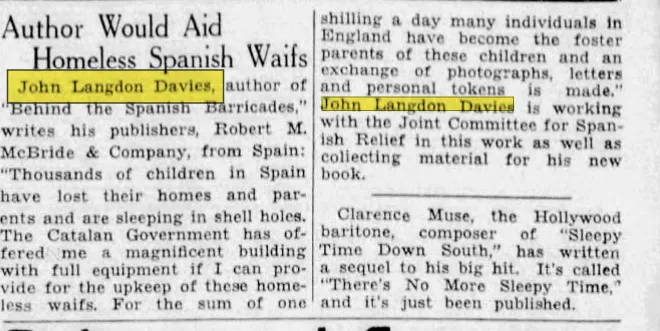
How they came about this model was unclear, but the transactional and relational expectations that have come to characterise modern child sponsorships are evident here, with donors described as ‘Foster Parents’ - although their role in the upkeep of the child was strictly financial. Children, in return, received limited details about the foster parent, with the charity reframing their perspective of the foster parent partnership as akin to having a personal friend.
ChildFund
ChildFund began in 1938 as China Children’s Fund, started by Rev. Dr. J Calvitt Clarke who was a founding member of Save the Children US in 1932. Clarke also had a history with relief work in Armenia with the Near East Fund, and wanted to help Chinese child survivors of the second Sino-Japanese War. With an initial goal of building orphanages, the scope of the organisation grew to help children around the world, and by 1951 the group changed its name to Christian Children’s Fund, and again in 2009 to either ChildFund International (in the US) or ChildFund Alliance. It is generally agreed that ChildFund is erroneously described as the originator of child sponsorship, especially given Clarke’s extensive experience with charities that utilised those models. Nevertheless, it was influential and successful and, in the 1960s, might have been the largest sponsorship programme at the time, according to Kaell. But, as per Watson, ChildFund had sacked both Clarke and his wife in 1965. Reasons why are unclear, but Watson suggested there were numerous complaints, as well as Clarke’s own reticence to change. Clarke and his daughter would start another charity, Children Incorporated, which is still in operation today and also uses child sponsorship. Watson noted that Clarke’s preference for orphan care and support of orphanages internationally came at a time when such institutions were falling out of favour stateside, with increasing preference of kinship adoptions or sponsorship. With the ousting of Clarke, ChildFund expanded its scope to help children outside of institutions. While the charity did move to individual child welfare support through cash transfers to families in the 1960s and 1970s, they soon found that few children and families were actually getting out of poverty, and gradually changed tack to improve parent autonomy and self-determination, in addition to some financial subsidies.
World Vision
World Vision is one charity that was inspired by ChildFund’s model. Founded in 1950, after the outbreak of the Korean War, its operations were based around meeting emergency needs in crisis. Founder Bob Pierce visited churches and orphanages throughout Korea, and shared his travels to evangelical audiences in North America. Like many charities serving children, the Korean War was a turning point due to the number of orphans needing support. World Vision would join the child sponsorship club in 1954, asking Americans to sponsor a rescued orphan. However, the message of World Vision harkened back to the colonial missionaries. Henquinet, writing for Economic Anthropology in 2022, provided this transcript from Pierce:
“They are like Cinderellas only without any great moment of deliverance. They do all the dirty jobs and wait on the rest of the family even though they are small children. Nobody uses the word “slave,” but if you followed one of these about you would find that is exactly what they are. That is why World Vision maintains orphanages rather than putting these children into homes.”
Further, Henquinet notes that charities operating in the 1950s-1960s also benefitted from innovations in technology, and the growth in size and wealth of the middle class. Access to industrial computers improved the efficiency of their data collection and the dissemination of their various appeals. World Vision was especially forward-thinking in using celebrities Roy Rogers and his wife Dale Evans Rogers in some of their adverts.
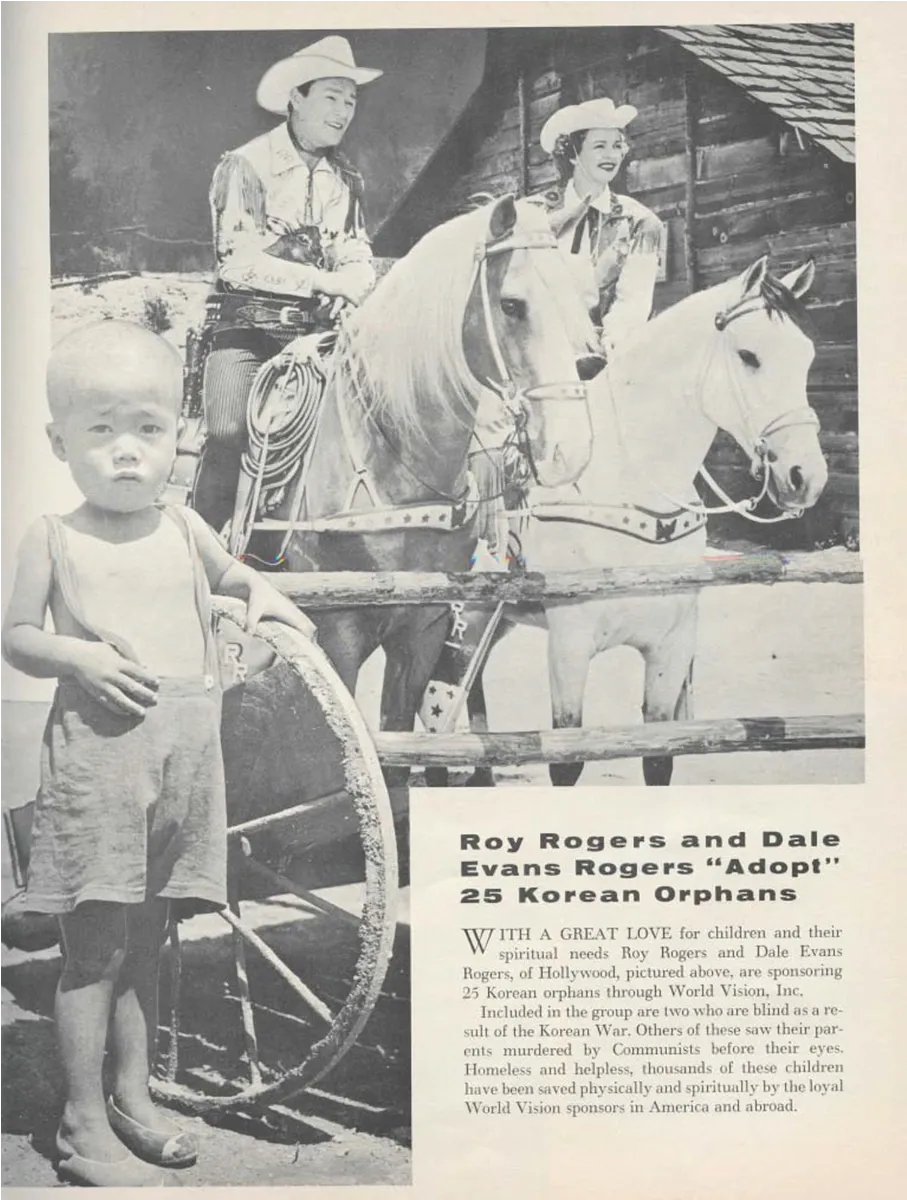
https://anthrosource.onlinelibrary.wiley.com/doi/full/10.1002/sea2.12267
Compassion International
The last of the big child sponsorship charities is Compassion International. The story here is pretty simple. In 1952, Rev. Everett Swanson flew to Korea to minister to troops, and was moved by the sight of war orphans in the streets. When he shared his story at revival meetings, attendees gave money for Swanson to buy provisions. Unsure about whom to send the money to initially, Swanson founded the Everett Swanson Evangelistic Association in his Chicago home, and would build his first orphanage in 1953. In 1954, Swanson introduced his child sponsor programme at a rate of $4/month and, in return, sponsors received a picture of the child and a questionnaire filled out by the child.
In a thesis by Lorie Henry Lee, it’s described that after two years in South Korea Swanson decided that it was better to work with resident missionaries and Christians established in the country to manage the urgent needs of orphans, and handed over his funds to a trusted reverend to manage.
In 1954, sponsors would receive additional details about their child, including report cards on academic progress. To its credit, Swanson’s organisation continued to build more orphanages and support more orphans, with administration being at minimum cost so that a majority of funds went to South Korea. By 1959, there were 19 homes or orphanages supported, and monthly sponsorship was $8/month (although, according to some inflation calculators I surveyed, this is equivalent to over $154 NZD today). In 1963, the organisation changed its name to Compassion International.
Lee adds that Compassion faced its first scandals in 1964. First, it was revealed that funds were being misappropriated by the Korean-based superintendents for two of the homes. Then, it was discovered that other superintendents were sending forged letters to sponsors requesting more money. Swanson went to Korea to personally deal with the situation, but became ill soon after his return home. When he died in late 1965, incoming leadership investigated how many children in the sponsorship programme were legitimate orphans. One of the issues that came up in the 1964 scandals is that some superintendents delayed the discharge of children from homes or orphanages in order to pad their sponsorship accounts. The 1966 audit found that 21% of children had parents, were not in school as promised, and were not in need, and there were concerns that the children were not demonstrating that they had become born-again Christians. Still, mismanagement by previous superintendents meant that corruption within the South Korean facilities was widespread, including smuggling and black market sales of supplies intended for the children. While Compassion saw growth in sponsorship and geographic reach through to 1970, the remainder of the decade was spent undoing the damage inflicted in the South Korean mission in the first half.
In part two…
The end of the 1960s coincided with the youngest of the Korean War orphans coming of age, forcing many charities to reconsider their core activities. The Jesus People and youth missionary movements might have buoyed Christian child sponsorship through the 1970s, but public opinion began to sour by the 1980s. Criticism about entrenching welfare dependence and destabilising communities emerged alongside demands to quantify the effectiveness of charitable giving, and the outcomes the charities claim to achieve. Traditionally, the most controversial are the perennial allegations that some foster children don’t exist, but in recent months it has been alleged, courtesy of a lawsuit launched by the New Zealand-born manager of the Newsboys, Wes Campbell, that World Vision and Compassion International pay Christian musicians and influencers up to $50 million to promote their charities.
But you will need to come back for part two in a fortnight to learn more about the historical and current controversies that child sponsorship faces and if there is even a way to do child sponsorship right.
Tags: children, child, sponsorship, charity, programme, home, war