Breaking the record for obsolescence? The history and controversies of Guinness World Records
Bronwyn Rideout - 28th April 2026
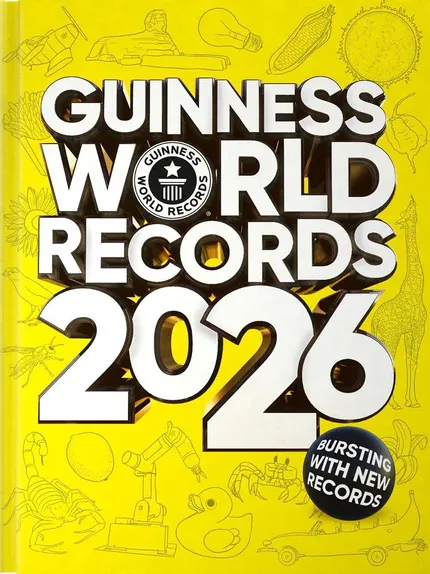
Over the past month, I’ve watched two YouTube videos where the topic of the ridiculous nature of Guinness World Records (GWR) came up. First, I was a johnny-come-lately to hbomberguy’s 2023 video on the history behind the Roblox ‘Oof’ sound, and the second was the first of two videos by Dan Olson of Folding Ideas about the inefficiency of the second season of Mr. Beast’s game show. In the former, suspicion is cast over the legitimacy of Tommy Tallarico’s records for video game concerts and video game composing. Meanwhile, Olson, albeit more briefly, questions whether the many records the Beast Games received are an unintentional monument to incompetence in the field of televised game shows. But whereas chasing after Guinness Records is used as a mark against Tallarico and Mr. Beast, I’m interested in the flaws in the awards process itself.

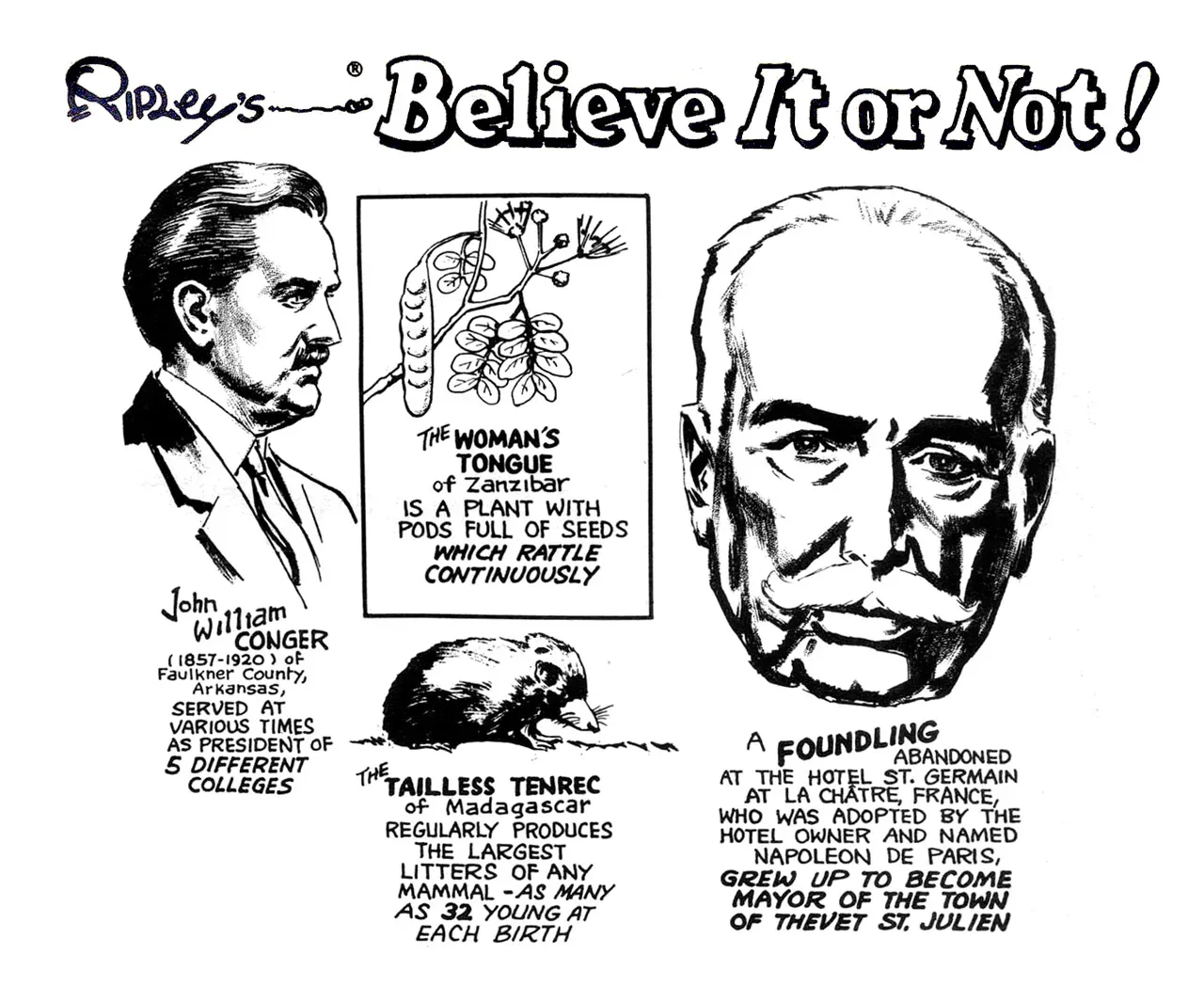
As an older millennial, I’m not immune to deconstructing the sacred cows of my childhood. The Guinness Book of World Records was a permanent fixture on the book shelves at both my elementary school and the public library. In the 1990s, these books were value for money - big, bright, and full of facts presented in a concise and straight-forward manner. In its weird way, it provided an uncomplicated view of the world where merit and achievement was acknowledged alongside the unexplainable (but verifiable) variations within humanity and across the planet. I would occasionally take out editions from the 1980s for pure curiosity’s sake. It was also far easier to access GWR in my small Canadian hometown than publications from the much older and much weirder Ripley’s Believe it or Not! Franchise. While there was some overlap between GWR and Ripley’s when it came to an obsession with Robert Wadlow and records for smallest or biggest things, Ripley’s indulges in the readers’ interest in more sideshow-style Americana, such as the Fiji Mermaid, shrunken heads, and the human owl. To whit, Ripley’s peddles in good stories and oddities, while the GWR is/was about facts.
I don’t recall if I ever gave a hoot about how the records were verified, and it wasn’t as if there were roving bands of adjudicators scouring the world for record-breaking feats. As of 2025, there are 81 adjudicators across six continents, and it appears to be something of a part-time gig. Although, if you are lucky, maybe editor-in-chief Craig Glenday might be on hand to sign-off on your strange skill, as he did for Tillman, an English bulldog with the record for the fastest 100m on a skateboard.
But Glenday is just a man, and this is a planet of billions; it is far more likely to me that thousands of record-breaking moments go unheralded each day than it is for Guinness to have captured them all. Maybe the true first milestone of becoming an adult is the realisation that many of the achievements listed in the GWR are really only possible due to either 1) a 1-in-1,000,000 outcome in the genetic lottery or 2) significant finance and time investment that would enable someone to become the fastest, strongest, be able to do the most of a thing, or maybe 3) a combination of both is a play. But, whichever way you slice it, there is one thing that any budding record holder must have: the desire for publicity.
What I’ve found is that the organisation that practically wallpapered the offices of both Tallarico and Mr. Beast with records is operating under a far different structure than many of us remember. So, let’s unpack the Guinness World Records.
History
The story of GWR is a story of fortune favouring the prepared. It is claimed that in 1951 Sir Hugh Beaver, then managing director of Guinness Brewery, was hosting a hunting party in Ireland when an argument arose amongst the assembled - what was the fastest gamebird in England. While no consensus or confirmation was reached at the time, Beaver saw a huge opportunity in getting into the business of settling trivial arguments. It should be noted that, at this point, Ripley’s Believe it or Not! had been running in newspapers in the United States for just over 30 years. An employee and former distance runner, Christopher Chataway, pointed Beaver in the direction of the McWhirter twins, Ross and Norris, who, after the war, both became sports journalists. In 1951, they had published Get To Your Marks!: A Short History of World, Commonwealth, European, and British Athletics, and had also opened their own fact-checking agency in 1949. They were commissioned in 1954 for the first book for the brewery, The Guinness Book of Superlatives, which was published in 1955 - just 11 months later.

Source - The McWhirter Twins, Norris (left) and Ross.
For a generation of British children, the McWhirters were the face of the Guinness Book of Records (or Guinness Book of World Records as it is known in the US) through the television show Record Breakers. However, the McWhirters were heavily involved in politics; both were staunchly right-wing and anti-IRA, amongst other beliefs. Ross also advocated for restrictions to be placed on the Irish community in England. Ross was ultimately murdered by members of the Provisional IRA in 1975, after publicly offering a £50,000 award for information on a series of bombings in Britain. Norris would spend the remainder of his life engaged in an anti-communist, pro-apartheid, eurosceptic pressure group The Freedom Association until his 2004 death. Although he retired from the Guinness business in 1985, he continued as an advisory editor until 1996, and even published an eponymous book of records.
GWR stayed under the auspices of Guinness Brewery until they became an independent organisation in 2001, after decades of spin-off books, TV series, museums, and related merch. They could not have been split off into their own entity at a worse time - they had to compete with the increasing popularity of Google, the launch of Wikipedia that same year, and the growing ease with which people could claim and fake claims of world records. Book sales were dropping, and GWR needed to find a way to stay competitive and keep the most lights on in a world records publication agency. The pivot they made to corporate services remains the organisation’s most controversial decision to date.
How does one get in the GWR?
The GWR contains about 53,000 records, but only 4,000 can be published in its books due to space. Of those 53,000, approximately 50,000 are active, with the rest having been retired or rested due to potential harm to competitors, spectators, animals, or the environment. Some records may be in an inactive state, due to controversies that surround their creation (see Tommy Tallarico’s record for Most prolific videogame composer, which is currently inactive).
According to a profile by television news magazine 60 Minutes in the United States, GWR will receive about 50,000 applications per year, and reject nearly 95% of them. How much money that translates into varies depending on the category. Potential record holders who are applying as an individual and who are seeking to beat an existing record do not need to pay any application fee. Individuals who are proposing an original record will pay about $5 USD. However, if you want to bypass the 12-week minimum wait, then you can shell out $800 USD to expedite your application for an existing record, or $1000 USD for an original record. The expedited service is not available at this time.
Groups, charities, and businesses can pay far more, with $12,000 to $500,000 being the commonly cited range. In return, these companies can access a consultancy service that will help determine a record that the applicants can achieve, provide licensed use of the GWR logo, and provide an official adjudicator - either in-person or remotely. However, the applicant will be expected to carry most other costs related to their record-breaking attempt. In the aforementioned 60 minutes piece, the organiser for the potential largest pizza party paid $30,000 in fees, and fundraised an additional, undisclosed six figures to cover the cost of ingredients and beverages, equipment, t-shirts, etc.
It makes me wonder if Mr Beast got a discount for his bulk attempt of 44 different world records for Beast Games, or if he fronted the full cost.
If you think the sticker shock is bad, consider the shock former professional Call of Duty competitor Doug ‘Censor’ Martin felt when Guinness first told him that his attempt at most pull-ups in a 24-hour period was not eligible. Martin had decided to take on the pull-up challenge and use it as a fundraiser for Project Purple in honour of his grandmother, who died of pancreatic cancer. He was able to fundraise over $8,500. There was also possible corporate sponsorship from both the gym and the company that provided the streaming services. In September 2024, Martin beat the record by 300 pull-ups in front of a large online audience. In October 2024, Martin was on a livestream when he received notice from GWR that because he had done it for charity, his record did not qualify because he had applied as an individual. This caused a tremendous ruckus for several weeks, with many interpreting GWR’s response as charities being disqualified from attempting world records. There was confusion because it was believed/rumoured that adjudicators from the GWR were there, but GWR later tweeted that they were not present on the livestream. This led to later gossip that the costs associated with the business application were too steep for Martin, hence why he went with the individual application. GWR publicly indicated that they were open to working with Martin further and reviewing his evidence. In November 2024, GWR announced that they would honour Martin’s record. Whether any money changed hands is anyone’s guess; if Martin was simply switched to a business application, it would suck as the fundraiser would have culminated in a financial loss.
But maybe the real kick in the pants is that it only took 5 months before Martin’s record was broken by YouTuber Justin Truett, in February 2025. Truett completed 10,001 pull-ups.
Frequent Flyers
For all the dreamers who hope to get into the GWR just once, there is a select fraternity who have multiple achievements. Silvio Sabba (180-200+ records), David Rush (350 records), and André Ortolf (130 records) are high achievers, but the record-breaker of, well, record breaking, is Ashrita Furman. Since 1979, Ashrita has set a total of 700 records, of which 200 are still active. It might be Ashrita you have in mind when you imagine a totally off-the-wall, but highly individualised, record. His collection of records are incredibly eclectic:
- Most jump rope skips in one minute
- Fastest mile while balancing a milk bottle on the head
- Longest distance balancing a bicycle on the chin
- Most candles lit on a cake (with other members of the Sri Chinmoy Centre)
- Most pineapples on heads cut in half in 30 seconds
- Most balloons burst by sitting in 30 seconds
- Most sugar bottles broken on head in 30 seconds (No longer holds this record)
- Most watermelons self chopped on the stomach in one minute
- A failed attempt at the highest bungee jump that ends with toast soldiers being dipped into boiled egg
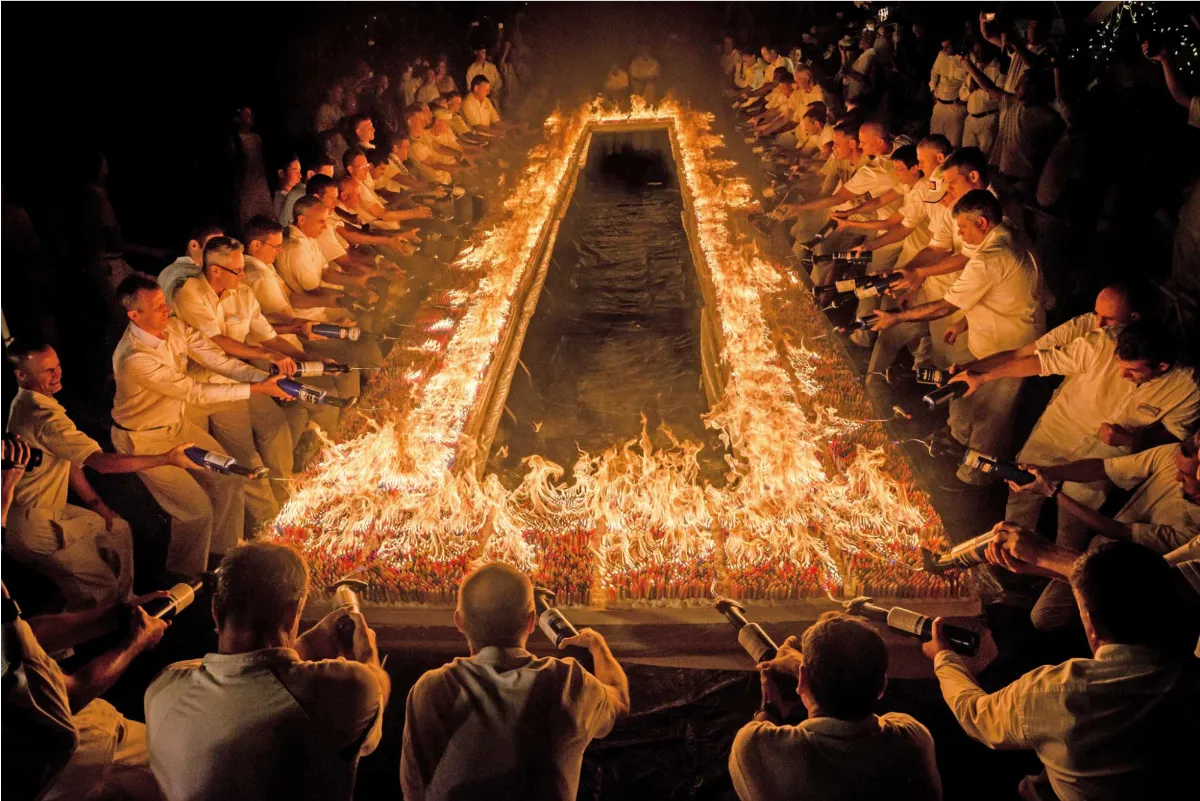
Source - August 28, 2016. 72,000 candles set alight on a birthday cake for the late Sri Chinmoy
The New Yorker magazine called him a leading practitioner of Guinnessport, but it is not a term that appears to have caught on.
I wrote about Furman a couple of years ago, in my articles about Sri Chinmoy. Furman dedicates many of his records to Sri Chinmoy, often coinciding with Sri Chinmoy’s birthday. Other members of the group appear to provide manpower and other support for Furman to reach his goals. Engaging in these record-breaking attempts is seen as a path to self-transcendence, where one pushes their physical and mental limits to challenge impossibility. Furman’s guru, Sri Chinmoy himself, engaged in similar feats of musical performance and poetry writing. Today, members of the group continue to gather to run 3100 Km or compete in games devoted to breaking records.
The business of making world records
When interviewed in 2023 about the evolution of GWR, Furman expressed his disappointment that the GWR were no longer maintaining the personal relationships with record holders they once had. But where Furman might be missing his annual lunch with the editor, others like John Oliver (using clips from episode 4 of David Farrier’s Dark Tourist) have identified a far darker side of this new pay-to-play type system GWR has created. Oliver argued that taking money from authoritarian regimes both played into the cult of personality and gave their leadership legitimacy. There was allegedly back and forth behind the scenes and in the press as to what happened between GWR and Oliver’s team on Last Week Tonight, as Oliver wanted to set a record for the largest marble cake with the picture of Turkmenistan President Gurbanguly Berdimuhamedow falling off a horse (or the monstrous folly as he called it). According to Oliver, GWR initially refused to send an adjudicator because their brand aligned with kids and families, and later agreed to adjudicate if they would sign a non-disparagement clause. After the show aired, GWR’s public statement did not confirm or deny Oliver’s claims, but merely stated that they were not going to participate in an event designed to belittle or mock title holders.
In any case, John Oliver and HBO clearly forked out some coin for their huge publicity stunt, but likely got a nice tax write-off in return - even if they didn’t get a certificate.
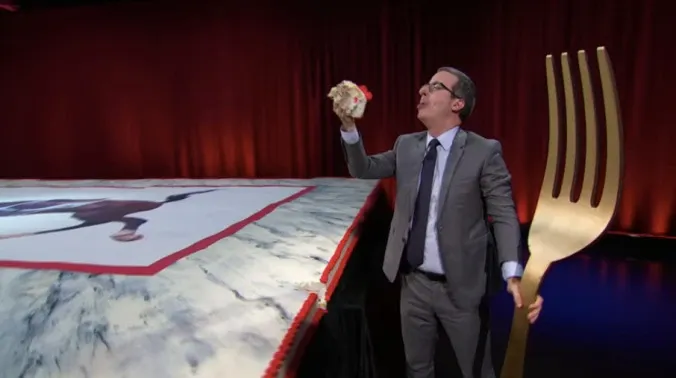
Source - All audience members were able to take some cake home, and the rest was donated to a local food charity.
Final Thoughts
I wonder, truly, if the very thing that started GWR down this disappointing path of reality fabrication may somehow redeem it and return it to its fact-checking roots. The adage that no one knows if you are a dog on the internet holds true today, but AI has truly made fraud and deception accessible to the masses. Is there still time for GWR to up their investigative game and retake the mantle as an authority on all things superlative? While Guinness may not be up for belittling paying customers or authoritarian rulers, there could be some profit in debunking claims or even talking about when they’ve had to disprove a claim. But that would only be possible if they apply the same standard to confirming claims that they do to ensuring a standardised approach to adjudicating the world’s largest pizza party.