Friday the 13th x 3: The mayhem, the meme, and some math
Bronwyn Rideout - 16th March 2026
I was originally approached by a television producer in January who wanted someone from the NZ Skeptics to talk about Friday 13th and superstitions. It’s been a cavalcade of mutual missed phone calls and messages since then, and I decided that if the powers-that-be don’t think I’m ready for primetime or the big screen (or that I just have a face for radio), then you, dear skeptic, have the bad luck of benefiting from my research.
History
How Friday and the number 13 became forever tied together as a day of bad luck in the West is unknown. Friday the 13th is connected to some unfortunate historical events, with many of the most memorable occurring (unsurprisingly) in the 20th century. These include the arrest of the Knights Templar in France in 1307 (frequently described as the incident that started this particular superstition), the end of the Aztec Empire in 1521, the 1939 bushfires in Victoria, Australia, the murder of Kitty Genovese, two plane crashes in 1972 (one of which was carrying a Uruguayan rugby team), the 1989 stock market crash, the murder of Tupac Shakur, and when President Trump declared a state of emergency due to Covid in 2020. However, there are numerous other days that could be described as more unlucky than Friday the 13th (such as April 14th or September 11th), but whether you agree will be a matter of personal taste and something of a race to the bottom. It is often suggested that, besides the arrest of the Knights Templar, the ominous beliefs around both arise from Christianity; in particular, the myths around Jesus’ final days. How true is this? It’s anyone’s guess.
Independently, Friday and the number 13 are unlucky on their own terms. The concept of Fridays being unlucky is embedded in nautical folklore and old wives’ tales. The earliest specific reference to the misfortune of Friday I could come across was published in 1656. Although Chaucer’s Canterbury Tales is often cited as an example from the 1300s, I find the quoted text of, “…and on a Friday fell all this mischance” too vague for my liking. The reputation of the number 13 is more varied, as it is both a lucky and unlucky number in certain cultural contexts and according to one folklore historian, the idea of 13 being unlucky wasn’t widespread before the 17th century.
Knock on wood: Why do we believe in superstitions?
The short answer is that superstitions can help us feel in control of events or circumstances we otherwise have no control over: by doing or avoiding certain behaviours, we can ensure something good will happen to us or avoid something bad.
A longer answer can feel like a mish-mash of pop psychology with a few reckons from evolutionary biology/psychology. Superstitions are largely learned behaviours and beliefs that, at one time - maybe back in the Pleistocene - kept our homo sapiens ancestors from yeeting themselves off the evolutionary path. When the threat of death or permanent injury is incessant, our subconscious is likely to accept decisions/beliefs that help keep us alive or unmaimed, even if that decision/belief was always mistaken, or became obsolete with time.
There are, of course, superstitions that we may come up with de novo, such as having a pair of lucky socks – beliefs that we know to be silly, but somehow provide comfort and, again, that sense of control.
Stuart Vyse, Psychologist and author, has written several articles on this topic with other columnists for the Skeptical Inquirer. Newsletter readers can dig into that oeuvre here.
Courting misfortune
If you have done any research into Friday the 13th, none of the above should surprise you, because essentially the same narrative has been presented ad nauseum throughout the internet. What we hear about far less often are the Friday the 13th or anti-superstition clubs which made sport of testing/disproving superstitions. Longtime skeptics may remember when Friday the 13th was “celebrated” during the 2009 conference with an evening of tempting fate.

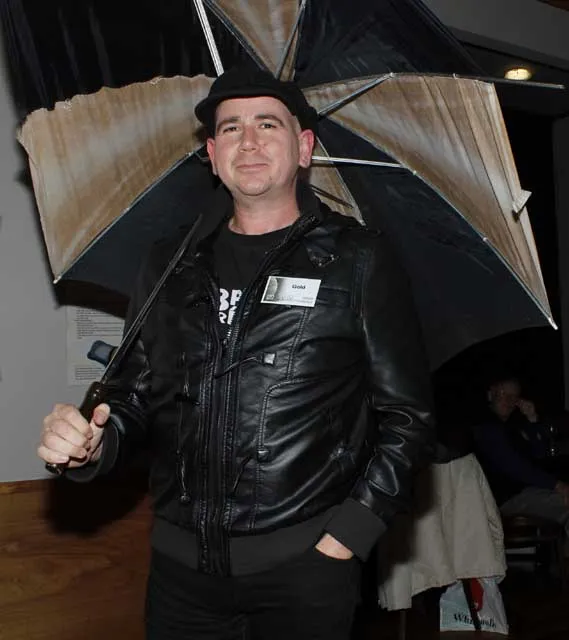
And it appears that the 2009 Skeptics were just another group in a long line of non-believers taking the mickey out of superstitions and Friday the 13th.
As reported by Kori Rumore and Marianne Mather of the Chicago Tribune, the Anti-Superstition Society in Chicago required each of the club’s original 13 members to partake in 12 “dangerous” activities in the 13 days leading up to Friday, January 13th, 1933.
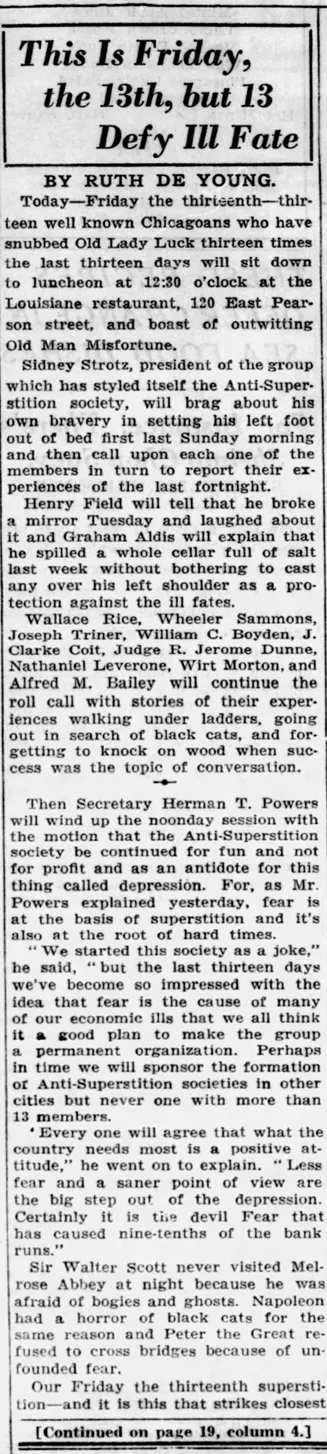
The Chicago Tribune, January 13, 1933
After that stunt, the group decided to make their group permanent, and their activities were a fixture of the newspaper for 50 years. To the surprise of none, they made it through their Friday the 13th antics unscathed. But that isn’t to say that bad luck didn’t find their way to the club’s membership on other days of the year. Many of the original members were part of the upper echelons of the Chicago community and, thus, victims of crimes and circumstances that would not have been experienced by your average lower and middle-class Americans, such as aeroplane crashes and hijackings.
None of which, as far as I can tell, occurred on Friday the 13th.
Looking at photographs from the Chicago Tribune, it seems like this group of wealthy men knew how to throw a party.
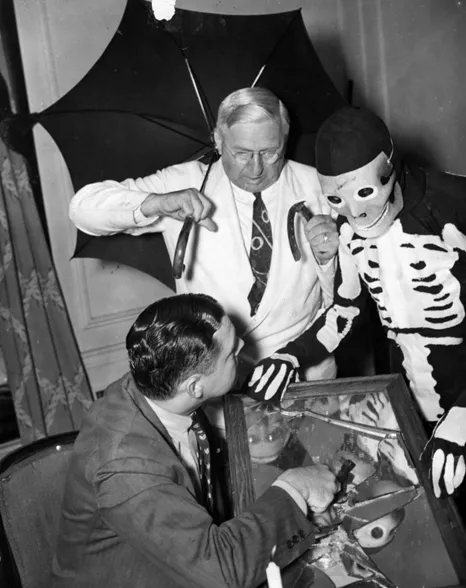
“Nothing could keep members of the Anti-Superstition Society from holding their annual dinner at Chicago on Friday the 13th in 1937. Even the presence of a skeleton was no jinx, nor was Gen. Anton F. Lorenzen, who held an open umbrella over his head, or the antics of Joseph Triner, state boxing commissioner, who defied every jinx by smashing a mirror.” Chicago Tribune
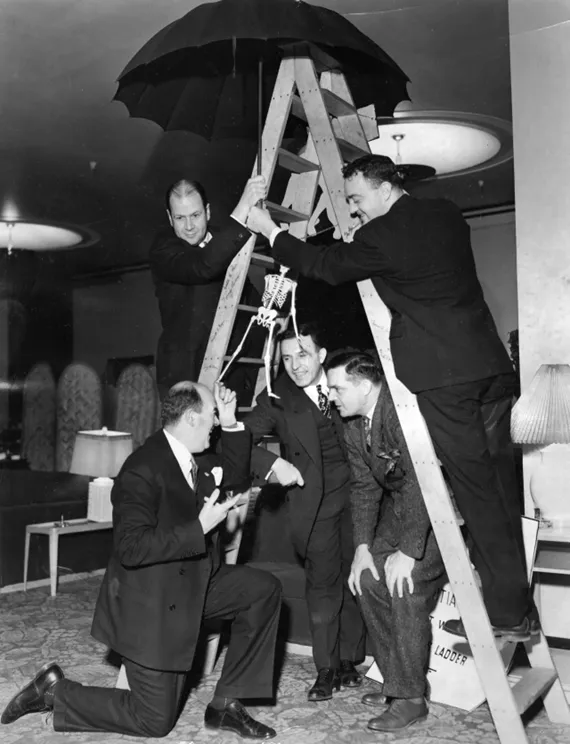
“Judge Robert Dunne, Judge Rudolph DeSort and Joe Triner are under a ladder while Atty. Robert Cantwell and Eugene Dunne hold an umbrella above on Friday the 13th in 1940. The group was at the 13th anniversary dinner for the Anti-Superstition Society, held at the Merchants and Manufacturers Club” Chicago Tribune
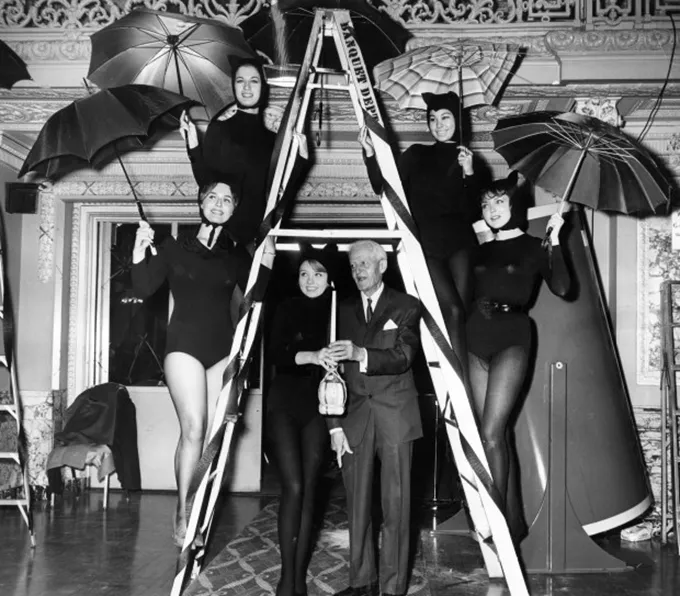
“Bernadine Stevens, Judy Kurtz, Patty Allen, Tani Sawa and Connie Jean are with Nathaniel Leverone, founder of the Anti-Superstition Society, as he enters the Gold Room under a ladder at the Pick Congress Hotel on Dec. 13, 1963, in Chicago.” Chicago Tribune
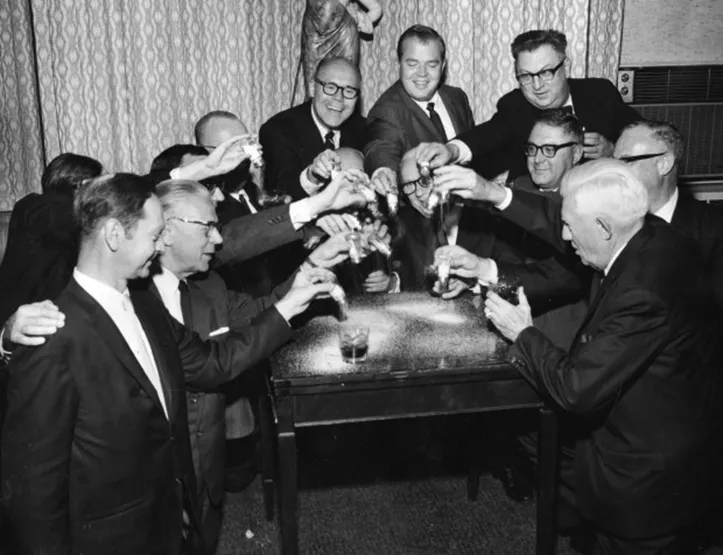
“Thirteen members of the Anti-Superstition Society pour salt while they drink on Oct. 13, 1967, in Chicago. The members are, from left, Jack Goldthwaite, Ed Welter, Joseph Kostner, Lew Regan, Les Lear, Mike Kilgore, Harry Puccetti, Ben Regan Jr., Judge Thomas Kluczynski, Ed Harrington, Walter Zawislak, Joe Regan and Tom Sexton.” Chicago Tribune
Similar clubs operated throughout the world or, like the Eccentric Club of London, celebrated Friday the 13th with a dinner and made a fine show of defying superstitions as they did in Chicago.
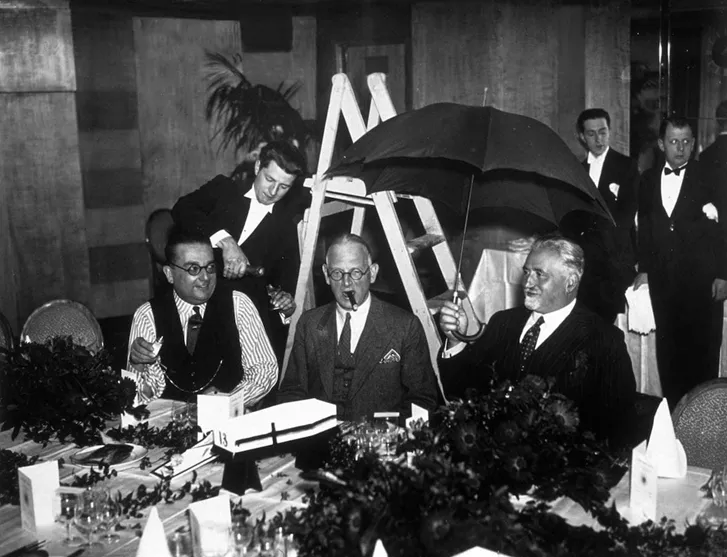
The Eccentric Club of London, hosting their annual Friday the Thirteenth lunch in Nov. 1936
Philadelphia had a club that operated from 1936 to 2000, disbanding at the turn of the millennium as the 1936 members anticipated they would all be dead by 2001.
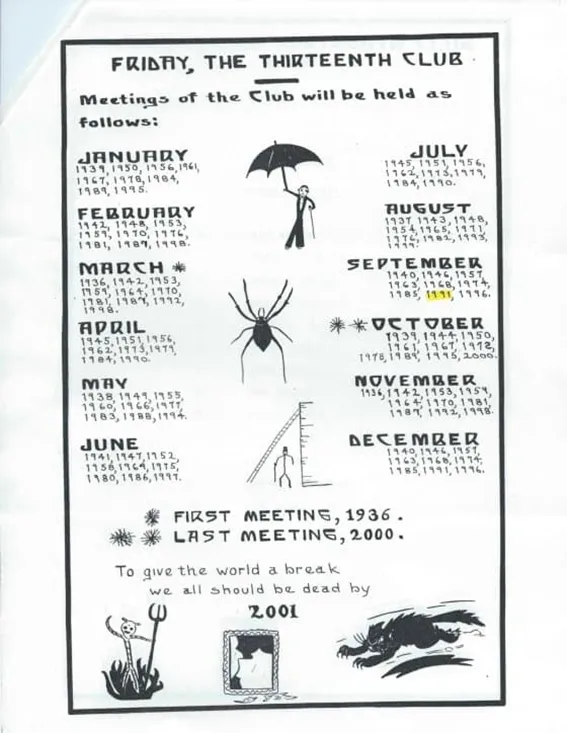
Calendar for Philadelphia’s Friday the 13th club. Time Magazine
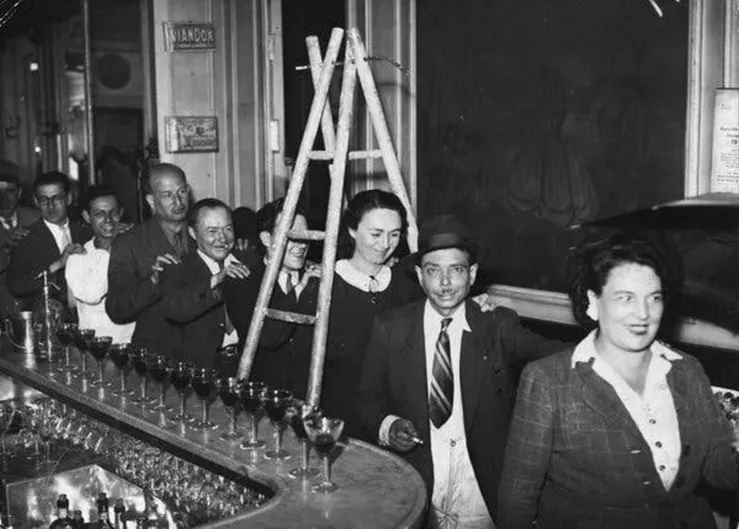
Members of a Friday the 13th club in Paris doing a conga line under a ladder. The New York Times
Sadly, I cannot find mention of similar shenanigans happening with clubs in New Zealand, although false reports of what happened to anti-superstition club members elsewhere in the world did make it to print here. The closest I found was the Wellington College Old Boys, who in the first half of the 20th century formed a Thirteenth Club, but it appears that their activities were more social or philanthropic in nature.
A triple threat
Is 2026 unique in having three Friday the 13ths?
No. The phenomenon is more common than you might think, and it’s all because of the Gregorian calendar.
EarthSky.org explains that every time this happens - whenever a common or non-leap year of 365 days starts on a Thursday - then the months of February, March, and November will start on a Sunday. Any month that starts on a Sunday in a common year will have a Friday the 13th. We will see 8 more February-March-November triads this century, 2037, 2043, 0254, 2065, 2071, 2082, 2093, and 2099. An easier way to think about it is as a 28-year cycle of 11-11-6: 11 years between 2015-2026, another 11 between 2026 and 2037, and then 6 between 2037 and 2043, and that cycle will happen 2 more times before 2100. And because our Gregorian calendar has a 400-year cycle, 2426 will also have a Friday the 13th triad.
There are other peculiarities of the Gregorian calendar that actually ensure that there are a couple more triad years coming up between now and the 24th/25th centuries. In the 22nd and 23rd centuries, the cycle is perturbed, so to speak, and all Friday the 13th triads occur 4 years earlier due to the leap year being suppressed. Further, the 28-year-cycle does not include leap years, something that many websites and news outlets explaining this phenomenon forget to take into account. A leap year can also have three Friday the 13ths, but only if it starts on a Sunday. When this happens, the triad occurs in January-April-July of that year. Friday the 13th triads that include a leap year have their own 28-year-cycle. Since 1981, there have been 2 Friday the 13th triads in a short 6 year period: 1981, 1984, and 1987, followed by 2009, 2012, and 2015 and this will happen again in 2037, 2040, and 2043 – two common years and a leap year that all start on a Sunday and, as you may note, these triplet triads also occur on a 28-year-cycle.
Tags: friday, year, clubs, newsletter, chicago