Jim Ring
37 articles
37,046 words
(1001 words per article)
Years Published: 1987 - 2024
Jim Ring goes fishing when the weather is good. Before retiring, he taught chemistry.
37 articles
37,046 words
(1001 words per article)
Years Published: 1987 - 2024
Jim Ring goes fishing when the weather is good. Before retiring, he taught chemistry.
Originally published in the February 1994 issue of our journal, The New Zealand Skeptic
Originally published in the November 2008 issue of our journal, The New Zealand Skeptic
Originally published in Issue 26 of the NZ Skeptic, February 1993
The suggestion that fringe medicine is more successful than orthodox medicine (NZ Skeptic 3, editorial) was presumably put forward at challenge). It is a suggestion encountered quite frequently these days but rests on two major fallacies. Firstly, medicine is narrowly described as a cure for disease. Secondly, it is assumed that people who recover have been cured by the treatment received. The success of real medicine is illustrated by a cutting from Scientific American, Oct, 1936. It gives the average life expectancy for white males and females in America. In 1900, it was: males 48, females 51, In 1936; males 59, females 63. Compare these with recent figures, The great successes of orthodox medicine have been in the prevention and eradication of diseases. The list of once threatening diseases in N.Z. includes; tuberculosis, polio, typhoid, diphtheria, cholera and smallpox.
I agree with Vincent Gray (NZ Skeptic 107), it is not possible to determine an average temperature for the Earth. However it is important to note that even the alarmists agree that the Earth is not warming and has not done so for about 17 years. The British Met Office even predicts it is not going to do so in the near future.
Some claim our society is too materialistic and lacks spiritual values. But what would it be like to live in a society that rejects materialism?
While we were in Fiji recently there was a dengue fever alert. This unpleasant virus is carried by mosquitoes and naturally we were careful to use insect repellent.
A visit to Lake Rotoroa in Nelson Lakes National Park is rewarded with a remarkable sighting.
In our last issue, Hugh Young looked at the practice of circumcision. But how did such a bizarre tradition ever get started?
It's often said that scientists long rejected the idea of meteorites, but the evidence for this assertion is far from convincing.

Attacks on Darwinian evolutionary theory have come from within the scientific community as well as from creationists. Much of this is the normal process of scientific scrutiny, but some bear all the hallmarks of pseudoscience.
Jim Ring finds some material to pass the time on a recent flight.
Jim Ring takes another look at Bishop Ussher's famous date for the creation.
The idea that low self-esteem is the cause of violent behaviour has been current for some time. Many years ago I attended numerous education meetings where I heard that certain (male) individuals "lacked self-esteem" when it seemed patently obvious that this was not true. I argued that these individuals greatly esteemed many of their own behaviours - it was just that these behaviours were those the counsellors thought should be deplored.
Increased litigation will do nothing to reduce the rate of medical misadventure
Insecurities about water quality have led to a boom in sales of bottled water. But the health benefits of the phenomenon are probably minimal.
Mass screening programmes have generated considerable controversy in this country. But these programmes have inherent limitations, which need to be better understood
In the second of a two-part series, Jim Ring looks at what evidence means to different people
The marketing of sodium chloride should be taken with a pinch of salt
Skepticism is very much concerned with assessing the quality of evidence in support of a particular claim. But evidence means different things to different people. In the first of a two-part series, Jim Ring examines the legal profession's view of the matter.
Goethe's Faust is a tale of the supernatural. According to a famous passage, on Walpurgisnacht a witch's sabbat was celebrated on top of the Brocken, a mountain in the Black Forest. Old maps show this point circled by witches on broomsticks. Although probably not a very ancient tradition, it grabbed the imagination of 19th century romantics. They claimed at certain times magical visions could be seen from the peak. Even though no witches were visible on the mountain, gigantic shadowy figures were projected onto the clouds; the Spectre of the Brocken.
Bob Metcalfe (Forum NZ Skeptic 54) seems to be calling for a change in editorial policy on footnotes and references. This has been consistent throughout the history of this society and any change would completely alter the character of this journal. What do members want? I thank him for his apology. Anything that increases feedback on articles in NZ Skeptic and the numbers of letters in Forum is to be welcomed.
The Swedish chemist Berzelius coined the term "organic" for substances that could only be made by living organisms and not synthesised by humans. His German friend Wöhler synthesised urea in 1828 proving Berzelius wrong: there was no such distinction. Another brilliant German chemist, Liebig, then used "organic" to mean carbon-compound chemistry, extending this to include the chemistry of living organisms and so beginning biochemistry.
THROUGH various articles, books, radio and TV programs, most New Zealanders will be familiar with the name Richard Pearse. Many are convinced that Pearse flew before the first official flight in history, made by the Wright brothers on 17th Dec 1903. Some are indignant that Pearse has not received the recognition that he deserved. The best book on the subject is The Riddle of Richard Pearse by Gordon Ogilvie first published in 1973 and revised in 1994. Ogilvie provides an objective account and he personally discovered some of the most important evidence in this case. Nevertheless he draws some strange conclusions at times.
Around 300BCE there started a school of Greek philosophy called Skepticism. It continued for centuries, but was more like dogmatic doubt than the modern version. Bertrand Russell put their creed as "Nobody knows, and nobody can know". They may simply have a bad press. Carneades, one-time head of the skeptical academy, was accused of denying the possibility of all knowledge. In fact he seems to have denied the possibility of certain knowledge, a very different thing.
NEW AGE theory holds that practically all cultures had a tradition of using medicines (mostly herbal) and that there is a danger that "Western medicine" will replace these, so losing irreplaceable knowledge.
Jim Ring takes a look at canonisation and finds the lives of the saints less than miraculous.
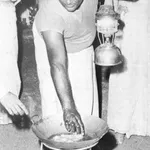
Jim Ring continues his investigations into the Fijian paranormal scene.
AROUND 40 years ago, at Hull Fair in England, I saw a man dip his fingers in molten lead. He also poured it into his palm and ran it through his fingers. He seemed to suffer no harm although it was real lead; I found a solidified splash and checked. In my vacations I used to work for one of the showmen at the fair, so I found my boss. "That fellow with the molten lead, why doesn't he burn his hands?"
It is rare that Nelson interests the world's news media. The "sheep suspended from pine trees" story was sufficiently bizarre to get their attention.
Surprising results from a US study of the effectiveness of counselling on reducing juvenile crime.
Visitors to Fiji are still being told that village people have the hereditary ability to walk on white-hot stones. This is quite untrue (see Hot Footing it in Fiji,Skeptic 26). A tourist promotion video for airline passengers features the ceremony. It is pretty obvious to the discerning viewer that the stones are not white-hot, but how many tourists give more than a cursory glance?
Seeing shouldn't always be believing, as a Nelson skeptic discovered thirty years ago.
Vicki Hyde suggests (Skeptic 30) that we are in for a lot more doomsday predictions as we approach the year 2000. I am afraid she is right, but why should fundamentalists get so excited about a round number of years?
Lights in the sky are not always aliens on the lookout for earthlings to abduct. Sometimes they are mostly a load of hot air.
New Zealand Skeptics walk happily on red-hot embers, protected by the laws of physics. Fijian firewalkers, however, are said to stroll across white-hot stones. How do they do it?
The suggestion that fringe medicine is more successful than orthodox medicine (NZ Skeptic 3, editorial) was presumably put forward at challenge). It is a suggestion encountered quite frequently these days but rests on two major fallacies. Firstly, medicine is narrowly described as a cure for disease. Secondly, it is assumed that people who recover have been cured by the treatment received. The success of real medicine is illustrated by a cutting from Scientific American, Oct, 1936. It gives the average life expectancy for white males and females in America. In 1900, it was: males 48, females 51, In 1936; males 59, females 63. Compare these with recent figures, The great successes of orthodox medicine have been in the prevention and eradication of diseases. The list of once threatening diseases in N.Z. includes; tuberculosis, polio, typhoid, diphtheria, cholera and smallpox.