Had an apophany lately?
Katrina Borthwick - 12th October 2026
No, not an ‘epiphany’. I’m talking about its occasionally evil twin, apophenia, which is the human tendency to perceive meaningful patterns or connections in random or unrelated data. An ‘epiphany’ on the other hand is the eureka moment where a complex problem or situation suddenly makes sense from a new perspective. An ‘apophany’ can sometimes feel the same, but it’s leading you up the garden path. Pareidolia is a specific type of apophenia where we tend to see a meaningful image, face or pattern in a random or vague visual or auditory stimulus, such as a face on mars or the moon. While that in itself is a very interesting topic, in today’s exploration I want to dig into the wider pattern-seeking that feeds conspiracy theories.
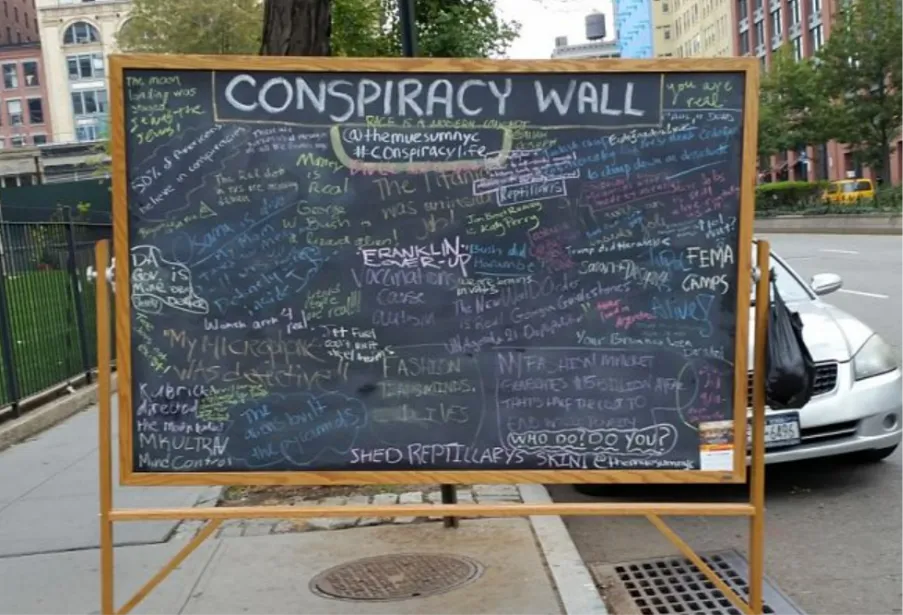
Don’t get me wrong, apophenia is not a bad thing - it’s a basic survival trait. People are more likely to remain alive if they can modify their behaviour based on recognised patterns - don’t eat the plants with the red bits, follow the animal tracks to find hunting grounds, the good mushrooms grow in this part of the woods, stay away from the big scary things with sharp teeth and, most importantly, your wife is always right. But unchecked apophenia can drive problematic behaviours. For example, in gambling someone may be convinced that the pokie machine has a pattern and they are ‘due’ a win. There are also people who think they have methods to game the stock exchange. If you’ve heard of ‘streaks’ in relation to gambling or trading, that’s likely to be apophenia. Although these methods may be appealing, the maths doesn’t really work in favour of these patterns being useful. Before you say it, card counting isn’t apophenia because it’s not random or unrelated data – it works because there really is a pattern. Ditto with insider trading on the stock market.
If you think you are immune to the effects of apophenia, think again. Have you ever noticed that after you buy a new car, there are heaps of similar cars everywhere? Have you been convinced a colleague’s email means they are angry at you, despite the words not saying that? Ever felt like the world was against you during a rough week? Have you seen weird numbers when you happen to glance at the clock, like 11:11 or 12:34, and then thought for more than a second about what it means? Had a friend text or call, just as you were thinking about them? Spun a whole narrative in your head after getting a minimal response to a message, like a ‘thumbs up’, ‘OK’ or ‘fine’?
Conspiracy thinking
Researchers have demonstrated a link between stronger apophenia tendencies and conspiracy belief. In a series of studies, people who saw patterns in randomly generated coin toss sequences were also more likely to endorse conspiracy and supernatural beliefs. The effect also appeared with chaotic paintings, where participants who detected deliberate structure in genuinely unstructured images tended to be more receptive to hidden plot explanations. In other words, ‘connecting the dots’ can become a habit that travels from one topic to another.
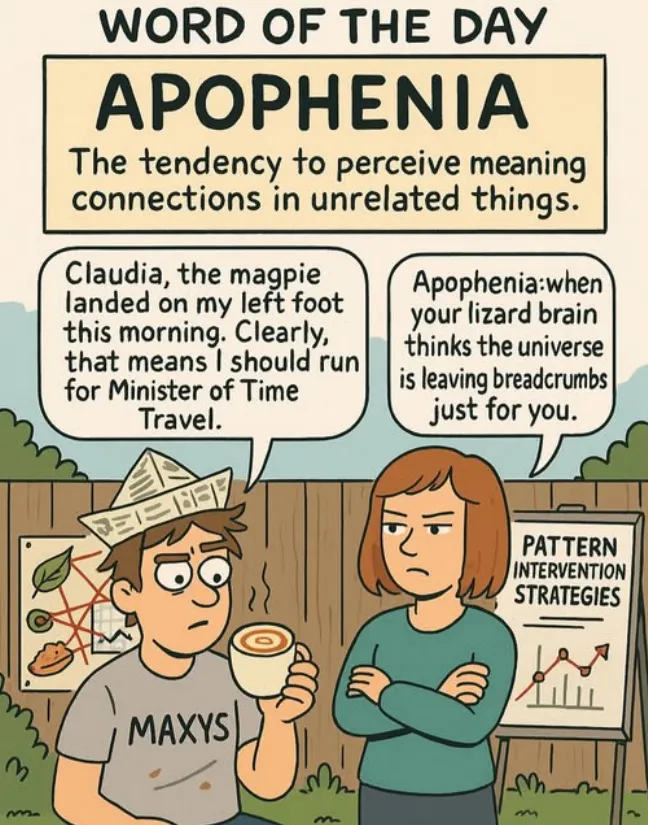
At a pathological level, such thinking patterns can tip over into clinical paranoia. I’m not saying everyone swept up in a conspiracy theory is suffering from this, far from it, but it definitely stands to reason that those with a tendency in that regard could end up impacted. Key elements differentiating benign apophenia from clinical paranoia are: inflexible beliefs that are impervious to counter-evidence, believing the individual is under threat (surveillance, control, malice), and functional disruption such as hypervigilance, defensive hostility, and problems with navigating daily life. All of this sounds pretty familiar to me, and probably anyone who has observed a conversation with the conspiracy believer.
Apophenia drives confirmation bias and clustering illusions in particular. Some famous examples of apophenia gone wrong are internet rumours like: ’Pizzagate’, where individuals claimed to have uncovered secret paedophile code words being used in Democratic Party emails; The ‘Rainey Street Ripper’, where Reddit and Tiktok sleuths linked together a bunch of unrelated drownings in Lady Bird Lake, Texas, claiming they were the work of a serial killer - despite the fact that these deaths did not deviate from any kind of statistical norm; and, notably, the ‘Missing Scientists’ conspiracy theory, which claimed the deaths and disappearances of research staff and high-ranking military personnel were linked to a cover up of UFOs and advanced tech, where the actual explanations for the deaths and disappearances over a number of years were a plausible mix of natural causes, homicides and suicides. New Zealand specific examples include the localisation of global plots, and some of the conspiracy theories that abounded during the COVID-19 lockdown (Plandemic).
This is not just a recent phenomenon linked to the internet. In 1969 a rumour spread that Paul McCartney was dead, and had been secretly replaced. This was ‘confirmed’ by fans scanning songs and album covers for an ever-increasing collection of ‘clues’, including playing songs backwards. Reversed soundtracks appear again in backmasking accusations in the 1980s, as part of the satanic panic where claims were made that rock albums contained hidden satanic instructions - resulting in unfounded investigations and prosecutions. This was a clear case of pareidolia. And then there’s the various moon landing conspiracies, many of which persist.
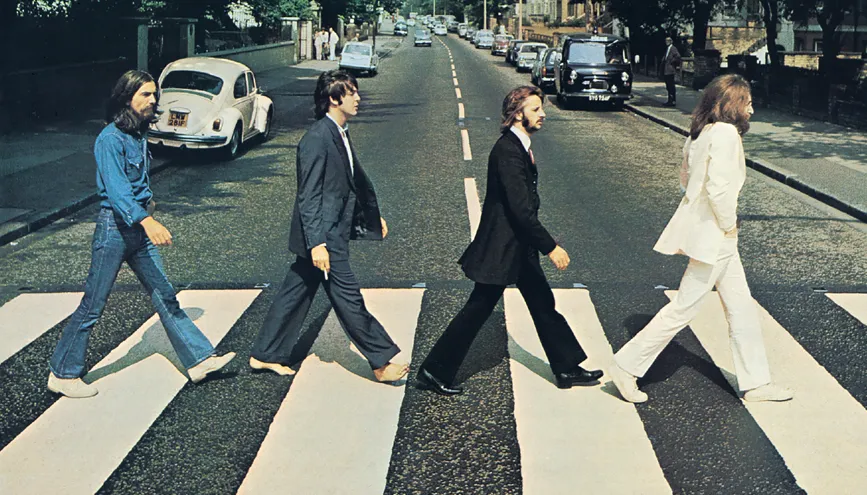
The ‘funeral procession’ on the cover of Abbey Road - John Lennon in a white suit was claimed to be the preacher or clergyman, Ringo Starr in a black suit was claimed to be the undertaker, George Harrison in denim was claimed to be the gravedigger, Paul McCartney out of step, smoking a cigarette, and walking barefoot was claimed to be the corpse.
In the world of deepfakes and social media, digital paranoia can spread quickly. A new movie, Appofeniacs, is a psychological thriller exploring how an individual could weaponise AI-generated deepfakes to trick a group of residents into finding patterns and hidden meanings. This movie doesn’t have a theatrical or streaming release date in New Zealand yet, so I may cover it in a future update on this topic once I have had a chance to watch it. That is, if it doesn’t turn out to just be a silly horror movie.
Our body is in on it
The primary drive of clinical paranoia appears to be dopamine dysregulation. Dopamine signals what is important to us. When it is dysregulated, it might make something unremarkable appear important, dangerous or surprising, thereby drawing our attention to it. Then the brain kicks in to offer an explanation for the otherwise inexplicable threat sensation. For example, the black car parked across the road might be ‘surveillance’. The following video gives a really good, quick five minute explanation of some of the topics discussed in this article, including the exaggerated salience effect mediated by dopamine.
Apophenia, then, is both a flaw and a necessary feature of the human mind - one that can help us make sense of the world, but can also mislead us when coincidence begins to feel like proof. The best safeguard is not to stop noticing patterns, but to pause before assigning them meaning. Assumption is, after all, the mother of all screw-ups.
Tags: apophenia, patterns, conspiracy, wiki, image