Response to Lance Kennedy's UV article
Ed Adie - 14th September 2026
I do not have the expertise to discuss the specific science claims made about the benefits of sunlight, but I was nevertheless troubled by the following aspects of the article.
The first thing that concerns me here is the framing; Lance implies that the official advice is to avoid all exposure to the sun as it is harmful. He then outlines some of the benefits of UV exposure, and implores us to ‘to expose ourselves for no more than 30 minutes in the morning or late afternoon, when the sun is less fierce.’ However, this narrative is misleading as the recommendations that he is making are essentially already those of Te Whatu Ora - below is a screenshot from their website.
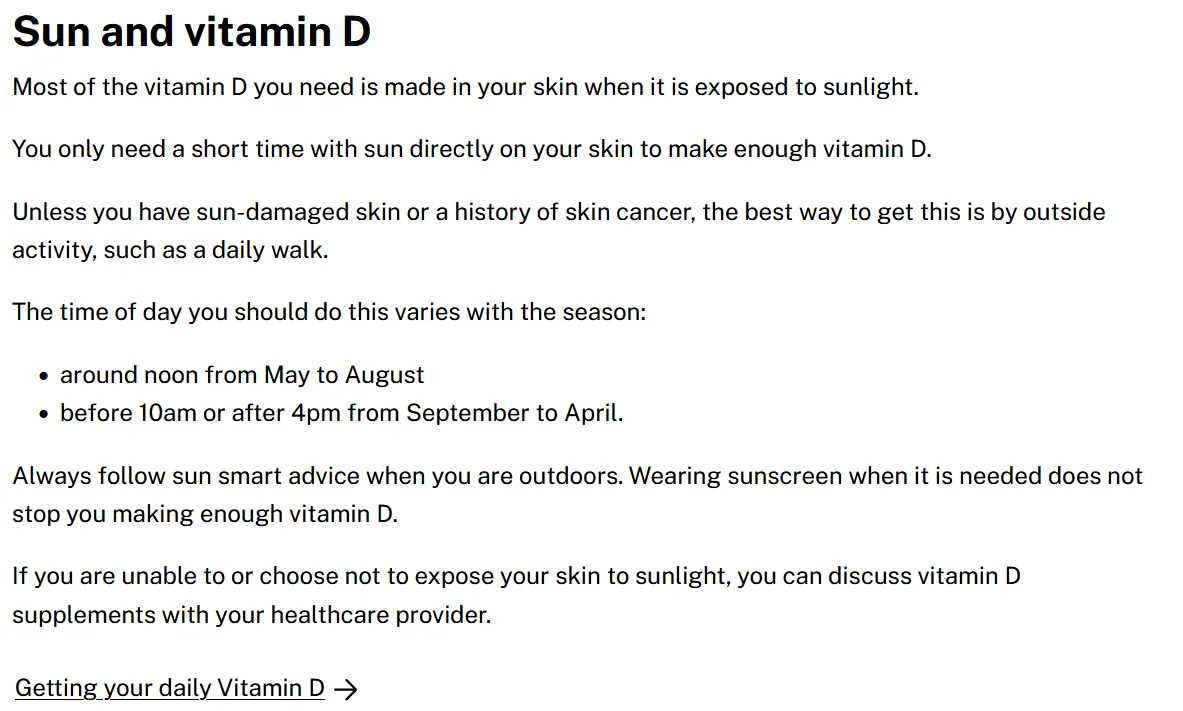
While it is interesting that research has demonstrated other benefits to UV exposure that are not listed by Te Whatu Ora, it seems unlikely that the findings would affect the advice that is currently given. The article does not adequately address the balance of risks, hazards and benefits of sun exposure. I would imagine that much of the official advice on how to reduce your exposure to the sun comes from the hazard of developing skin cancer and the increase in risk of this associated with increased exposure. I am speculating, as I have not looked at any data, that it is probably the case that the health system deals with a greater number of cases related to over exposure to UV than underexposure, and that the health issues caused by overexposure are often more serious in nature. Hence the focus of the advice given is on how to reduce our exposure to the sun.
The anecdote about the doctor adds nothing to the article. Does this doctor’s dismissive response reflect that of the profession as a whole? Did this take place as described? It is not an informative or useful paragraph, and the only reason that I can see for it to be included is to add an emotional element to the narrative that implies that the medical establishment is closed-minded and cannot adapt to new research.
I also took issue with the notion that the human love of sunshine evolved because it is good for us. There are many counterexamples, both positive and negative; what about the human love for alcohol, and the corresponding absence of it for brussel sprouts or broccoli for example? The idea that we have evolved this trait because it is good for us again fails to address any nuance of risk, hazard and benefit. It may be that we evolved a tendency to expose ourselves to the sun for the short term benefit of producing sufficient vitamin D, while there is limited selection pressure caused from developing skin cancer to remove this trait. After all, cancer tends to develop later in life, after we have had a good chance to pass on the code. Again this is just speculation, but the premise that humans have evolved a love for the sun because it is good for us fails to look at other possible reasons, and seems far too simplistic.
I don’t mean to be critical of Lance in particular, in fact I am grateful that he has written the article as it has given me the opportunity (for better or worse) to practice my skepticism, and I note that this book seems to have been well reviewed. Despite this I think that the points that I have made above stand, and welcome any response relevant to the points that I have made.