Updated Guidance for Police on SovCits
Katrina Borthwick - 20th July 2026
In late February the police issued an updated chapter in their manual on sovereign citizens (SovCits). This is a 24-page chapter aimed at assisting police officers in managing problematic behaviours from SovCits in a professional and respectful way.
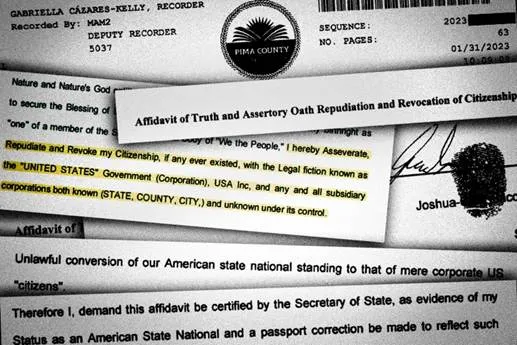
When we talk about SovCits, we are referring broadly to a diverse group of individuals who assert their separation (sovereignty) from any government and any legal obligations, including the authority of the courts. They see the legal identity created by the government as separate to them as a living man/woman. Often their arguments are paradoxical – simultaneously rejecting the legitimacy of the government while still demanding publicly funded protections and benefits. They often use pseudo-legal arguments to justify what they do. I wrote a three-part series about SovCits last year if you want to read more about them and their strange internal logic.
SovCits are known to engage in what is sometimes called ‘paper-terrorism’ – inundating councils, courts and government agencies with hundreds of pages of essentially fake ‘legal filings’ and ‘notices’. What lands with the police is often a failure to cooperate with law enforcement, which can lead to confrontations and threaten officer safety.
General approach
Helpfully the guide says upfront that SovCits can often be identified by the language they use, including statements such as “I am a real person”, “I am a living person/being”, “I am a freeman of the land”, “I do not consent to contract”, “Admiralty Law”, “Magna Carta”, “Suri Juis” and “Postmaster General”. The Police take this gobbledygook quite seriously. When it is determined that a SovCit is being dealt with, the instructions are to record it in the NZ Police Intelligence database (NIA), including ‘SOVCIT’ or ‘Sovereign Citizen’ in the notes, and to let the Security Intelligence and Threats Group (SITG) know. If the individual holds a firearms licence, they also need to notify Te Tari Pūreke (the Firearms Safety Office). If they consider that someone represents a national security threat - for example violent extremism, terrorism, infiltration or espionage - then they also need to email their National Security Group (NSG). And the threat is real. In 2024 SovCits used fake IDs to enter Government House and the Prime Minister’s floor at parliament and serve pseudo-legal papers. In 2025, a soldier with ties to far-right extremist groups admitted to attempted espionage when he tried to pass sensitive military information and base maps to other parties.
Much of the guidance in the chapter is around a graduated response model and deescalation, so I won’t bore you with the details of that – it’s pretty generic stuff that applies more widely to other situations. But a key change in the latest guidance is to assert authority – that all people in New Zealand are subject to the law - and to absolutely not enter into a debate. The guidance is clear that officers shouldn’t be drawn into arguments over ‘common law’, ‘contracts’ or the Magna Carta, which have no legal standing, and that engaging on those topics will just lead to a long encounter and increased tensions. It is also highly unlikely that that police would stand a chance of changing a Sovcit’s mind on these matters during such an encounter.
The guide goes through a number of scenarios which are quite interesting.
Fake credentials
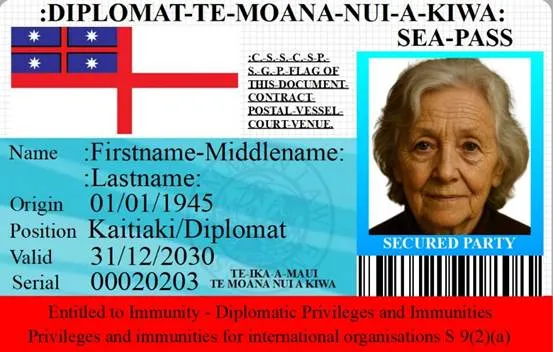
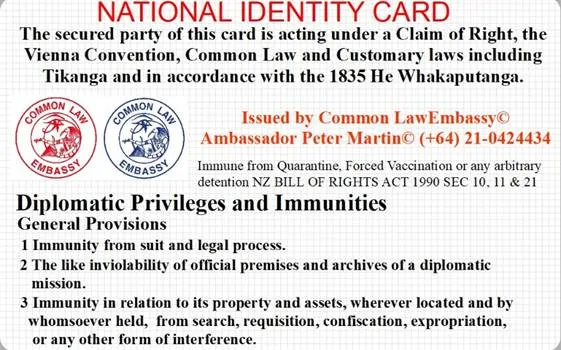
Common behaviours include refusing to provide ID, or presenting fake IDs such as driver’s licenses or diplomatic IDs. And while the fake legal documentation is not recognised by law, the guidance says it’s worth checking as it may contain useful details such as a person’s real name and date of birth.
Fraudulent diplomatic identification cards may feature the Flag for the United Tribes, or claim affiliation with entities such as the Moana a Nui A Kiwa Embassy. The Ministry of Foreign Affairs (MFAT) does issue Diplomatic ID cards, but never to New Zealand citizens - only to foreign national diplomats and their entitled family members. Genuine diplomatic cards look different, and can be verified by contacting the relevant embassy. I haven’t included a picture, as public specimens of these identity cards are tightly controlled for security purposes and are not published for general verification. The Police have access to examples of these cards and, according to the guide, they feature a New Zealand coat of arms. If the police encounter someone claiming diplomatic privileges or immunities, they need to contact the MFAT Protocol Division - it’s easy to see how this could unravel very quickly. Added to this, a person with diplomatic immunity can still be issued with an infringement notice anyway. Fines must be paid, and there is absolutely no diplomatic exemption for run of the mill driving offences. A special process must be followed to get a waiver for serious driving charges that could result in conviction.
Travelling not driving
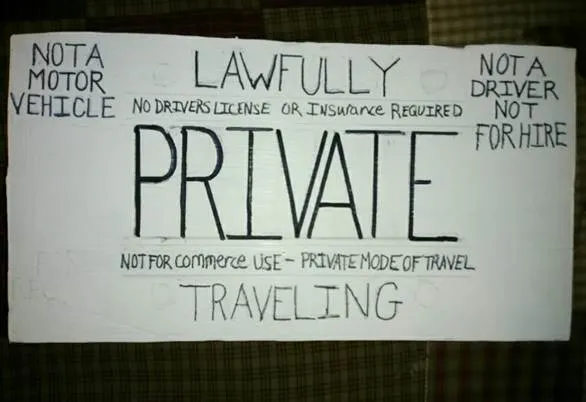
Another tactic of SovCits is to claim they are ‘travelling’ rather than driving – a misinterpretation of historical legal terms and the right to free movement. Using these terms during a traffic stop is a good way to get your vehicle impounded.
Trespass
Officers have experienced being trespassed by a SovCit on entering their property. Police have an implied licence to go onto (but not into) a property (including multiple times) and knock on a door (even multiple doors on multiple occasions) to make reasonable enquiries. This implied licence exists unless it is revoked by a posted notice, or verbally - for example by locking a gate, putting up a sign, asking the police to leave, or asking for a search warrant. The courts have established that a reasonable enquiry may include taking photos or videos. If the police tell someone they are under arrest before being asked to leave, then the officer can remain to take the person into custody. So revoking implied licence won’t stop them mid-arrest. There are also special rules where there is a firearm and imminent risk present.
Sheriffs
Police sometimes come across an individual claiming they are a ‘sheriff’, and the person may even be wearing a silver star or sheriff’s badge of some sort. Sheriffs do exist in New Zealand, but these are officers of the superior courts, and responsible for serving summonses and subpoenas in the same way that Bailiffs do for district court processes. They do not wear silver stars or behave in the manner of Sheriffs in cowboy movies. Essentially this is a misinterpretation of the Sheriff’s Act 1887, which is a UK law and will be ignored by NZ police.
Serving the police
Sometimes an individual will approach a police officer and ‘serve’ them with papers from an ‘actual monarch’, stating something along the lines of “actions of police staff at the time of the delivery of this paper makes them liable for treason under natural law”. The officer needs to check there are no questions that could constitute a Privacy Act or Official Information Act request, but otherwise these will be ignored as having no effect. What it will result in is the police logging this on their database, and checking if the individual has a firearms or alcohol licence, or any other risk factors that need to be looked into and addressed.
Magna Carta
If an individual invokes the Magna Carta during a serious incident when approached by a police officer, then it won’t stop them being arrested. Only article 29 of the Magna Carta is still in effect. This states:
“NO freeman shall be taken or imprisoned, or be disseised of his freehold, or liberties, or free customs, or be outlawed, or exiled, or any other wise destroyed; nor will we not pass upon him, nor condemn him, but by lawful judgment of his peers, or by the law of the land. We will sell to no man, we will not deny or defer to any man either justice or right.”
The language here is a bit dated, but essentially it’s saying that the government cannot punish someone simply because it wants to. Any loss of liberty, property, or rights must be based on the law and a fair legal process. Justice must be available to everyone equally, without corruption, discrimination, or unnecessary delay.
The original text in this part of the Magna Carta is sometimes used to claim arrest is unlawful. However, numerous court decisions have determined that the Magna Carta, along with other historic UK laws that still apply in New Zealand, are subject to section 15 of the Constitution Act 1986, that provides that parliament has the power to make laws. That means the Magna Carta can be superseded by subsequent New Zealand legislation. Many of the rights protected by Article 29 are now also found in more modern legislation, for example the Bill of Rights Act 1990, and particularly sections 22-25 that deal with detention and arrest. The reference to a ‘freeman’ is no longer interpreted literally. Modern courts understand the protections as applying to everyone.
Information requests
Like anyone in New Zealand, SovCits have rights to be provided with information under the Privacy, Official Information and Local Government Information Acts. However, SovCits have a habit of document bombing, and those information requests may be hidden in the resulting mess somewhere. They may also request information under irrelevant Acts, but that doesn’t limit the obligation to respond to these requests under the legislation that does apply.
There may be a bit of work needed to separate out the actual request out from their statements of pseudo-law belief and requests for opinions or legal advice. SovCits may often start with the opening phrase “is it not true” which can make it difficult to identify if it is genuine request for information, or asking for confirmation of a belief held. The latter doesn’t require a response.
There is also a requirement under section 12(2) the Official Information Act that the request must specify the exact information being sought with ‘due particularity’. In other words, there needs to be enough detail so it can be known exactly what records or data are being requested without making guesses. Asking for ‘anything and everything’ about a topic may be declined.
There are some good examples of responses to information requests in the police instructions, but I’m including an example below to give you the flavour:
Requests
Is it not true that all Law in New Zealand is contract Law and consent makes the contract?
Please confirm common law is a separate jurisdiction from New Zealand Acts and a man standing in common law jurisdiction while he may be arrested for breach of the peace cannot be charged for it or any other crime under any NZ acts, as per s9 of the Policing Act 2008.
Does the New Zealand Police acknowledge that New Zealand is a common-law jurisdiction?
Example response
This is a request for advice about aspects of the law and the Official Information Act does not apply to your request.
New Zealand Police does not provide legal advice or legal interpretation services. If you require assistance understanding what legislation may apply in a particular situation, you should seek your own legal advice. Your local Citizen Advice Bureau or Community Law Centre may be able to assist you.
Notes
Given that common law (properly understood) is part of New Zealand’s legal system it may appear harmless to confirm this. But “common law” as SovCits understand it is not part of New Zealand’s legal system.
These are not requests for information but an attempt to use the OIA to compel Police to express an opinion, which the OIA does not require.
The case for safety
Desmond ‘Dezi’ Freeman (born Desmond Filby) became one of Australia’s most notorious self-described sovereign citizens. For years he challenged Australian courts and government authorities, claiming they had no legal authority over him, and using pseudo-legal sovereign citizen arguments to contest traffic offences and other legal matters.
Police attended his rural property in Victoria, Australia in August 2025 to execute a search warrant relating to child sexual offence allegations. Freeman allegedly opened fire, killing two police officers and seriously injuring a third before fleeing into remote bushland. His escape sparked one of Australia’s largest manhunts, involving support from the New Zealand police, and lasting seven months. In March 2026, police located him at a remote property, where he died after an armed confrontation with specialist officers. Hence my necessary use of the word ‘allegedly’, as he died before he could be convicted.
The case focused national attention on Australia’s sovereign citizen movement. While many followers are non-violent, Australian law enforcement has warned that a small number may become dangerous, particularly when confronted by authorities. The Freeman case is widely regarded as the most serious violent incident associated with the movement in Australia, and illustrates why extra caution is being taken by New Zealand police.
Conclusion
Ultimately, the updated guidance is less about giving SovCit arguments any special status, and more about helping Police respond consistently, safely and lawfully. It recognises that pseudo-legal claims can be time consuming, confusing and occasionally risky, but recommends that the answer is to not debate them on their own terms. The clear message is that everyone in New Zealand remains subject to the law, and officers are being encouraged to keep interactions calm, focused and firmly grounded in their actual legal powers.