Review: Universe Designed
Mark Honeychurch - 20th July 2026
On Friday night Bronwyn, Tim and I went to the New Zealand premiere of Universe Designed, a new Christian movie that attempts to prove that the universe, earth, life, and humans are not the result of random, undirected processes, but instead are created by a loving God. The subtitle of the movie sums up at least part of the movie’s message nicely - “Creation is an act, not an accident”.
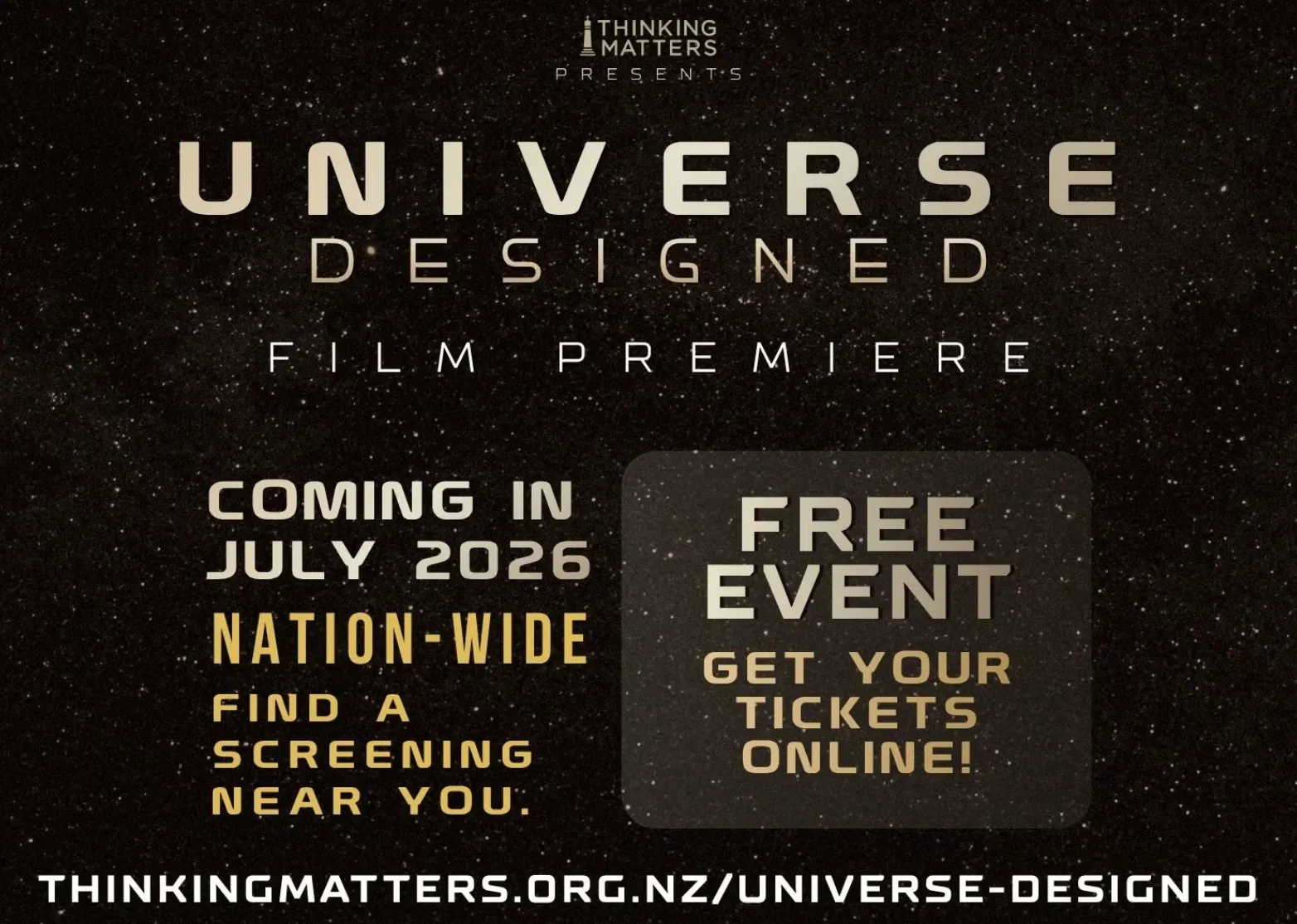
This nationwide “premiere” was being hosted by Thinking Matters, a New Zealand based Christian apologetics organisation which had found venues around the country - mostly churches - that had a projector and were willing to play the movie. Tickets were free, and there are still a few events that are running over the next week or so, so you may still be able to see the movie at a church close to you (although after reading my review, you may not want to do this!).
This event was a bit of a treat for me, as our local Wellington screening was in my suburb, Whitby. Before heading into North Porirua Baptist Church, we popped across the road into the New World and I grabbed some popcorn. I figured I was going to stand out like a sore thumb munching on caramel covered popcorn while sitting in a church watching a documentary about how the universe was made by god, but was pleasantly surprised to see that, amongst the audience, there were a couple of church youth groups that had turned up with movie snacks. Beyond those two groups of maybe 15 teens, there might have been another 20 to 30 audience members - what looked like a mixture of couples and families.

We grabbed what we thought were good seats, in the second row, but quickly regretted it as the small projector screen was so high that our necks started aching. There were three kids around 8-10 years old in the front row - I guess their necks were young and supple enough that they just didn’t care.
The movie was preceded by a short intro from the CEO of Thinking Matters, Rowan Locke, but it was uninteresting enough that I can’t remember anything that he said. Then there was an introduction by the film maker, Michael Ray Lewis, who talked about how he’d come to Jesus after he found out that his wife was considering returning to Christianity. In an interview with Mama Bear Apologetics he describes how before finding Jesus he was comfortable being an atheist, and that films like Zeitgeist (a conspiratorial documentary about religion being myth, how 9/11 was an inside job, and shadowy figures running the Federal Reserve bank in the US) shaped his beliefs. I can’t help but think that if this was his level of intellectual understanding and belief, he wasn’t doing a very good job of being skeptical - despite calling himself a skeptic at the time.
In the intro Michael went on to talk about how, before making the Universe Designed documentary, he made horror movies - although all I can see from IMDB are a few low-budget, low-rated movies where he was the cinematographer, most of which are just shorts. So, to go from that to directing, producing, writing in and appearing in a documentary that took three years to make is something of a testament to Michael’s dedication.
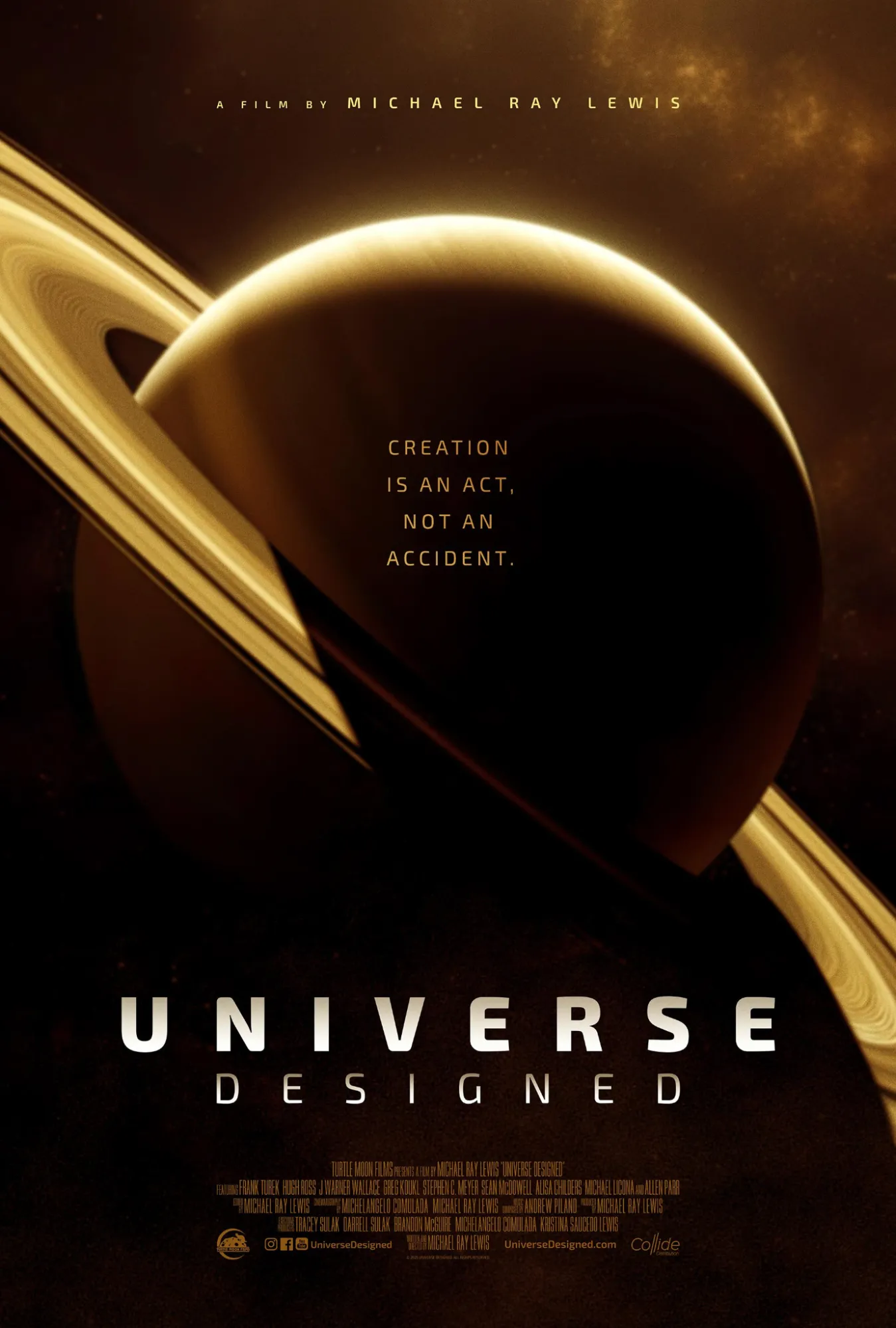
The first 10 minutes or so of the film were hard to object to. There was a lot of stock footage of the earth and computer-generated imagery of space - birds in flight, a forest, the ocean, Saturn’s rings, black holes, the galaxy - and a voiceover along with some talking heads, all espousing how huge the universe is, and how it’s important to ask for evidence before believing anything. I figured this could be the start of a simple, straightforward science lesson, the kind of thing you’d show to kids at school.
But the talking heads who were offering their opinions weren’t scientists - they were a mix of Christian apologists such as Frank Turek and Andy McDowell, CDesign proponentsists (I’m being facetious here, using a joke name for Intelligent Design proponents) like Hugh Ross and Stephen Meyer, and a couple of younger people who seemed to have been thrown in to make the documentary feel a little more relevant - a podcaster who runs the eponymous Alisa Childers Podcast, and a YouTuber called Allen Parr. Honestly, with the number of tired old Christian apologists that were wheeled out for this film, I wanted to cheer out loud when Stephen Meyer, the once shining star of the Discovery Institute, first appeared on the screen. I have a warm place in my heart for Stephen, even though he peddles pseudoscientific nonsense in order to promote his religious beliefs.
After about 10 minutes, the documentary moves to the argument from fine tuning - the idea that for many of the constants in physics, if you tinkered with them and changed them just a small amount, the universe would not have evolved in the way that it has - and that in most of those scenarios, galaxies and solar systems that have the potential to give rise to life would not occur. The logical conclusion, according to religious arguments, is that a God must have designed the universe. This is one possible scenario, but not the only one. The idea of random multiple universes would allow for many “failed” universes without life, along with some universes where the starting conditions are just right. Whatever the reasons, the anthropic principle tells us that we can only be here to observe a universe that has suitable conditions for life to arise - in any universe incapable of supporting life, there will be nobody there to ask the question about why they exist.
An argument is made that because our universe began to exist, it must have a cause - a creator. The documentary tells us that matter, energy, space and time (MEST) came about with the start of the universe, and that something needs to have created it all (Christians often call this the Kalam Cosmological Argument - which is interestingly an Arabic name from Islamic tradition, meaning speech). There’s a counter-argument that causality - something causing something else to exist - is nonsensical because causation requires a concept of time, and outside of the universe time doesn’t exist, as it’s a property of our universe. So something outside of our universe can’t “cause” it to exist, at least in the sense that we understand the word.
After arguing from physics, the film moved on to biology, and some of Intelligent Design’s arguments were briefly mentioned. The Cambrian Explosion, DNA, cellular machinery - all tired old arguments that have been dealt with over a decade ago. I was disappointed that there was nothing new in this section of the documentary, but not overly surprised. The Talk Origins archive is well worth perusing if you’re looking for answers to any tough questions posed by a creationist.
Sadly this is where the film took a turn for the worse. What followed this brief attempt to argue that science is too stupid to see that the fingerprints of a loving God are all over evolution, for the next 45 minutes or more, was a retreat to religion. First an attempt was made to explain how reliable the bible is - both from the perspective of it being a case of good record-keeping, with many manuscripts dating back to only 100 years or so after the death of Jesus, and from the perspective of the claims made in the bible being true. At this point J. Warner Wallace is brought into the film, to argue from a police perspective that the bible is about as reliable a piece of eyewitness testimony as you could hope for. I can’t remember whether J (apparently he decided that J. Warner stands out more than James as a name) or Frank Turek said that the bible is the most consistent, factual, error-free historical document to have ever existed, but I had trouble not scoffing out loud at this claim.
Following the hackneyed attempt to convince everyone that the bible is a uniquely trustworthy historical document, and that Jesus really did rise from the dead, the documentary descended into a boring, indulgent plea for everyone to accept Jesus as their saviour. This part consisted of emotionally rousing music, lots of stock footage of nature, and a voiceover that nearly put me to sleep.
There was nothing interesting in the second half - no fact claims for me to get my teeth into, nothing that made me want to pull out my phone and start doing background reading on. I nearly fell asleep a couple of times, and it was probably only the neck pain from straining to look up at the screen that kept me awake. Maybe it was because this was Friday evening, after a week of work, but I found it hard to focus on the words that were being said once the documentary stopped saying things that were falsifiable.
When the movie ended, we again saw the director and the CEO of Thinking Matters each plugging their own agendas. It was suggested that we should all go to video hosting site Vimeo and purchase a digital copy of the documentary that we could show to our friends and family. Given that we got to see the movie for free, I guess this is how the director is planning to make his money back - invite everyone to a free premiere at your local church, and then guilt them into buying a copy.
After the movie, the three of us skeptics quickly moved to the pub, where we had our obligatory debrief. We chatted about how disappointed we all were with the quality of the arguments in the documentary over a couple of drinks, and then headed home.
A couple of days later I figured I’d check out some reviews of the movie online. They were so gushingly positive that I had to check that the writers were, indeed, talking about the same movie I’d just watched, and not just another Christian documentary with the same name:
Only after nearly half an hour of scientific groundwork does Universe Designed begin gently introducing explicitly Christian ideas—a brilliant move
What I appreciated most was how methodical it was
the film presents a robust case for the trustworthiness of the New Testament
The documentary is incredibly well-made and well-directed
I highly recommend you watch and share this documentary
For me personally, the film moved me to tears
This movie reminded me of a previous documentary that tried to gain traction in New Zealand. In 2008, not long after I arrived in this country, the news media covered a story about Focus on the Family sending copies of the documentary The Privileged Planet to all New Zealand schools. Incensed about this, I emailed Focus on the Family and directly challenged them - something that, looking back now on the actions of me as a proto-skeptic, makes me cringe to re-read nearly two decades later. I emailed them saying:
As a new parent in New Zealand, I beg of you to stop sending Creationist/ID materials to public schools. If you believe that this material has some truth to it, please submit it first to the scientific community and/or the government. Once the hypothesis has been verified, the theory of Intelligent Design will then be integrated into the school curriculum. It seems a bit dishonest to sidestep public scrutiny and national guidelines by sending materials directly to schools.
Wayne Mulqueen, a seasoned kiwi, responded to my barbed email with a perfectly disarming and genuinely kind response:
Hi there Mark,
Thank you very much for your email and your opinion on this matter, we value your feedback and appreciate you point of view.
There is good reason to make the Privileged Planet material available to students. For the standard curriculum which is widely taught in NZ schools, there is plenty of time put aside to explain the Darwinist views of evolution and we applaud this. This suits many parents and so we agree that the material is essential.
If you saw the Sunday star times this weekend, you’ll have seen the poll they conducted on the question “Should ID be taught in school science classes?” 2560 votes (66%)were for and 1296 against (33%)
This suggests that there are a number of parents that think the ID position should also be explained.
Can I ask you, have you seen this DVD yourself? I’m guessing not.
After watching it, I think you’ll find that all of the observations made in the DVD are just standard cosmology framed with a slightly more hopeful perspective.
I’m very happy to send you a copy to view.
Kind regards
Wayne
I took Wayne up on his offer and, sure enough, he sent me a copy of the DVD, which I immediately ripped and added to my media collection - I’ve never been a big fan of physical media. When I watched the documentary there were no new arguments, but at least unlike Universe Designed it stuck to the science and didn’t try to guilt me into believing that I need “saving”- and it featured both non-religious scientists, such as Seth Shostak from SETI, and a voiceover from John Rhys-Davies (who played Gimli in Lord of the Rings). You can watch it online, although by now it’s starting to look pretty dated.
Tags: universe, documentary, movie, film, new, christian, argument