Making cents of charity: Famine as fundraising
Bronwyn Rideout - 20th July 2026
I’ve contemplated writing a series about charities and common fundraising practices since Christmas, when retrospectives and takedowns of Band Aid’s 1984 hit Do they know it’s Christmas? made their annual rounds. To be up front, I worked as a door-to-door fundraiser in Canada for several months while I waited for my visa application to return to New Zealand to be approved. It was a great job, and allowed me to work on behalf of global charities like World Wildlife Fund and Doctors without Borders. It also gave me insight into the pitfalls and controversies that exist in this field, and how charities and their audiences mutually struggle to adapt to each other’s evolving needs and interests. Practices for public engagement that seemed well-meaning in the 1970s continue, despite decades of criticism about child safety and questions about how much money actually reaches people and communities most in need.
Starve-Ins
For this newsletter, I will provide a brief lowdown on the popular experiential activity for teens: famine events, or Starve-Ins. Young people, often of high school age, get together and don’t eat for a period of 24 hours or more, save the odd sip of water/Just Juice, and the occasional barley sugar. The fundraising comes through individually getting sponsors, or collecting donations through group activities conducted over the course of the event, i.e. car washes. Other social and leisure activities occur throughout to keep participants awake and active, but, depending on the length of the event, participants can spend large portions of time sleeping. The best known, and possibly longest running, is World Vision’s 24 (UK)/30 (North America)/40 (Australia and NZ) hour famine, but the roots of this event can be traced, albeit distantly, to the political act of hunger strikes.
There are obvious differences between the 40-hour famine as it exists today and what Gandhi and the suffragettes sought to achieve with their political protests. But, in the 1960s, hunger strikes were given a hip new name, the Starve-In, borrowing from ‘Sit-in’, which is another form of non-violent direct action that was popular in the 1960s and 1970s.
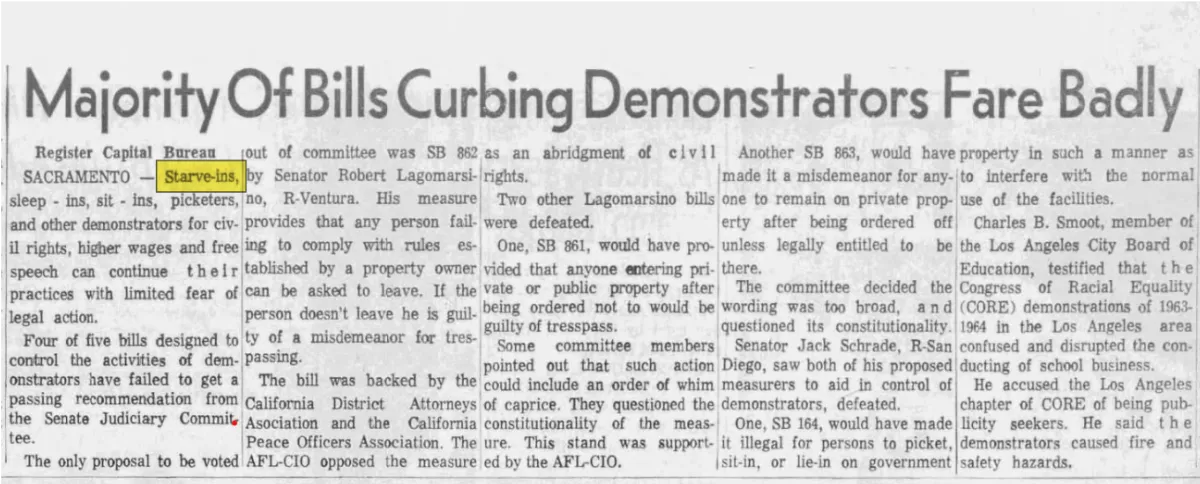
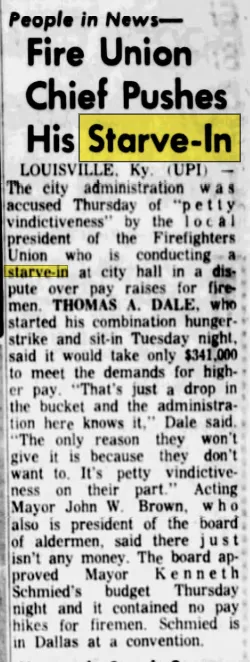
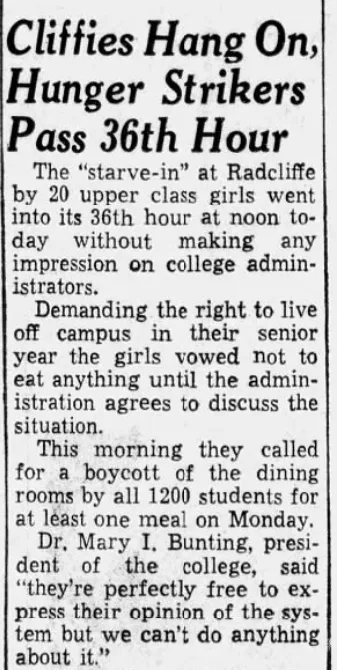
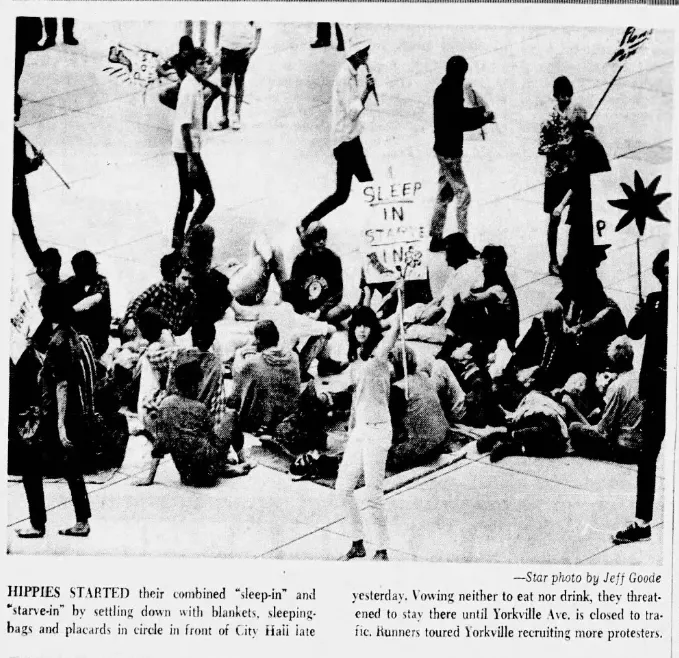
Starve-Ins were used during the civil rights movements by demonstrators in support of integration, by a fire chief trying to increase the wage of firemen in his city, by female tertiary students demanding to live off-campus in their senior year, and by hippies for various causes.
As far as I can gather, the first time it was recorded that students ‘starved’ themselves to fundraise for charity and experience hunger was in November 1966, when the students of St. Francis Xavier High School in Edmonton gave up their lunch money for Unicef.
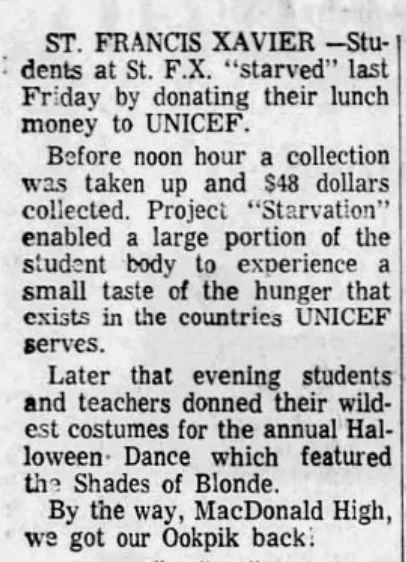
It is unclear whether ‘Project Starvation’ was an established campaign for Unicef, or a name they made up, but this wasn’t a one-off blip of youth interest in combatting world hunger and food insecurity. There was a daisy chain of UN initiatives in the 1960s that focused on youth mobilisation and long-term agricultural developments intended to empower those facing hunger. It started in 1960 when the United Nations Food and Agricultural Organisation started the international Freedom from Hunger Campaign (FFHC). The FAO followed this in 1965 with the Young World Mobilzation Appeal (YWMA), with the intent of facilitating youth involvement with the FFHC.
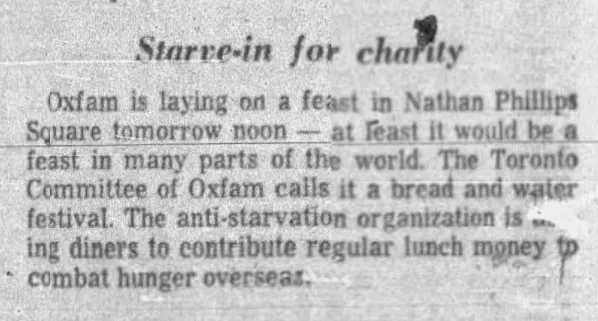
Oxfam was one of many humanitarian groups that partnered with the FFHC or YWMA as needed. In October 1967, it hosted an event that The Toronto Telegram called a starve-in, but what the organisation itself described as a bread and water festival:
The first recorded all-day starve-in by church going teenagers possibly occurred in Wymondham, UK in 1967. The youth group of the local Congregational Church, called the Rebels, hosted their starve-in to support Christian Aid’s Youth Against Hunger campaign in two ways: 1) by having members of the group fast for a day and 2) selling servings of soup and bread.
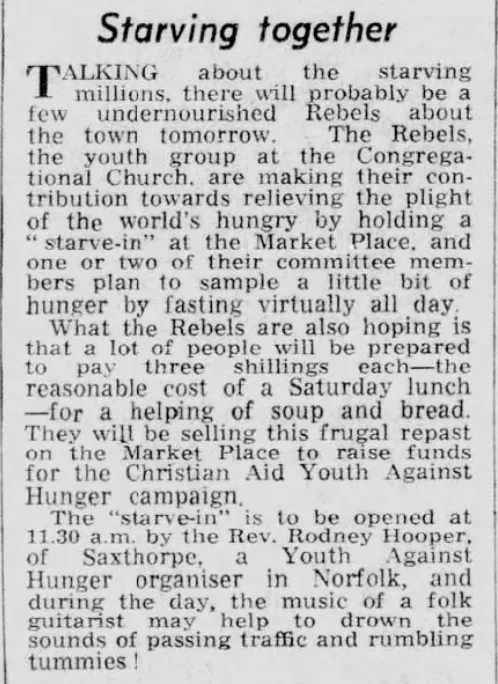
Youth Against Hunger (YAH) was not a sectarian initiative, but started as a 21-week UK-based campaign under the auspices of the FFHC and YWMA that morphed into its own project to drive youth involvement in overseas development through agriculture and other strategies. Christian Aid was just one of many groups that integrated YAH activities into their own campaigns, but it remains one of the few that continues to include a 24-hour fast as an act of solidarity and protest.
In New Zealand, the first mention of a starve-in was in 1970, when 19 students from Hawera High School survived 48-hours on water and 3 Jaycee milk biscuits each day.
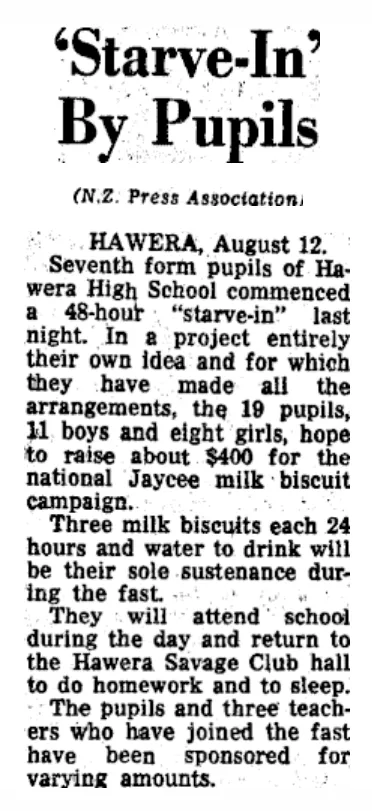
Source - Press, Volume CX, Issue 32375, 14 August 1970
New Zealand saw a boom in starve-ins through July of 1971, with the National Youth Council and CORSO engaging students from Christian youth groups and colleges across New Zealand to go 24 hours without food to support refugees from Pakistan. Although kudos to the high schoolers who went 70 hours without food to fundraise a Polynesian centre in Porirua East.
The Starve-In that would come to rule them all
However, the most famous starve-in was held in Calgary in February 1971. Ruth Roberts was a 17-year-old youth fellowship leader at her Baptist church, and was moved by images of starving children from Ethiopia. Roberts asked the other teens in the fellowship if they had ever felt hunger, and together they agreed to fast for 36 hours. Why Roberts decided to host a starve-in is pretty simple, “I decided I had to do something. I recruited my friends for what we called a “starve-in.” This was the era of protests like “love-ins” and “sit-ins” so for us to take action on an issue that was important to us seemed like a natural thing to do”.
While Roberts doesn’t outright claim that she invented starve-ins, the framing is unusual, because starve-ins/hunger strikes were used across North America. They were also deployed in high schools and youth organisations across Canada from 1968 to 1970, with particular popularity in Saskatchewan, often in connection with Unicef, YMCA, or other causes focused on international development. However, it is entirely likely that as a teenager, Roberts just wasn’t aware of these other activities.
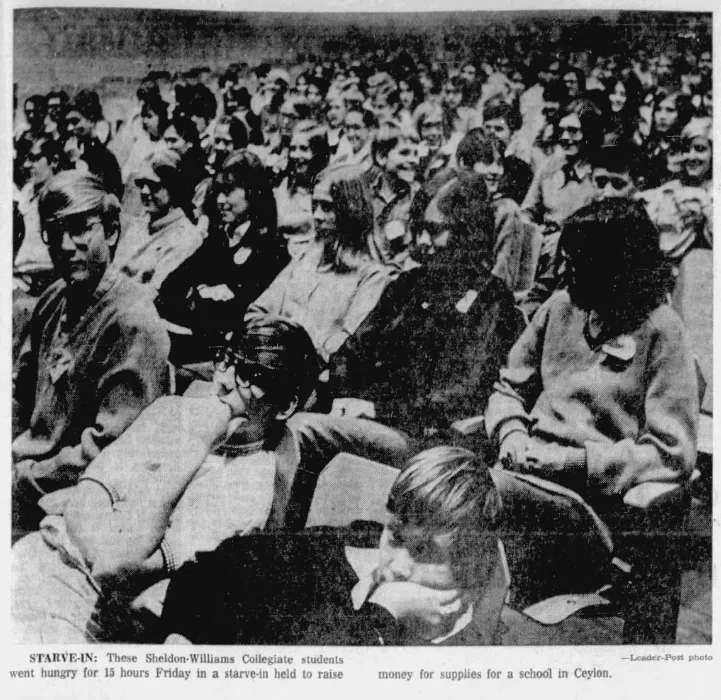
Source - The Leader-Post (Regina, Saskatchewan), Dec 06, 1969. This event was hosted by the Sheldon-Williams UNESCO.
Anyways, to distract themselves during the starve-in, Roberts and the other teens played volleyball, went for walks, and watched a film. Robert’s father helped the group collect sponsorship and, for their efforts, they collected $600 dollars, which is equivalent to $3,500 today. Once the money was collected, the youth then had to decide where to donate the funds. The decision to give the money to World Vision was made with the encouragement of their youth leaders, John and Grace Jarvis, who were sponsoring a child through World Vision. World Vision is an interdenominational (albeit very evangelical in its leanings) Christian humanitarian organisation. According to Ministry Watch, World Vision International is one of the largest relief and development organisations globally, with over $1.4 billion in revenue in 2025. It would be the Jarvis’ whom Roberts credited as pushing the idea to World Vision. The idea spread to Vancouver in 1972, when Rev. Ron Allen, then Western Canada representative for World Vision, led a similar event and raised $6,000 CAD, equivalent to $47,000 CAD today. $47,000 could go quite far in those days. As Jarvis explained, sponsors could commit to 10 cents or more for each hour, but it was ‘requested’ that participants secured $4/hour in sponsorships, or a total of $160, for a 40 hour fast, which is $1,047.72 CAD adjusting for inflation. $160 was sufficient to care for one child for a year, therefore in one weekend, Rev. Allen’s efforts enabled the sponsoring of 37.5 children.
From hereon in, World Vision would become synonymous with the planned-famine fundraising model worldwide, and would maintain the practice when it fell out of favour with groups like Oxfam and Unicef.
From Starve-ins to starv-a-thons to planned famines
Through the 1970s, under the direction of World Vision the event spread through Canada as a 40-hour planned famine, or starv-a-thon, under the name Project 17,200 Plus - because at the time, 17,200 children died of malnutrition every 40 hours. Participants who raised the full $160 had the choice of sponsoring a child or putting the money in to World Vision’s emergency fund. While the earliest use of the term starv-a-thon is in 1969, it appears to have fully replaced starve-in as the preferred descriptor for these events by World Vision and other groups by the mid-1970s, strengthening the connection to its fundraising purpose, ala walkathons, rather than activism. By 1974, the project name fell out of use as newspapers broadly introduced the event as a 40-hour famine. Then, for reasons I cannot uncover, from 1976 onwards the event would become better known as the 30-hour famine. Several other countries would come to follow this model, including Hong Kong (1984), Taiwan (1989), the US (1992), Malaysia (1997), and Singapore (mid-late 1990s)
In 1975, the 40-hour famine jumped the Pacific and the Tasman, with a pilot famine held in Victoria, Australia in July of that year, followed by the New Zealand event in August. Both the Australian and New Zealand organisers made much hay in the news about how safe it was to fast with water and a couple of barley sugars, but the most impressive achievement was the $571,000 AUD collected from the Victoria event, followed by $630,000 AUD in NSW in 1976. By 1988, Australia had significantly outpaced Canada when it came to fundraising, securing $5 million compared to Canada’s $300,000 in that year.
Two years after Band Aid, and 1 year after Live Aid, the first 24-hour famine was held in the UK, in 1986. It is unclear why they only fasted for 1 day. Several newspaper articles put emphasis on the safety of fasting for 24 hours, and the involvement of school children, not just high schoolers as was evident in the Canadian events. It’s possible that a different level of community and medical input was sought in the UK. The majority of starve-ins hosted after the Wymondham Rebels event in 1967 appear to have kept to the 24 hour timeframe, with longer events of 31, 36, or even 100 hours being less frequent and with fewer participants. Articles regarding these older events make no mention about physical safety, and the events also involved older teens, indicating that established starve-in practice also informed the duration of the event in the UK.
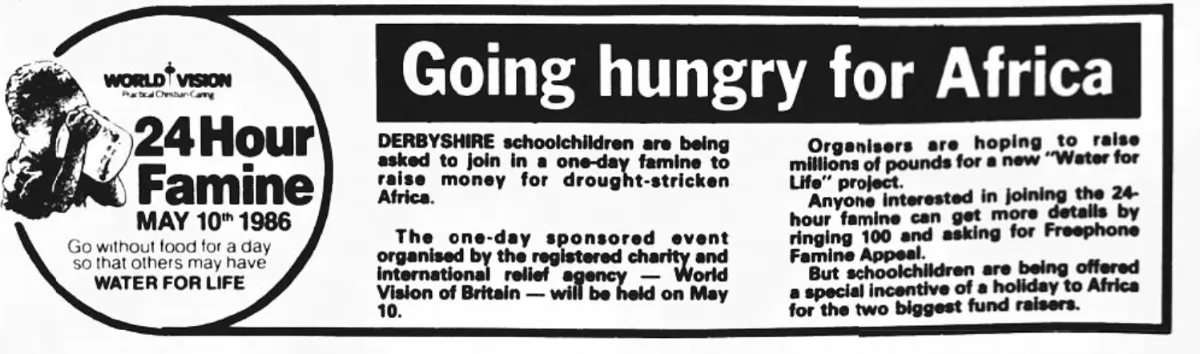
Source - Evening Telegraph (Derbyshire, England), Apr 07, 1986
Criticisms and adaptations
The major criticism of these famine events is that they were unhealthy. Initially, there were concerns about the impacts that acute fasting could have, which is evident in the persistent advertising response of World Vision back in the 70s and 80s that doctors thought fasting for 24-40 hours was okay. With time, this concern has evolved into worries about whether the event can cause or worsen disordered eating in the long-term. Many readers might be familiar with comedian Chris Lilley’s character Ja’mie King, antagonist of the shows We Could be Heroes and Summer Heights High, and how the character was used to skewer both child sponsorship and famine fundraising; some of you may remember the joke that she completed a 40-hour famine once a week, in part because it helped her look hot.
But, in 2014, the Vancouver Coastal Health authority issued a warning ahead of that year’s 30-hour famine advising students and teachers not to participate, citing increased risk of disordered eating and unhealthy body image. While self-denial of food is put at the fore of their promotions, since the late 2000s at the latest World Vision has supported people to choose something else to refrain from if fasting is not appropriate to them. Suggestions ranged from going without furniture and electronics to transport, etc; anything that would cause some discomfort or inconvenience in your life, while still being safe. By 2021 there was a major shift away from the various famine events across the Western World Vision branches. For Australia and New Zealand, it became the 40-hour challenge event. These countries have taken different approaches to this event, which has made it less of a cohesive event than its predecessor. In 2025, World Vision Australia not only supported those who were abstaining for 40 hours, but one could also perform 40 acts of kindness, or spend 40 hours outdoors. One teen decided to flex on everyone with his mad piloting skills:

Source - Facebook
Far be it from me to dunk on a minor, but I hope the cost vs. donations ratio was high enough to justify the plane rental over just giving the money straight to World Vision. In 2026, World Vision in New Zealand decided that the activity was going offline, whereas Australia allowed youth and organisations to have more freedom to choose their challenges. While a self-organised 40-hour famine was still possible under the new programme, the suggestions were heavily biased away from food-based challenges.
The US branch retired the 30-hour famine, and has not replaced it with a similar event, instead favouring other activities such as the 6K walk for water. The 6K walk is not quite a walk-a-thon, but has much more in common with organised walks popular in the late 2000s that were in solidarity with Ugandan night commuters, children displaced by war, and avoiding abduction by the Lord’s Resistance Army; Gulu Walk and Invisible Children were the best known, if not the only, organisers of such walks, but neither group exists today. World Vision UK makes no mention of either the famine or the challenge. World Vision Canada, and some of the branches in Asia, continue to support the 30-hour famine, albeit with less fanfare than in the past.
A second, but less frequently explored, criticism of famine models is that they overfocus on mobilising the public, while avoiding more complex and confronting conversations about the socio-political causes of malnutrition that can implicate the very systems the young would-be benefactors benefit from. It is a discussion that is addressed loudly, and with more complexity as it pertains to child sponsorship, but in this anonymous missive archived by the South African Digital Initiative still retains a fair amount of its relevance today as it did in 1981:
“It is unemployment, landlessness, economic exploitation backed by political repression, the bantustan policy and migrant labour that are the major strands in the web of poverty and social disruption that are finally responsible for hunger and starvation. World Vision is doing nothing about these problems, and yet claims, through its 40 hour famine to be trying to wipe out malnutrition… The second flaw in the World Vision campaign is the attitude that it helps to create…the sticker reads: “I have starved so others won’t”. There are a number of problems with slogans like this…”
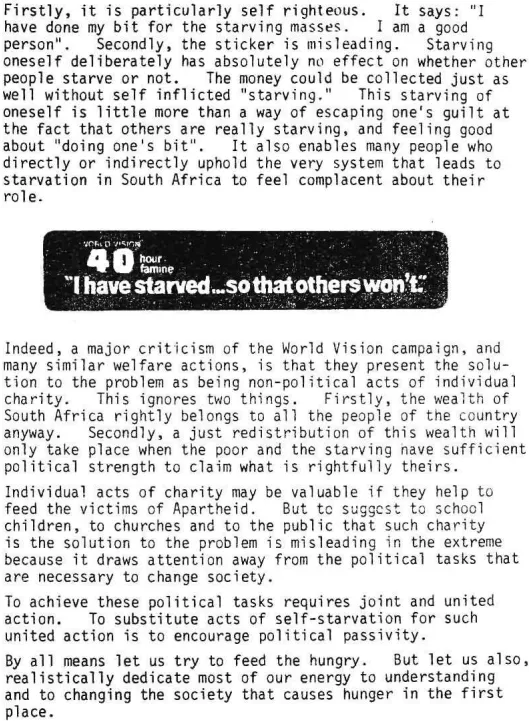
Source - South African History Archives
Final Thoughts
Looking at the reported donations made to World Vision through the famine events, it is worth considering, as the South African commentator above identified, what the value of the famine events were - is it money or mobilisation.
If the expectation was that the famine events eventually converted the young fundraisers into generous donors over the coming decades, then someone’s math was way off. The new 40-hour challenge suffers from a visibility problem. Back in the heyday of music television and youth television of the 1990s, there was always a huge advertising campaign with a long lead-in to the 30-hour famine; in Canada, pop singer Tom Cochrane was a common fixture. Now, my social media algorithm only sent me one advert for the 40-hour challenge despite my intense search history over the past several weeks. It appears I may not be the only one who was wondering what had happened to what was once a rite of passage for many teens, Christian and secular alike. Several Reddit threads are available where people are nostalgic for barley sugar lollies while also illuminating the growing cynicism over the ideology of World Vision and its dispersal of donations. Nor did anyone have fond memories of going door-to-door seeking sponsors, a practice that has largely disappeared due to online banking. In its weird way, the shared misery of starving for 30-40 hours draws a measure of commiseration that the more diffuse and more individualised ‘challenge’ lacks.
Over the lifetime of the various famine events, Australia donated over $200 million, the US and Canada branches each raised around $190 million, and New Zealanders contributed $80 million over 50 years. However, these are just blips on the radar compared to the $1.4 billion in revenue that World Vision garners each year. But, the counterargument can be made that as an annual event that is largely driven by volunteers, the revenue for the charity is relatively quite high. Still, the famine events have already faded away without replacement in the UK and US to no fanfare, while the rebrand down under has similarly gone unnoticed by the very demographic who should be targeted for donations. It will be interesting to see if the 40-hour challenge or the original 30-hour challenge in Canada can make it to their respective 60th anniversaries through the 2030s.