Majorana 2: A new state of matter?
Mark Honeychurch - 22nd June 2026
Last year I wrote about Majorana, a quantum computing chip created by Microsoft. Back then the company claimed that they had discovered/invented a new state of matter, the topological superconductor, which exists at near-zero temperatures and allows their chips to work more reliably than other quantum computer designs.
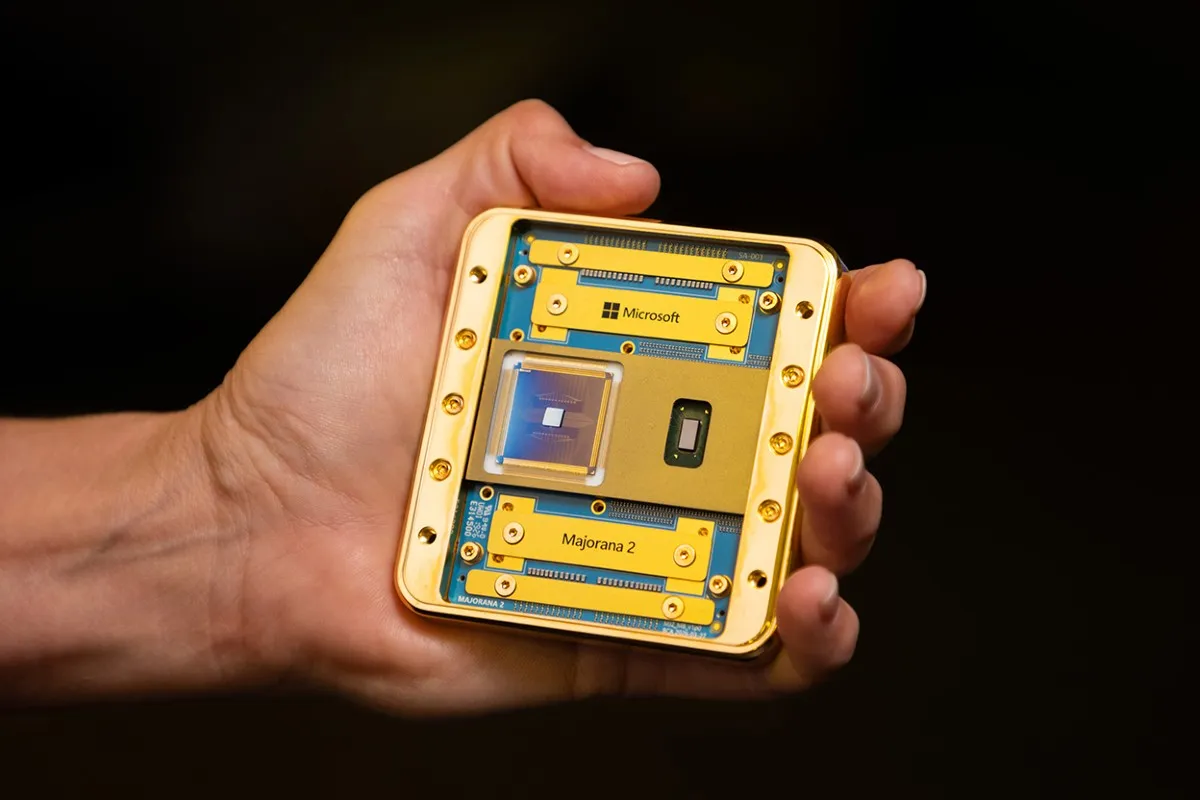
A new video from Microsoft announces that the new improved Majorana 2 has now been created, with its qubits 1000 times more reliable than the Majorana 1 - an average qubit lifetime now of 20 seconds. They’ve done this by swapping out the aluminium superconductor for lead, and using indium arsenide and indium arsenide antimonide as the semiconductor layer, and these changes were facilitated by using AI to help choose the new materials.
Let’s see if I can explain how this chip is purported to work… When chilled to near absolute zero, with electrons shoved into both the semiconductor and the superconductor wires (which are very close to each other), the superconductor electrons pair up into Cooper Pairs. Because of the Proximity Effect, the electrons in the nearby semiconductor wire also pair up. Then a precisely controlled magnetic field is applied to the electrons, forcing them into this new, theorised, topological phase. In this phase, the electrons are kind of split into half, with one half at each end of the wires. Two of these wire setups, joined by a cross bar, create a qubit. And this spreading of the quantum state between two ends of two tiny wires is what is meant to make the qubit resistant to stray photons and other disturbances accidentally flipping the bit’s value and ruining the computation. If this has confused you in any way, don’t worry, you’re not alone! I too am not entirely sure I understand what’s going on here, but this video may help to explain things:
This new version of the chip has a 50% increase in qubits, from 8 to 12. Microsoft expects to be able to increase this to a much more useful 1,000 qubits by 2029, which sounds like a very optimistic timeframe to me, especially given that, like with the Majorana 1, Microsoft still hasn’t been able to prove that they’re reaching a quantum state at all!
One of the issues is that Microsoft, like other quantum computing companies before it, is keeping things very close to its chest. So there’s limited information for academics to go on, and sadly this includes a lack of sufficient data to work out whether what’s being measured is quantum or just other, more mundane electronic effects that are being measured.
Henry Legg from the University of St Andrews has been concerned that Microsoft has only supplied some of the data needed to evaluate whether this chip actually works. Science News quotes him as saying about the new chip “Nothing in the presented data proves the existence of a topological qubit or Majoranas in these devices”.
Microsoft says that it will release more data over time, and I can’t help but think that the company has to have enough data internally that makes it confident the chip is doing what they think it’s doing, but there’s always the chance that these engineers have fooled themselves into believing that they’ve created something they haven’t. I wonder if it won’t be until Microsoft considers itself far enough ahead of the competition that it’ll be difficult for a rival company to recreate their chip designs before they allow more rigorous examination by independent academics.
DARPA, the American Defense Advanced Research Projects Agency, is already involved and is allowed to see more data than the public is being shown. This third party validation increases the likelihood that the chip is really working as intended, although having said that DARPA has been fooled into investing in bad ideas in the past - including partial funding of the Stargate psychic warfare program, participation in the Hafnium Controversy, a failed plan to make a “mechanical elephant”, and their horribly unethical idea of the FutureMap.
I guess I’ll be back with another article in a year or so, when Microsoft unveils the Majorana 3 chip with another flashy video and numbers that are bigger than 12 qubits and 20 seconds, asking once again if they have found a new state of matter. And maybe at some point they’ll allow academics to properly validate their work, so that I can finally be excited about their advances rather than just skeptical.