Good News for Climate?
Patrick Medlicott - 22nd June 2026
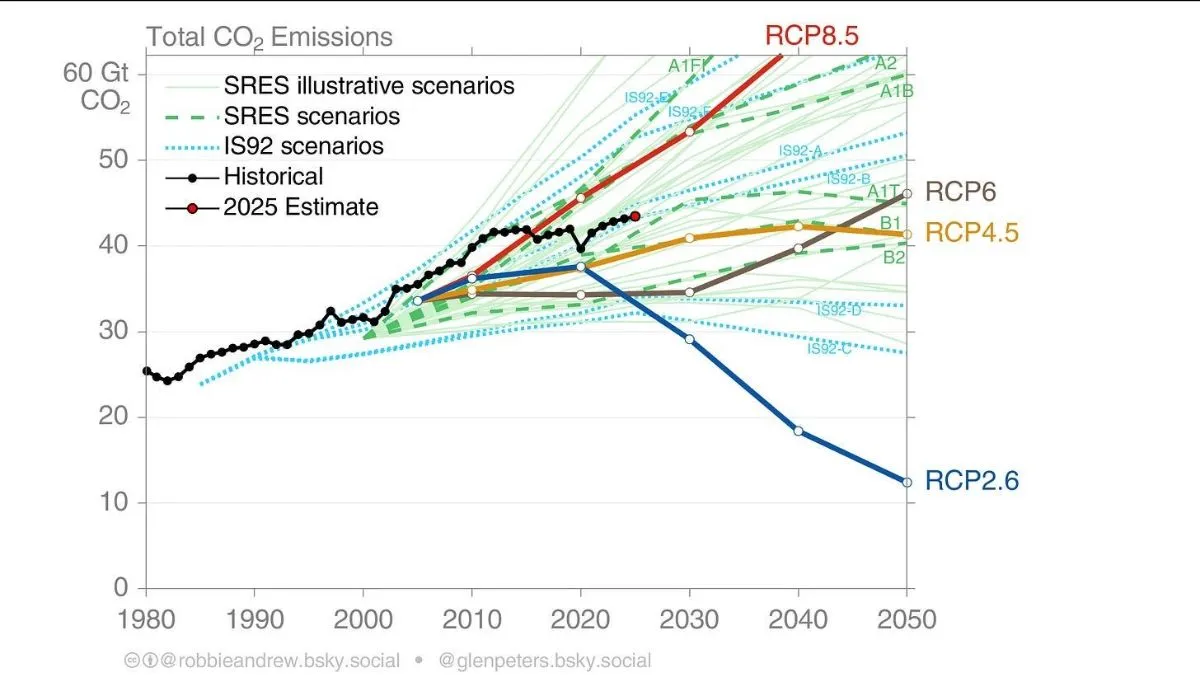
On The Death of RCP 8.5 (RCP = Representative Concentration Pathway of CO2) This was reported on by Zeke Hausfather et al, 19/5/26 at The Climate Brink.
The emissions scenarios that will be used in the upcoming IPCC seventh assessment report suggest that the worst scenario, that of 8.5 C warming, will now be retired. Many people including the President of the United States have lauded this, and said that the United Nations was just plain wrong.
However, like most pronouncements from the President of the United States, the truth is significantly more nuanced. Removing this pathway does mean that there has been some success. The original pathway was made and modelled to include the world continuing to use the amount of coal and other fossil fuels that it was previously. This is not happening, as renewables are beginning to replace fossil fuels worldwide. Other people have pointed out that RCP 8.5 was never particularly plausible.
Zeke Hausfather says that RCP 8.5 was always intended to represent a worst-case scenario that pushed fossil fuel expansions to the max.
So, what has replaced RCP 8.5 as the worst-case scenario in 2026? I quote Zeke Housefather:
“Our business-as-usual projection of 3C of warming rather than 4 or 5C is a testament to the progress in global decarbonisation over the last few decades. It also reflects the fact that rapid growth in coal use during the 2000s was not necessarily characteristic of longer-term energy use trends. The world has taken concrete steps to move away from coal in the past decade, and this progress should be reflected in our assessments of likely emissions pathways and their resulting climate impacts going forward.”
“So, if we were likely never heading for a world of RCP 8.5, with its tripling of global CO2 emissions by 2100 (and fivefold increase in coal use), where are we actually headed? How much has energy transition to date (which has grown to over $2 trillion annual global spending) actually changed our future trajectories?”
This can only be estimated. The worst case now is possibly around 3.5 C warming by 2100. (This can be significantly improved if renewable energy replaces fossil fuels).
Zeke Hausfather then gives an example of what is happening concerning solar energy. He notes that research and development of these was done by Bell laboratories in the United States in the 1950s and the United States Department of energy in the 1970s to help develop and commercialise the technology, with further subsidies in Germany and Japan helping to drive down the costs with larger scale deployments in the 1990s and 2000s. Since that time dramatic cost declines have been driven at least in part by enormous investments in domestic and export markets by China. What will drive what happens to future emissions depends on the sensitivity of the climate to increasing forcing, and the carbon cycle feedback that will determine how much of the emissions remain in the atmosphere. The median estimated change is 2.8C for 2100. The future emissions are in society’s hands.
To quote Zeke Hausfather, “the brutal math of climate change is this: as long as CO2 emissions remain above zero, the world will continue to warm.”
Other climate news in the Guardian is not positive.
There is an immense marine heat wave off the United States’ West Coast, as reported in the Guardian today. This is likely to be compounded with a new El Niño. This heat wave stretches thousands of miles from the California coastline to halfway across the Pacific. This affects oceanic habitats from Hawaii to British Columbia, and southward to Mexico.
The effects of this may be far-reaching, and could influence everything from record-breaking temperatures on land to disrupted marine food chains. Ocean temperatures have recently soared to a level warmer than typically seen during peak hurricane season. Abnormally warm Pacific waters tend to retain atmospheric heat from the warmer summer months, and rerelease it during the relatively colder winter months, significantly altering weather patterns. It mentions that more than one third of United States weather stations have set all-time temperature records for March.
Mortality of birdlife and animals dependent on marine life may occur. This is likely to be a big hit on fisheries for at least a couple of years. Species may be shifting their behaviours, and a great white shark has been reported in British Columbia waters. The bottom of the food chain, krill, if impacted will of course worsen this problem.
Also reported in the Guardian today is that the General Assembly of the United Nations voted overwhelmingly in favour of a climate crisis ruling brought by Vanuatu.
The resolution, co-sponsored by 90 countries, urges states to transition away from fossil fuels “in a just, orderly and equitable manner to reach net zero by 2050.”
Unfortunately, the fossil fuel producing states and the United States did not join in the resolution, and the United Nations is being increasingly sidelined by the oligarch dictators in Russia, China and the United States.
The resolution reinforced that states, including our own, have a responsibility to prevent the worst consequences of climate change. Virtually all the present New Zealand government has done is to prevent emitters from being responsible for the downstream effects of their omissions. Law has been brought in in New Zealand, under urgency, to prevent citizens and their representatives taking companies to court to prevent further climate change emissions, and parliament is supposed to do this. For the last three years parliament in New Zealand, in my opinion, has done absolutely nothing except remove accountability for the effects of climate change and its mitigation.