Kessler Syndrome
Katrina Borthwick - 8th June 2026
Are we going to get trapped on earth by a swarm of colliding space debris?
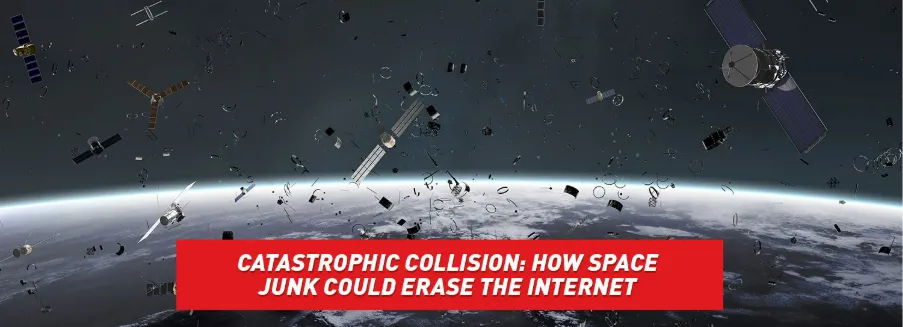
This thought occurred to me as I read First Ascent, a sci-fi book by Douglas Phillips about a space elevator where an out-of-control chain of satellite collisions has led to Kessler Syndrome - sometimes called an ablation cascade or collisional cascading. This led to a swarm of space debris in low earth orbit so dense that collisions were increasing exponentially and making any kind of spaceflight impossible. The possibility of Kessler Syndrome happening in real life is something that is worrying scientists and those reliant on space operations, including satellites. Although, curiously, in the sci-fi book the satellites are still working… hmmm.
The Conspiracy theories
It turns out there are a bunch of conspiracy theories surrounding this topic. One of those claims is that Kessler syndrome is just a made up risk to justify the militarisation of space through measures such as anti-satellite weapons programmes, orbital traffic control, increasing surveillance and restrictions of private space activity. Another conspiracy theory claims that a Kessler event has already happened, and major governments know that certain orbits are already unusable but are hiding the truth. They claim launches are already being covertly restricted and there have been hundreds of undisclosed satellite losses and collisions that we aren’t seeing because the tracking databases have been tampered with. However, this doesn’t really pan out, as there are so many amateur astronomers, universities and companies independently tracking objects in orbit, it would be extremely hard to conceal a kessler event.
Another conspiracy theory is that there is a group or nation that wants to intentionally create Kessler Syndrome. Perhaps to deny space access to rivals, create havoc with global communications, or disrupt technology so that an authoritarian power can seize control. The reality is that such a strategy would damage everyone, not just the organisation trying to seek control. A similar theory often referred to as the ‘Orbital Great Reset’ came about after the launch of various constellations of satellites, and this theory says that the reset is part of an effort to create a planned orbital catastrophe to disable the internet and GPS, triggering economic chaos and forcing the adoption of centralised technologies. Related to all of these is an internet myth called ‘Project Starfall’ which varies a bit with each telling, but in broad terms talks about secret satellites being positioned to start chain reactions (you can’t avoid it if you don’t know it’s there), classified debris-removal systems that are actually weapons, and governments secretly holding technology capable of clearing orbits - but refusing to use it. This one just seems to be viral internet whispers, and there is zero evidence of any programme resembling ‘Project Starfall’.
But no space conspiracy theory repertoire would be complete without a UFO cover up. There are claims that UFOs are being described as ‘orbital debris’ to conceal their existence, and that the same explanation is being used to hide secret alien activity and classified aerospace programmes. I have to admit that would be way more interesting than space trash, but sadly there is no evidence of alien activity.
And there’s a newcomer to the conspiracy theory list, artificial intelligence (AI). This is similar to the other theories around deliberate debris creation, only this time AI is doing it in an effort to lock humanity out of space as a sort of self-preservation effort. I’m not sure I follow the logic on that, but it sounds like a debate that could be had at our next ‘skeptics in the pub’ event.
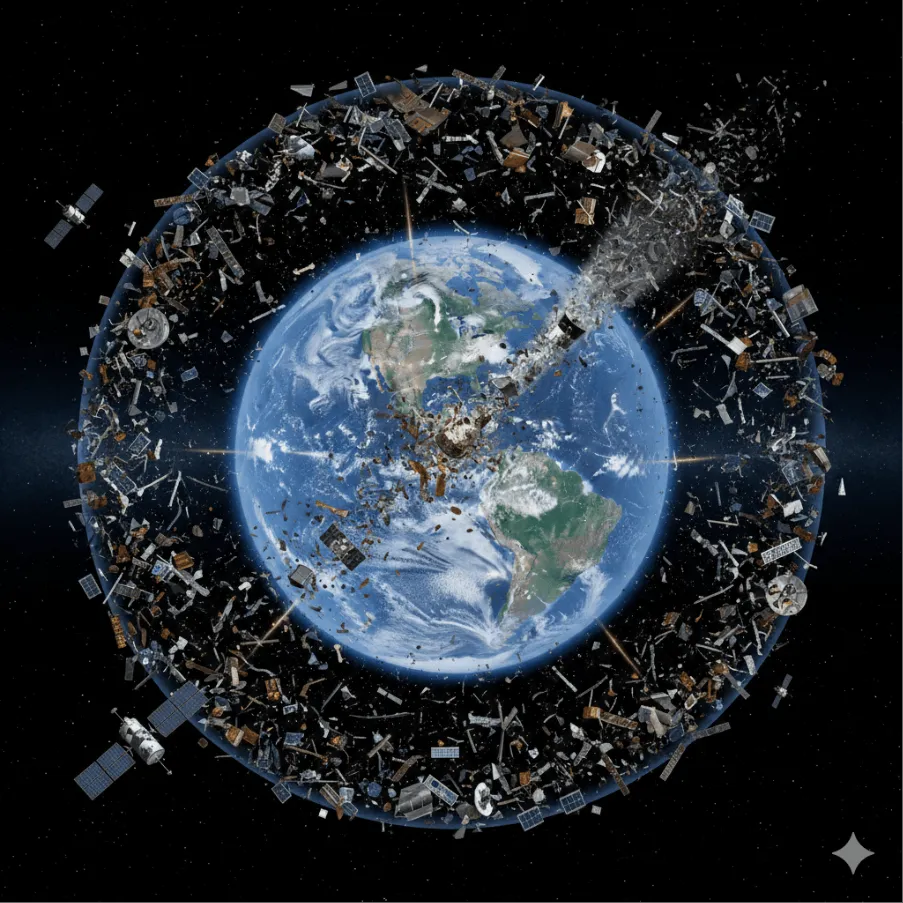
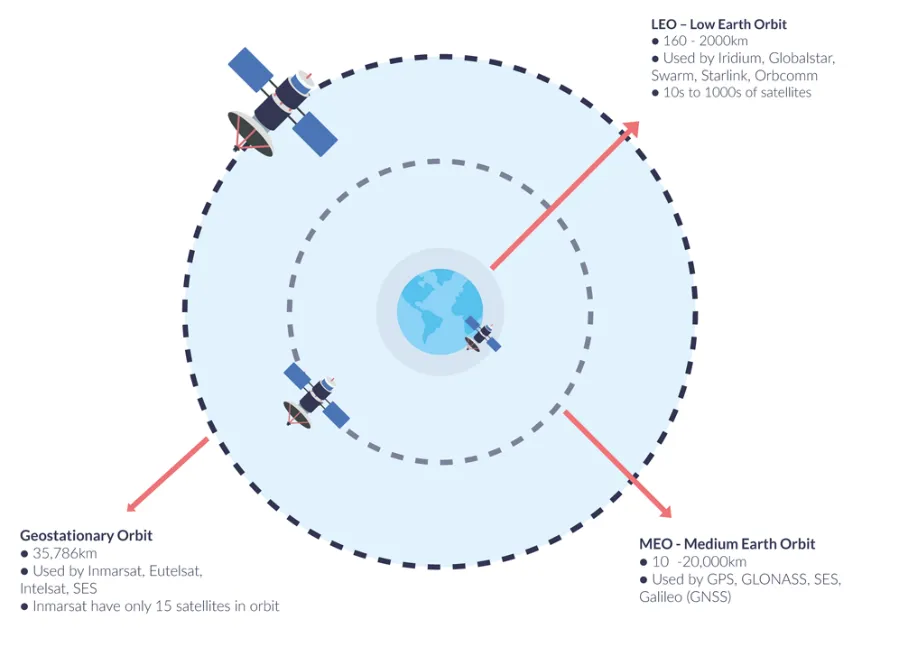
Another idea, which is more of an extreme theory than conspiracy theory, is that we could get trapped by some sort of continuous artificial shell around earth made of junk. However this is not supported by physics and orbital mechanics. Orbital debris is spread over different orbits at different heights, moving at different speeds, so a solid barrier is not a possibility - even with severe debris.
I think that Kessler Syndrome is a magnet for conspiracy theorists because satellites in orbit are not directly observable to most of us, most people lack the specialised expertise to understand it, and the reality is that governments do operate classified space programmes. But this is a case of reality not needing augmentation. The scientific debate is dramatic enough already.
The science-based debate
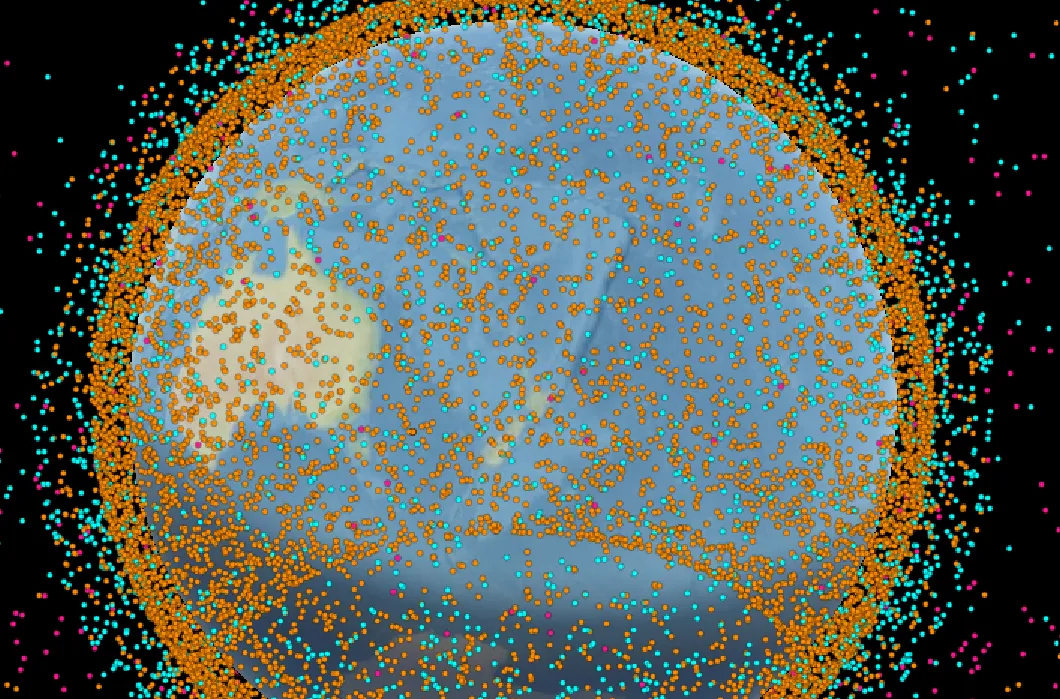
There is some really good data out there, including extensive real-time mapping of objects in orbit. The Astria Graph, for example, shows all the objects in orbit, mapped and colour-coded for how close they are. There is an option to view the map where objects within 6 km of each other show as red.
A 2025 study used decades of observations of rocket remnants in geostationary transfer orbits to work out how debris is generated over long periods. Another study that took place over 2025 and 2026 looked at how Very Low Earth Orbit (VLEO) satellites could reduce debris accumulation, as the atmospheric drag is causing these satellites to deorbit. There are also ongoing studies looking to mathematically model launch rates, satellite lifetimes, disposal success rates and debris removal rates to see what conditions lead to collision cascades. Several recent analyses have examined how rapidly collision risk increases in mega-constellation environments. A widely discussed 2025-2026 study introduced the “CRASH Clock” concept, estimating how quickly a major collision might occur if satellites lost maneuvering capability. ‘CRASH’ stands for Collision Realization and Significant Harm Clock, and is a metric developed by space researchers to quantify orbital congestion and the risk of Kessler Syndrome.
There is some 2026 research modelling debris growth in the 500-600 km Low Earth Orbit (LEO) trying to quantify how much debris needs to be removed each year to prevent collision cascades becoming self-sustaining. It suggests removing 60 objects per year would be enough. There is also another 2026 study arguing that different orbits have different risk profiles, and debris removal and tracking services may need to be treated and funded separately. A 2025 study developed better methods for deciding which objects need to be removed as a priority, using simulations - size and mass being a big factor in this decision-making.
In terms of removal technology, researchers have proposed contactless removal systems might be best, as they do not require tricky docking with tumbling objects. Techniques such as plasma thrusters to move the debris are frequently proposed.
Where the debate lands
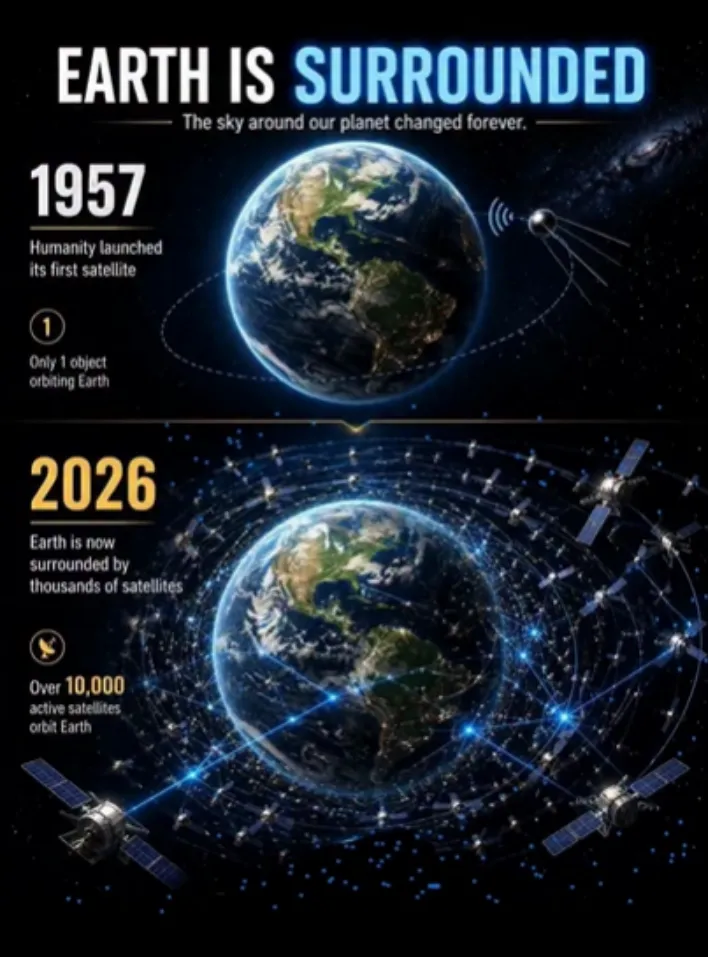
Nearly everyone studying the science of orbital debris, or involved in monitoring, agrees that collision cascades can occur under the right (wrong) conditions. The debate is mainly about timescale, severity, location and reversibility. What is becoming clear is that preventing debris may not be enough, and many models suggest that active removal may be needed. Mega constellations of satellites are changing the risk landscape. Tracking accuracy is becoming very important, and there are increasing concerns about reentering debris.
The scientists who believe we are close approaching a Kessler Syndrome scenario point to the significant increase in active satellites since 2018, and the increasing, now routine, demand on collision avoidance operations. They are concerned that a major failure of satellite maneuverability from an event such as a solar storm or large-scale software outage could trigger multiple collisions in a short period. Supporters of this view often point to European Space Agency modeling showing that even if launches stopped entirely, some orbital regions would continue generating debris through collisions faster than natural decay removes it.
Other scientists are less worried about an imminent satellite apocalypse, saying that the threat is exaggerated by the media. They are of the view that most of the Low Earth Orbit (LEO) is not close to a cascade, and atmospheric drag means that lower altitude objects fall back to earth and are cleared. They say there are just a few altitude zones at risk. They suggest the operational risk is getting worse, but this is a much slower process occurring over decades, and there is no risk of an immediate loss of access to space.
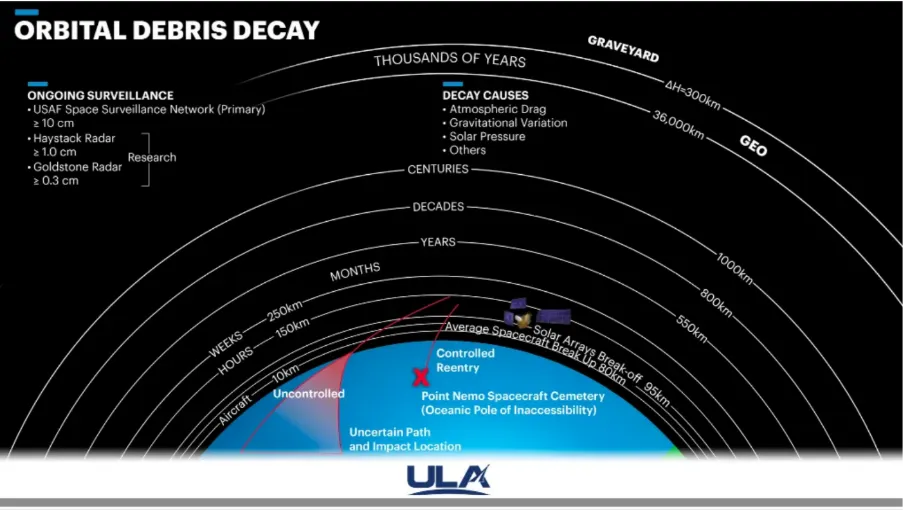
Increasingly, researchers are converging on a third position - that although we aren’t nearing a doomsday event, we are getting a traffic problem that is becoming a major engineering and governance challenge. It has been described as a modern-day example of the ‘tragedy of the commons’. It is unclear who will take responsibility for cleaning up debris, given this is both everybody’s and nobody’s problem. Some sort of cooperation or shared rules will be needed, and putting stuff in space is set to become more risky and costly over time.
What is being done to avoid it?
Reading the ESA Space Environment Report 2025, I can see there is a bit of activity going on to try to address the space congestion problem. Space agencies and satellite operators are trying to stop new debris from being created, remove some of the worst existing debris, and improve traffic control in orbit.
Active debris removal missions are being developed. The most famous example is ClearSpace’s ClearSpace-1 mission, supported by ESA. The idea is to rendezvous with a dead satellite, grab it using robotic mechanisms, and push it into Earth’s atmosphere where it burns up. Other concepts include robotic arms, nets, harpoons, magnetic docking systems and tugs to drag away dead satellites. This would all be at great cost - perhaps tens or hundreds of millions of dollars for a single object.
Satellites are also being designed to leave orbit faster. Historically, operators often followed a ‘25-year rule’, where a satellite could remain in orbit for up to 25 years after retirement. The European Space Agency has moved toward a 5-year post-mission disposal target for many LEO missions. Satellites are increasingly being required to deorbit themselves at end of life, move to a designated ‘graveyard orbit’, carry enough fuel for disposal maneuvers, and include hardware that makes later removal easier if they fail.
Space traffic management is becoming much more sophisticated. Operators now constantly track conjunctions (close approaches). Large constellations such as SpaceX’s Starlink routinely perform thousands of collision-avoidance maneuvers, and modern satellites increasingly automate these decisions. Researchers are also developing better tracking systems and AI-assisted orbital prediction tools. This is fast becoming the equivalent of setting up air-traffic control for orbit.
Engineers are also trying to prevent satellites from exploding. A surprising amount of debris comes not from collisions, but from spacecraft breaking apart. Modern spacecraft are increasingly made safe from explosions at end of life by venting remaining fuel, discharging batteries, and depressurising tanks. Researchers are also attempting to identify the most dangerous objects in orbit, as not all debris is equally risky. As stated previously, mass and size are important factors, as is the potential for explosion.
Although there is no global space policing body, new international rules are emerging such as the EU Space Act. These include licensing requirements, debris mitigation guidelines, sustainability regulations and industry ratings and certification. The goal is to make responsible disposal a requirement rather than a voluntary best practice.
So where does this leave us?
Many experts think that mitigation alone is no longer enough. The current debate is not whether we should stop creating new debris - that’s widely accepted. The debate is whether active removal of existing large debris has become necessary to prevent long-term instability in some orbital regions. ESA’s recent assessments explicitly argue that preventing new debris alone will not stop the risk of a runaway collision environment, even if this may be somewhat slower than what doomsdayers predict.
So, the strategy today is increasingly to prevent new debris and remove some existing debris, plus also improve orbital traffic management. Most researchers see all three as necessary if LEO is going to remain usable over the coming decades.