Degrowth is exactly the wrong solution to Climate Change
James Kerr - 8th June 2026
Climate change is real, substantively human-caused and represents a serious problem that humanity needs to put real effort into solving. I believe this, not because I have “done my own research”, nor because it fits my ideology, but because the consensus of experts (in this case, climatologists) have concluded that it is true, and a good sceptic must follow the evidence where it leads.
As such, I am not here today to debate the question of whether Anthropogenic Climate Change is real, but rather what we should be doing about it. And that brings me to Patrick Medlicott’s recent article about the book Less is More, and the philosophy of degrowth.
In my expert opinion (as an economist who has studied environmental economics at a postgraduate level), Degrowth as a philosophy is a pseudo-economic belief that relies on fundamental misconceptions of how economic growth works, and how economists approach the topic.
In particular, there are three claims Medlicott made that I wish to refute:
- That future economic growth must be sharply limited: “there cannot be infinite growth on a finite earth”
- That degrowth is the best means of combating the environmental problems we currently face (climate change in particular)
- That economists reject the above due to an ideological commitment to endless growth.
What do economists believe about growth?
Economists define economic growth as an increase in Gross Domestic Product, a core economic statistic that is designed to measure the economic value of the goods and services produced by a country over a period of time. This will then usually be adjusted for inflation to produce real (as opposed to nominal) growth. Since Medlicott’s criticism is of economists, and how we think of growth, it makes sense for us to use that definition for this argument.
It is flatly untrue that economists have an ideological or methodological commitment to infinite growth.
- Only macroeconomists concern themselves with economic growth or GDP at all. Microeconomists primarily focus on how efficiently the economy converts production into subjective wellbeing, using measures entirely unrelated to the overall size of the economy.
- Even macroeconomists do not assume perpetual growth - most of macroeconomics is about analysing the past, not forecasting the future.
- While macroeconomic forecasts do (generally speaking) predict growth happening in the future, this reflects a short-term prediction that makes sense given recent history. Economists seldom try to predict the future state of the economy past 6-7 years in the future, as the uncertainties grow so large that prediction becomes too hard.
Now it is true that economists will say that higher GDP is generally a good thing. That’s because higher GDP generally means more goods and services for people, which makes them better off - not only by letting people have more of what they want, but also by making it possible for governments to fund more public services and welfare initiatives. As any first-year economics student can tell you, economic growth isn’t the only thing that matters, and not all growth leads to better wellbeing - but any approach to improving human wellbeing benefits from economic growth being higher rather than lower.
Could we grow forever?
One of the traps that even intelligent people can fall into, when considering a phenomenon outside their expertise, is that they take concepts that are familiar to them and misapply them to new problems because they don’t understand the full context of the new field. A lot of degrowthers are biologists or ecologists, and I think this is the source of some of the confusion. It makes sense to think of the number of organisms a biome can sustain as a fixed number, thereby making the idea of perpetual growth seem ludicrous.
But this does not apply to economic growth, for several reasons:
- GDP isn’t measured in tonnes of physical material, but rather in dollars, and those dollars represent the subjective value the purchasers place on the goods and services they are buying. If we figure out how to rearrange the material we already have in a way that people value more, then we raise GDP without raising resource consumption.
- We also invent new resources fairly regularly. Crude oil used to be a nuisance that ruined land by contaminating the water table, but (until we make it obsolete) it is a hugely valuable resource. Solar panels and wind turbines are a good example of how this doesn’t necessarily come at the cost of the environment.
- Finally, even if economic growth proved to be limited, the existence of limits does not imply we are near them. The world is no less finite than it was 300 years ago, and yet the Industrial Revolution has led to humanity being unfathomably richer than it was back then. I wonder how meagre our lives will seem to our descendants 300 years from now.
Can we grow in the face of Climate Change?
I have thrown a lot of theory at you, but if we really want to resolve this issue, we must consider the evidence. Can we see evidence that climate change can be combatted without stopping economic growth?
The answer is yes. Our World In Data (a collaboration between Oxford University and non-profit the Global Change Data Lab), reports that a wide range of countries managed to experience economic growth and decreasing emissions (New Zealand among them).
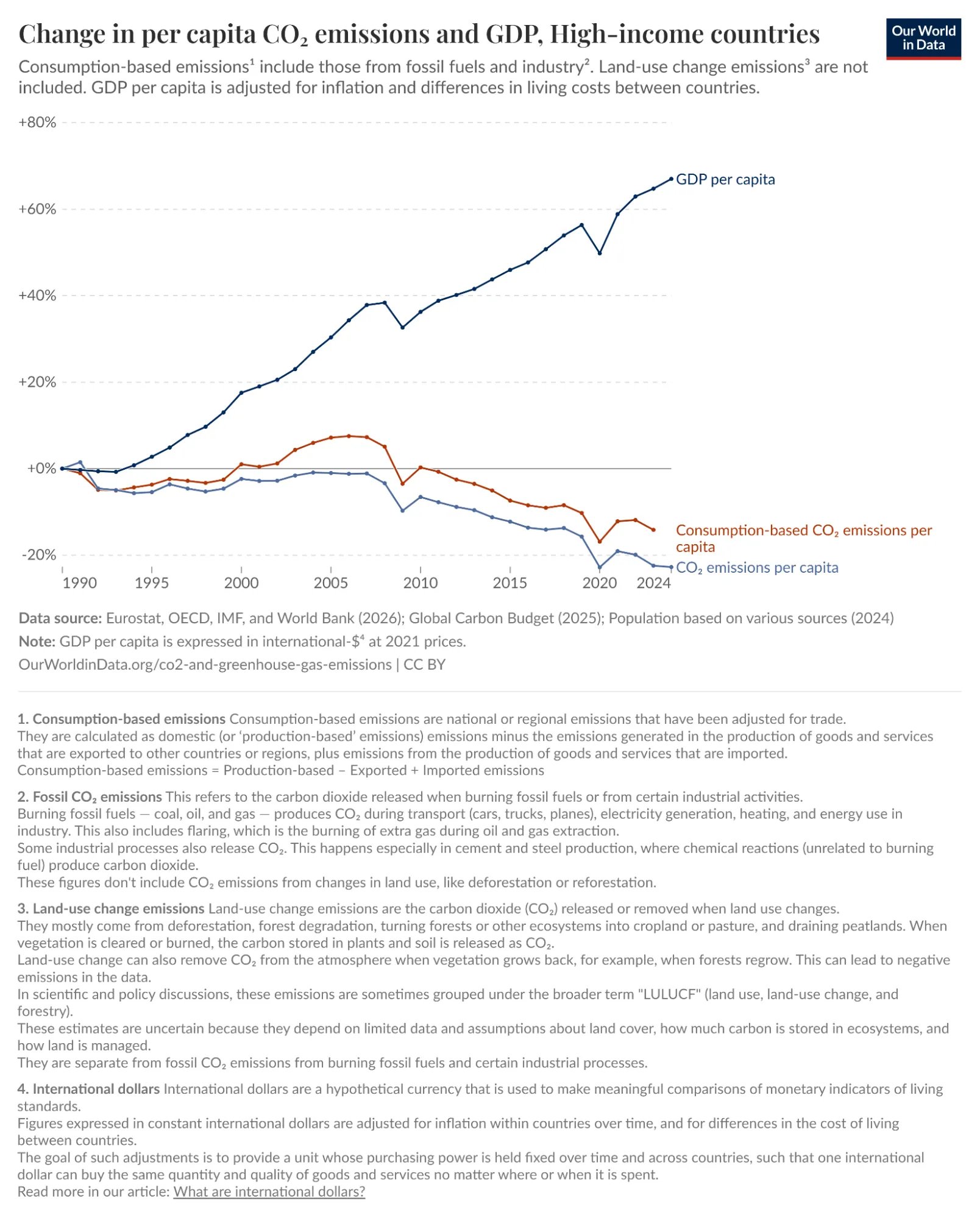
You can see that since 1990 (the international baseline for CO2 emissions) high-income countries have seen substantial GDP growth while per-capita emissions have shrunk, even accounting for the outsourcing of manufacturing to poorer countries.
And there is every reason to believe this will continue. The International Energy Agency predicts that global renewable power capacity will double between 2025 and 2030. Texas is now the leading state in the US for grid-scale solar power, overtaking California. Texas’s government has little interest in environmentalism - this is simply a reflection of the fact that it is more profitable to build solar in Texas than coal and gas. And this is from 2025, before Trump’s Iranian folly pushed up the price of fossil fuels.
None of this is to say that we should be complacent - there is still much to be done. We have a lot of legacy infrastructure that we must replace, and more research is needed to find good solutions for long-haul transport, industrial heating and carbon-intensive goods like fertilisers, steel and concrete. But it is clearer than ever that solutions exist - we just need to reach them as fast as we can, to minimise the damage Climate Change will do to our civilisation. That requires more investment, more research and development as well as sensible anti-carbon policies like the Emissions Trading Scheme (an idea developed by an economist in the 1970s, in response to the work of an economist from the 1920s).
But understand that more investment and more research will lead to more economic growth, not less. We best protect our planet and ourselves by accelerating our economy, not throttling it.
There’s no turning back, and we cannot afford to stay where we are - the only way out is through.