A Skeptical Reaction to Reactionless Drives
Mark Honeychurch - 8th June 2026
Although the chemicals in rocket propulsion have changed over the years, from kerosene and liquid hydrogen, to complex ammonium perchlorate compounds and more recently liquid methane and oxygen, the basic idea of how it all works is the same - following Newton’s idea of action and reaction (or conservation of momentum), if you shove stuff out the back of a rocket, it pushes the rocket forward. The more mass you shove out, and the faster it’s shoved, the quicker the rocket moves.
This method of getting stuff into space, and moving it around in space, has its limits. The Tsiolkovsky rocket equation, which governs how much fuel you’ll need to change your velocity by a certain amount, is pretty brutal. As the change in velocity is proportional to both the fuel’s exhaust velocity and the natural log of the ratio between the start and end mass of the rocket, there are diminishing returns as you try to speed up a rocket. Because of the natural log, the more speed you want, the exponentially more fuel you need. This is why most space rockets are 90% or more fuel by weight on take-off - to escape the earth’s gravitational pull (and air resistance, etc), you need a lot of fuel. And most rockets are multi-stage, so that as much mass as possible can be jettisoned en route, increasing that start-to-end mass ratio to squeeze out a little more delta-v (change in velocity).
Blue Sky Thinking
Because of this severe limitation, which is one of the down-sides of living on a large rock, there’s always a lot of interest in ways around the problem. The idea of space elevators has been around for decades, at least since Arthur C. Clarke’s fascinating novel about them - The Fountains of Paradise. But other, cheaper and more realistic ideas have also been floated, such as the launch loop that slingshots things into space, the skyhook dangling down from orbit to the upper atmosphere, and even a rideable space fountain of pellets being shot up into orbit, where they’re turned around and fired back down again.
There’s also a startup company, SpinLaunch, that’s working on a large wheel that spins a rocket around and around, slowly increasing its speed, until it’s fast enough to be released and flung into the upper atmosphere (and then pushed into orbit with a small conventional rocket booster) - although there’s a lot of scientific skepticism about whether this project will ever be feasible. Maybe, along with Green Space and Auriga Space, these companies and their novel ideas will be worthy of a future article.
As well as futuristic plans for hoicking things up into orbit, there are some novel ways of powering spacecraft that are either in orbit or travelling further afield that sound like they come from a science fiction book. Ion Thrusters, Hall Effect Thrusters and Plasma Thrusters all use ionised heavy gas particles, like xenon, as a propellant. These technologies try to solve the Tsiolkovsky problem by accelerating the matter used in the action/reaction equation as much as possible before ejecting it, with each one using a different method of acceleration. Using a very different propulsion method, though, are solar sails - large flat surfaces that solar radiation bounces off of, slowly pushing a craft away from the sun.
But we’re not here to talk about real science, as we have more far-fetched ideas to investigate…
A History of Reactionless Drives
Since even before we first travelled into space, there have been several attempts to discover new scientific principles that can be utilised to design novel propulsion technologies that don’t use action/reaction for propulsion. Known as “reactionless drives”, there’s no lack of people hoping to make their first billion dollars inventing the holy grail of long-term space travel.
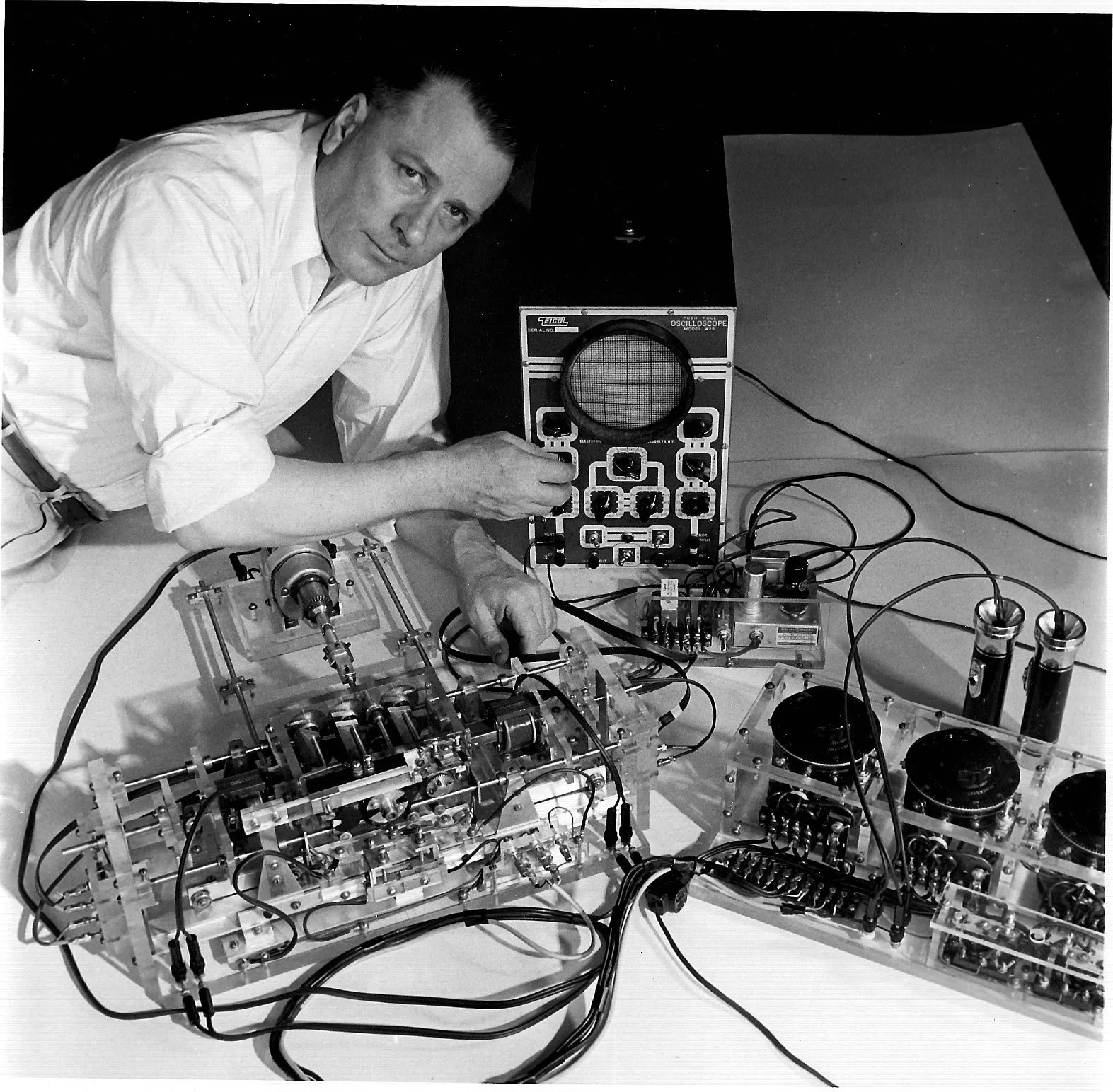
All the way back in the 1950s, the Dean Drive, invented by Norman Dean, was an early attempt to create reactionless thrust. Using misaligned weights that were spun around central axles, the idea was that the asymmetrical forces created by the movement of the masses would somehow cause the device to climb up its own vibrations. Although Dean’s own testing showed positive results, more rigorous testing by third parties was not possible because Dean wanted to be both paid and given a Nobel Prize before he handed his machine over to anyone else.
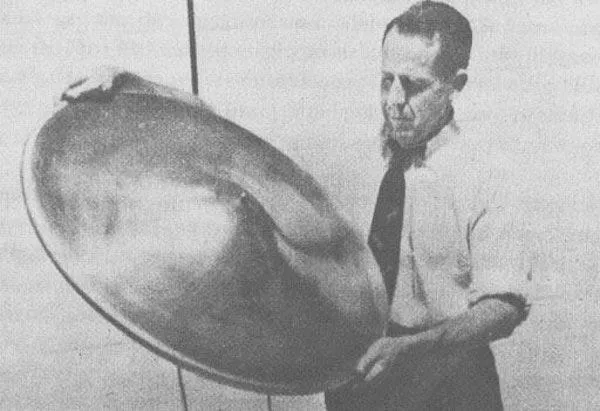
The Biefeld Brown Effect is another attempt to design a reactionless drive, although this one may be familiar to skeptics as it’s also often been touted as the mechanism UFOs use to move around. Like the Dean Drive, this one relies on asymmetry, but in this case rather than an asymmetry of weights it’s an asymmetry of electrodes in a capacitor. The idea is that if the negative electrode is larger than the positive one, when a charge is placed across the capacitor it creates a net thrust. Although its inventor, Thomas Brown, thought that the thrust was related to a brand new field of science he’d discovered, electrogravitics, in reality it seems that, in cases when these devices appear to work, they’re basically creating an ionic wind - a stream of charged air particles pushing in one direction - and that’s what’s producing the thrust.
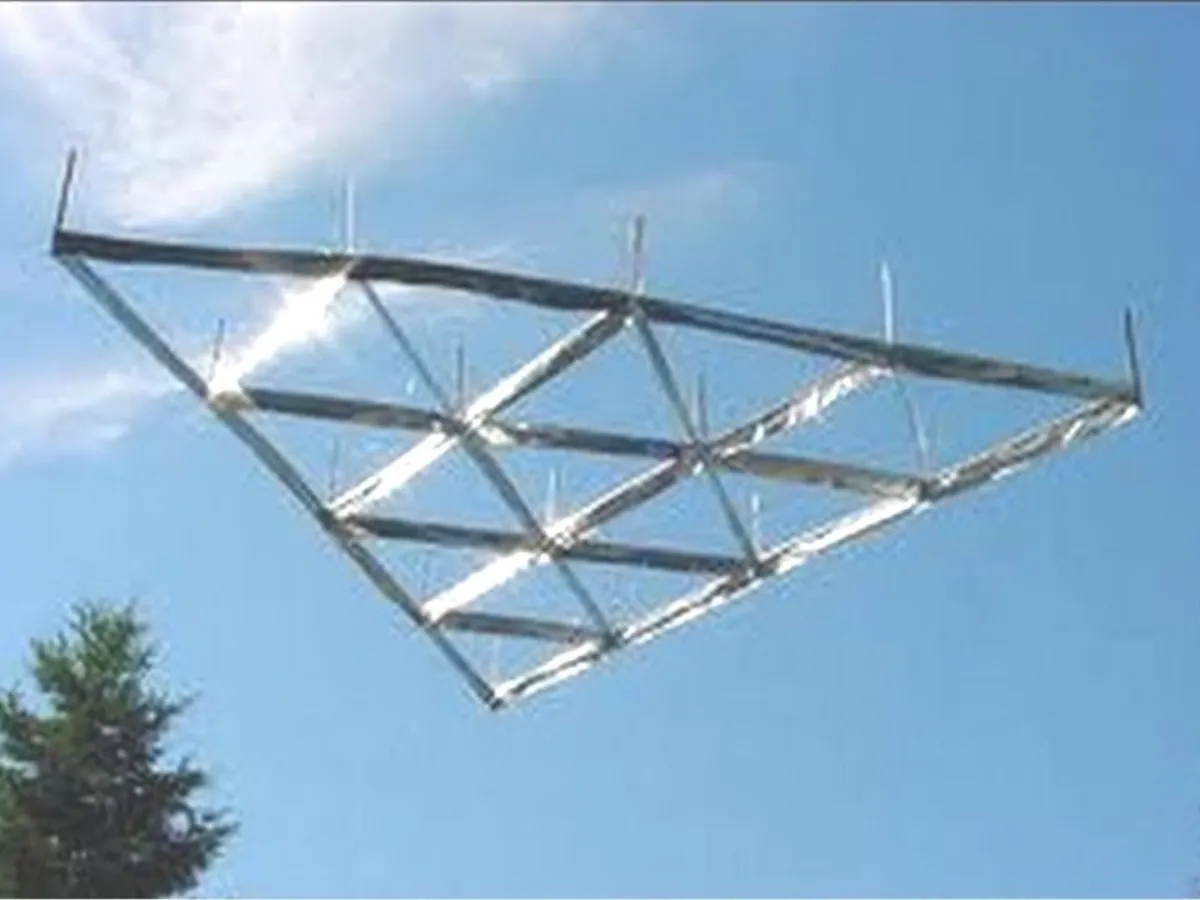
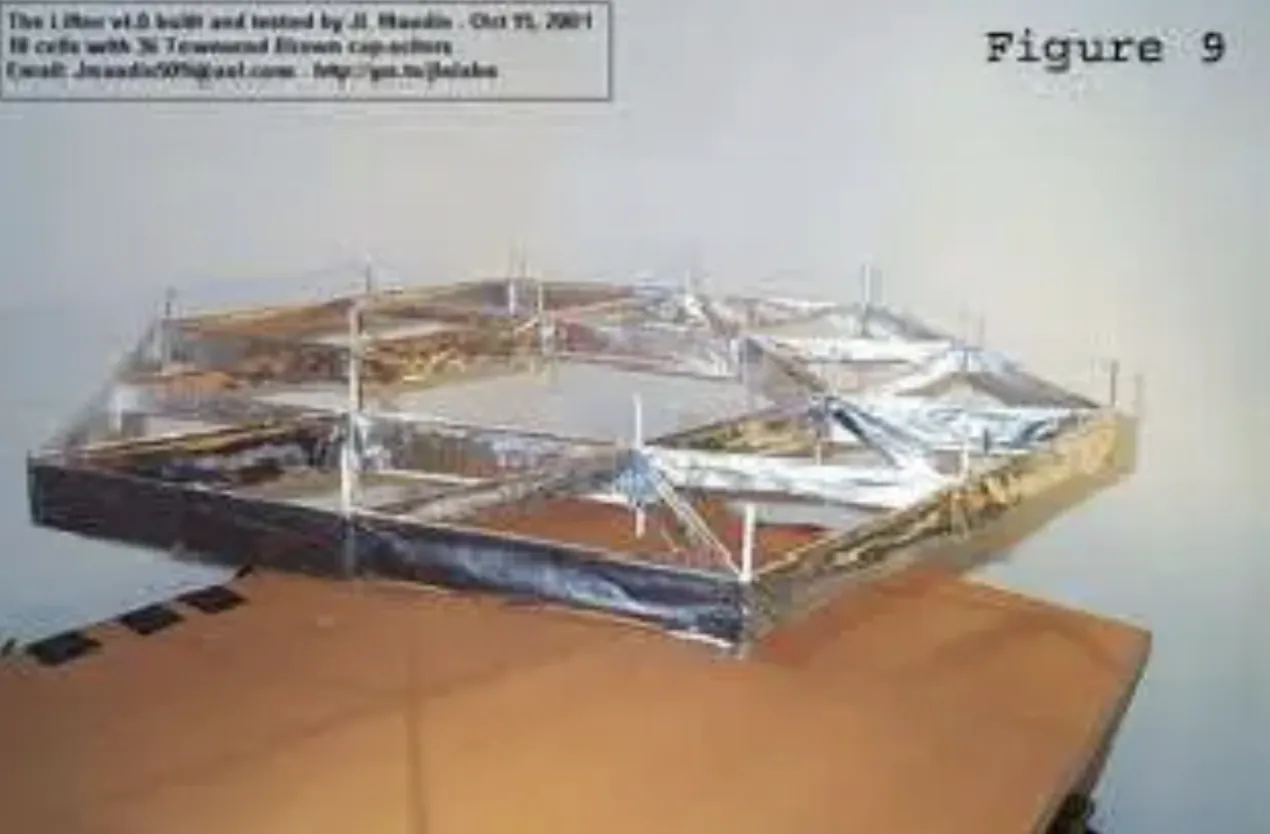
Many years ago, as a budding young skeptic, I used to watch videos posted on forums that purported to demonstrate the Biefeld Brown effect in action, using tin foil triangles, metal discs and other devices that were designed to prove that UFOs were shaped this way because they rely on this effect. Some of the designs were as funky as they were flimsy:
In the early 2000s the EmDrive was announced by British engineer Roger Shawyer. EmDrives are copper cones that have microwaves fired into them - the microwaves bounce around inside the cone, and a net force magically appears, pushing the drive forward.
Purported mechanisms for how the drive supposedly works include that it’s accelerating a quantum vacuum virtual plasma, that it’s using “Unruh radiation” (which is also a controversial idea in physics), and that it’s utilising Lorentz forces - although the makers have never offered an official explanation of how they think it works, beyond:
- Fire microwaves into an enclosed copper cone
- ?
- Thrust

Because the forces being measured are so small, it’s been suggested that various subtle physical effects are likely to be the real cause of the thrust that has been measured in those experiments that have managed to record a positive result (and many experiments on EmDrives over the last 20 years have not managed to generate any thrust). Thermal gradients, the interaction of the earth’s magnetic field with the device’s power cables, stray air currents and warping fasteners have all been identified as the root cause of false positive measurements in experiments. And often these forces are tiny enough that they fall within the margin of error of the measuring equipment and experimental design - meaning that the measured thrust could feasibly not even exist at all in some cases.
The Exodus Drive
All of this history brings us to the latest of these devices - the Exodus Propulsion drive. The drive was recently invented by Dr. Charles Buhler, who previously worked for NASA as an expert in electrostatics. Buhler’s work as a founder of the Electrostatics and Surface Physics Laboratory was all about ensuring electrostatic effects, like sparks, don’t cause sensitive hardware to fail, or ignite any fuel where/when it’s not supposed to. This is very important work for NASA (and anyone else interested in launching rockets), and by all rights it sounds like Buhler was an accomplished scientist who made meaningful contributions.
As part of Buhler’s day-to-day work with electrostatics, he believes that he’s found a new electrostatic force that is reactionless. The Exodus Propulsion Lab that he’s created to research this supposed phenomenon has even claimed that, in testing, they have managed to generate enough thrust with their propulsion engine to overcome the earth’s gravity.
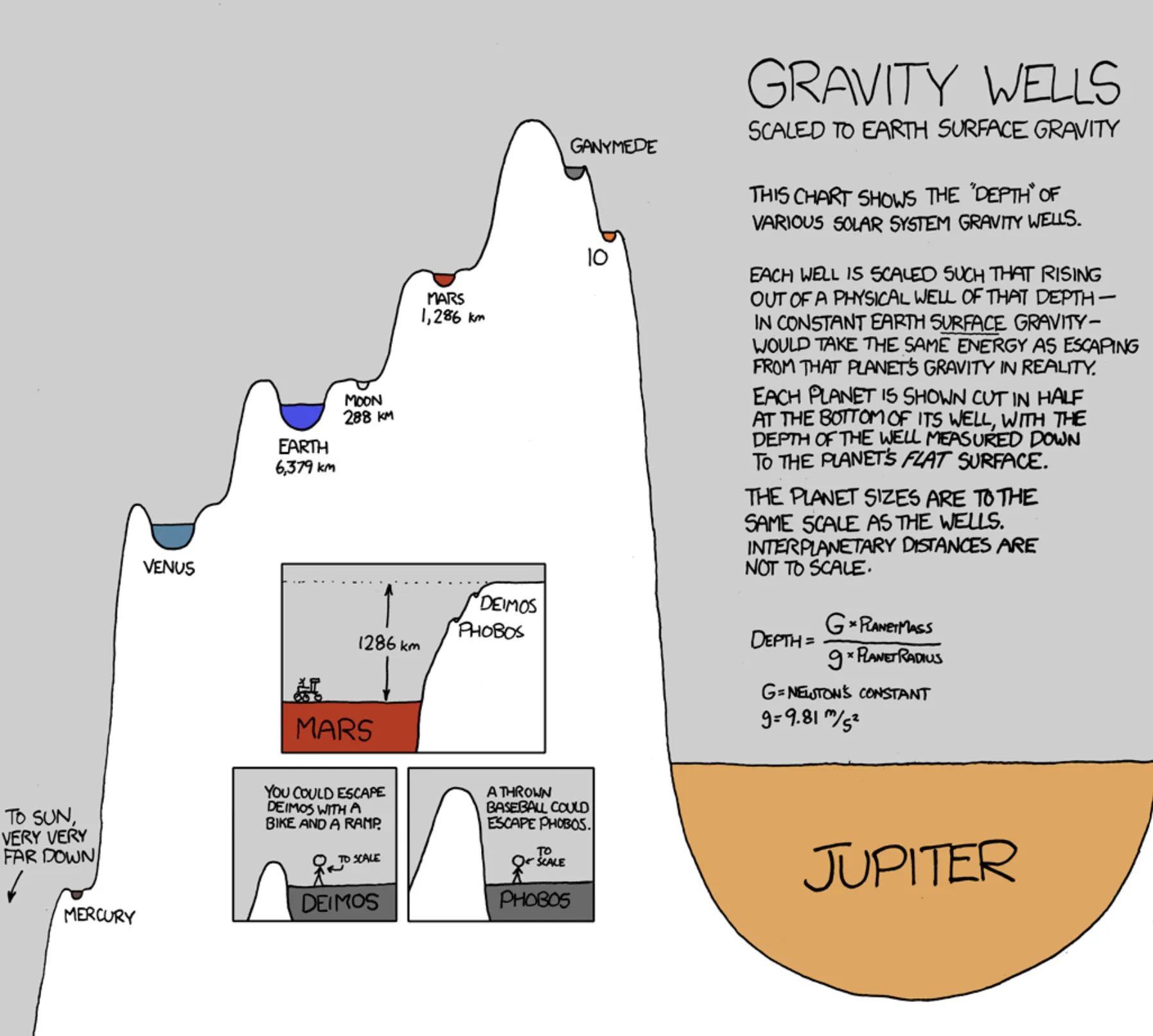
Now this claim is a little misleading, given that all the drive did was push just under a gram of thin metal film sideways with enough force to lift a gram vertically against gravity. The device technically didn’t overcome gravity, and can’t even theoretically overcome gravity unless we accept Buhler’s sleight of hand and just focus on the 1 gram shiny thing, conveniently ignoring the kilograms of power storage and high-voltage transformer hardware it needs to be hooked up to, to power it. So, sadly, even if this claim of reactionless thrust was true (and it’s very, very unlikely that it is), the drive still wouldn’t be able to provide anywhere near the force needed to allow a rocket using it to escape the earth’s gravity well.
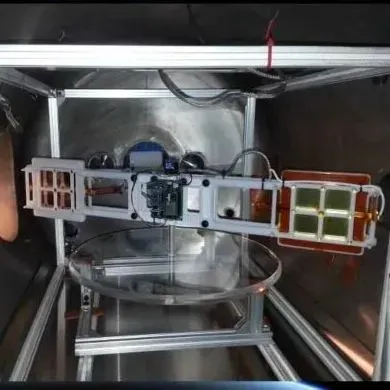
The drive itself, like the older Biefeld Brown drives, is an Asymmetrical Capacitor Thruster (ACT), but with a few changes to the geometry of the capacitor electrodes. Here are a couple of pictures of the drive, mounted on a lightweight frame, suspended in a lab rig, and sitting inside a vacuum chamber (the chamber is an important part of any test, to ensure there’s no ionised particles producing thrust through ionic wind).
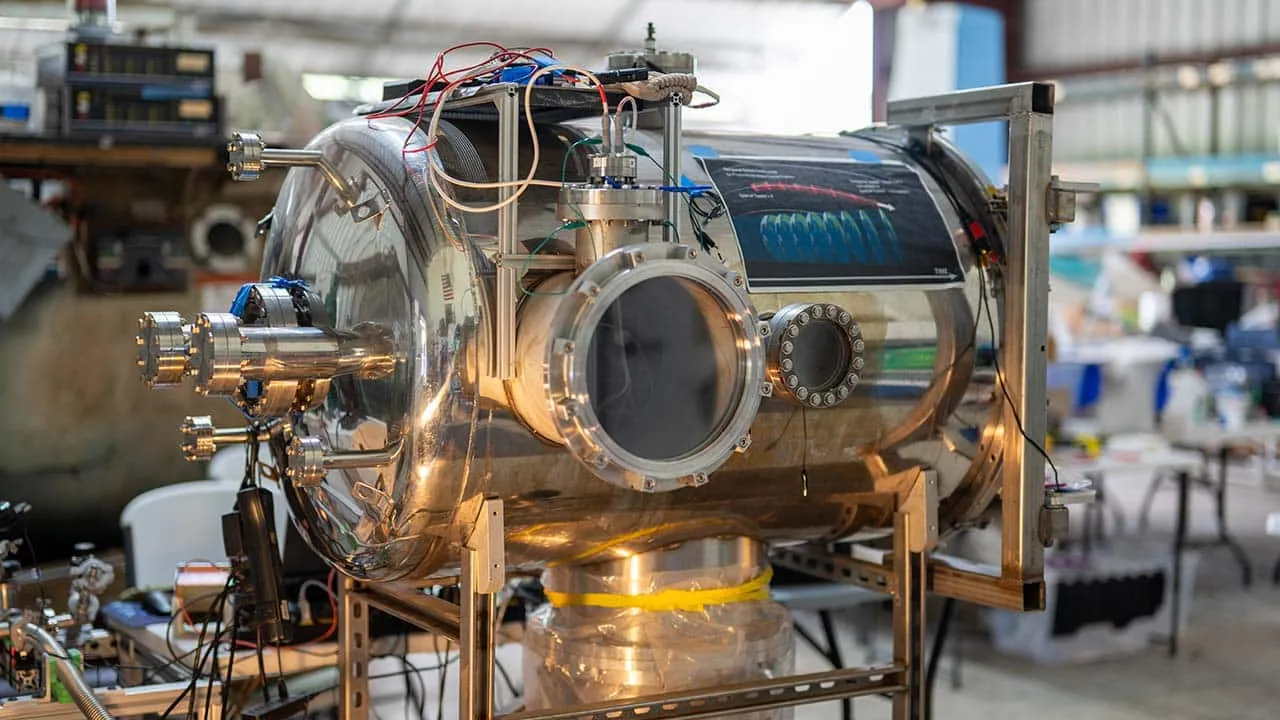
Of course, just because ionic wind is ruled out as a source of the thrust, that doesn’t mean the experiment is fool-proof. The massive chunk of metal surrounding the drives, the rig and frame it’s mounted on, the power cables feeding it, the heat produced by the high voltage conversion, and many, many more variables mean that the researchers have to be very careful that they’re not producing thrust in any other way. This setup is most definitely no spherical cow in a vacuum.
Beyond the fact that this device is eerily reminiscent of a previously debunked reactionless drive idea, there are some other red flags to be aware of.
For one, Buhler’s far-fetched and sometimes bombastic statements are concerning. As well as the claim of being able to produce enough thrust to counter gravity, he’s also announced that his drive somehow provides thrust even after it’s been turned off. He brazenly told The Debrief a couple of years ago that:
“The most important message to convey to the public is that a major discovery occurred… This discovery of a New Force is fundamental in that electric fields alone can generate a sustainable force onto an object and allow center-of-mass translation of said object without expelling mass.”
Another red flag is that Charles Buhler is featured on the APEC website. APEC is the Alternative Propulsion Engineering Conference, a fringe annual event where “warp-drives, gravity-modification & UAP physics” are discussed. At these events, reactionless drive engineers (like Buhler, and the previously mentioned Roger Shawyer, inventor of the EmDrive) hob-nob with fringe journalists such as recently-deceased UFO nut Nick Pope and zero-point energy nut Nick Cook, futurists, “independent” researchers and alien/UFO chasers.
Sadly, Dr Buhler’s work appears to have already been used as a starting point for other people’s delusions, including this thread on Reddit where, in response to someone asking for more details about Buhler, a poster instead talked about how he had validated the drive mathematically, and that after emailing over 30 physicists, none had responded to him proving him wrong.

It seems unlikely that this new Exodus reactionless drive, like its predecessors, will ever prove to be real. The concept of a reactionless drive breaks what we currently think of as one of the fundamental laws of classical mechanics - that every action must have an opposite and equal reaction. Although it may turn out that one day someone will figure out something novel that will overturn this idea, for now it seems that those who are chasing the dream of inventing the first reactionless drive are going to spend their time - and their investors’ money - chasing their own tails, confusing experimental error with evidence of efficacy.
Until someone can get one of these devices up into space and show it working in a hard vacuum, far enough away from any other matter to not be meaningfully influenced by it, I’m going to assume these devices are all just snake oil - even though deep down I really, really want them to be real.