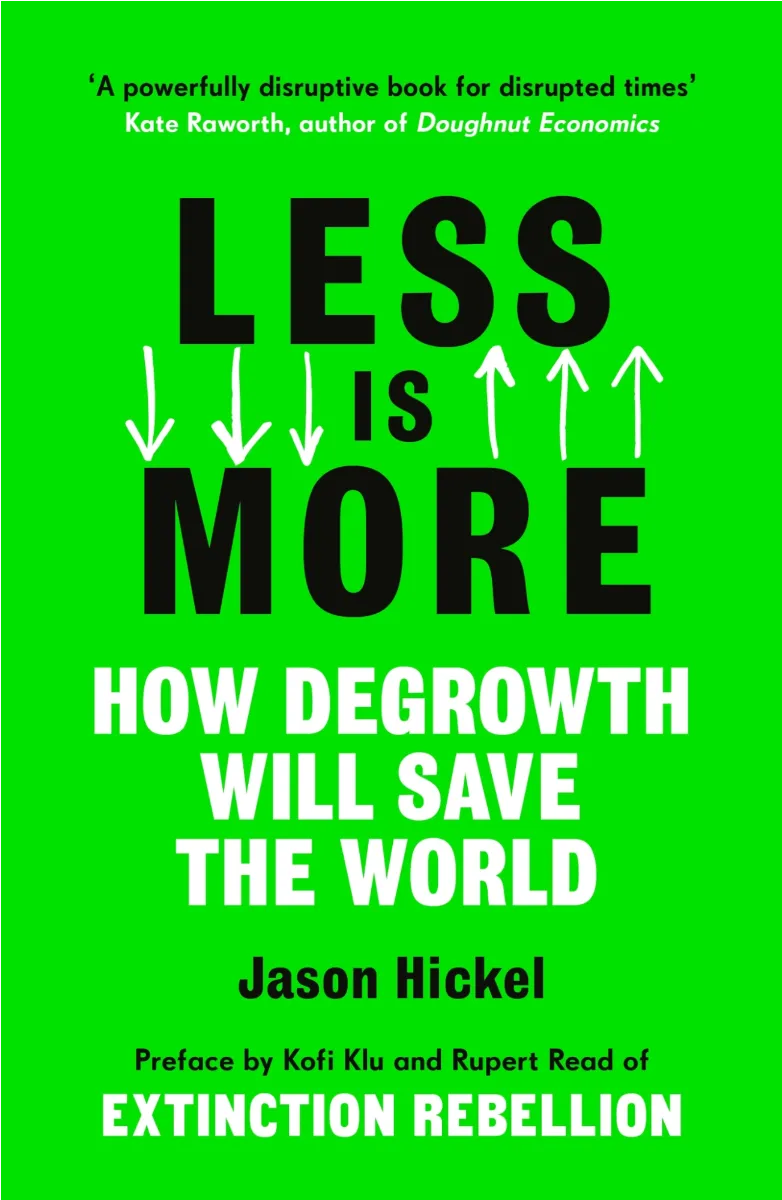
Less is More, by Jason Hickel
Patrick Medlicott - 25th May 2026
Jason Edward Hickel (born 1982) is a Swazi economic anthropologist, academic and democratic eco-socialist. He is a professor at the Institute of Environmental Science & Technology (ICTA-UAB) at the Autonomous University of Barcelona, a Fellow of the Royal Society of Arts, a visiting senior fellow at the International Inequalities Institute at the London School of Economics, and was the Chair of Global Justice and the Environment at the University of Oslo. He serves on the Climate and Macroeconomics Roundtable of the US National Academy of Sciences.
His research focuses on political economy, inequality, and ecological economics. He is a prominent proponent of the degrowth movement and a critic of capitalism, neocolonialism and the use of GDP growth as a measure of progress.
…
He served on the U.K. Labour Party task force on international development in 2017–2019. As of 2020 he serves on the Harvard-Lancet Commission on Reparations and Redistributive Justice, on the Statistical Advisory Panel for the UN Human Development Report, and on the advisory board for the Green New Deal for Europe.
Source: Wikipedia.
After recent criticism from Mike Joy (13/4/26 newsletter) I have reread and reviewed a book I read by Jason Hickel some years ago. The title is “Less is More” (2021). Then, I think during Covid, I was also reading books about the green new Deal (Green new Deal, Rifkin 2020). Around that time, I took a course at Victoria University of Wellington titled “Climate change and New Zealand Society”, which was an excellent course. As part of that I had to write an essay. In the essay I postulated that change from our “business as usual” (BAU) political mentality in New Zealand was unlikely to solve our climate problems, due to our Westminster style of government and the forces of capitalism and consumerism. So far, I have been proven correct. All the good initiatives with bipartisan agreement have been quietly ignored and shelved by our present “three-headed Taniwha”, in favour of GDP economic growth - forgetting that we all live on a finite planet. Kenneth Boulding wrote in 1973 “anyone who believes that exponential growth can go on in a finite world is either a madman or an economist”. Dr Boulding was an economist!
This mantra of continued economic growth is espoused by many economists and many politicians, especially those on the right wing. The Council of Rome wrote 50 years ago on the fallacies of continued economic growth measured by GDP; this was called the” limits to growth”. Many of those who wrote the original document are no longer with us, however the tenets were reviewed again in 2022. Most of the predictions made in 1972 are confirmed, and if capitalism continues at the present rate of GDP growth it will require the resources of at least 5 planets. We already are over-extracting up to 1.5 planets’ worth of resources.
Limits to growth, degrowth and green growth are now in mainstream discussion. These are available in many recent books: V_alues (2023 by Mark Carney, now president of Canada), Good Economics for Hard Times (2020 Banerjee and Duflo, Nobel prize winners), Donut Economics (Kate Raworth 2018), Limits and Beyond (Bardi 2022), It’s Okay to be Angry About Capitalism (Bernie Sanders 2024), The Day the World Stops Shopping (JB McKinnon 2022), Austerity (Blyth 2015), Post Neoliberal Economics (Fulbrook 2021), The New Economics (keen 2021), Too Much Money (Rushbrooke 2019), The Corruption of Capitalism (Standing 2021), Reimagining Capitalism (Henderson 2021), Why Women have Better Sex Under Socialism (Godse 2019), The Green New Deal and Beyond (Cox 2020), The Zero Marginal Cost Society (Rifkin 2015, The Deficit Myth (Kelton 2021), The Green New Deal (Rifkin 2020), Degrowth and Sustainability ( Ellwood 2014), The Third Industrial Revolution (Rifkin 2021), Prosperity Without Growth (Jackson 2019), The Uninhabitable Earth (Wallace-Wells 2019), There is no Planet B ( Berners-Lee 2019), Can Democracy Survive Global Capitalism (Kuttner 2019)_. All these volumes are available on Kindle (I don’t like the business model, but it is convenient, especially when studying under a Covid lockdown).
Jason Hickel believes “We are living in a world that is dying”. This has been known for over 50 years, and the causes were discovered by oil company scientists. In those 50 years there has been the Kyoto protocol 1997, Copenhagen Accord 2009, Paris agreement 2015, and annual United Nations COP (conference of parties) since 1995. “Yet every year carbon dioxide emissions have continued to rise while ecosystems unravel”.
Fossil fuel companies and the politicians they have “bought” bear significant responsibility, even in New Zealand.
The underlying problem, Jason Hickel believes, is economic growth and the mantra of capitalism fuelling it. The imperative of constant expansion or “growth” of GDP, which doubles in exponential fashion every 25 years. This is in exponential growth coupled to energy and resource use. The global South countries need more growth but, in most countries, especially the United States and New Zealand (which has one of the highest emissions per person in the world) further growth is not a necessity. Consumerism and growth have been unhinged from any present need.
“Clean energy might help deal with emissions, but it does nothing to reverse deforestation, overfishing, soil depletion, and mass extinction. “Growthism”, as we might call it, stands as one of the most hegemonic ideologies in modern history. Nobody stops to question it”. Hickel believes this is an induced cognitive dissonance. (I think this is where Mike Joy’s criticism of my advocacy of green technologies is correct). Hickel believes green growth is a fantasy, and has no empirical support. He believes it is not necessarily our technology that is a problem. It is growth.
Hickel quotes a gentleman called Frederick Jameson (1934 to 2024), an American literary critic, philosopher and Marxist political theorist. Jameson said, “It is easier to imagine the end of the world than to imagine the end of capitalism”.
I have discussed these comments with friends, but all I seem to get is “you either have to have capitalism or communism”. Personally, I believe that there are many forms of capitalism and, in some countries, it can encompass redistribution of resources and preservation of the environment.
Hickel: “Why are we so wedded to the dusty dogmas of this old 16th century model to a point of dragging it doggedly into a future for which it is manifestly unfit”.
Younger people may be ready to consider other alternatives. 64% of people in Britain believe capitalism is unfair, and 55% even in the United States, 70% in Germany and 74% in India. 75% of people across all major capitalist economies say they believe corporations are corrupt. I do not know what the figures are in New Zealand, but I would suspect they are similar.
Hickel believes that overconsumption is putting our planet and society at risk, that we should buy and own less, and that doing so would not compromise our happiness or well-being.
If scientific evidence conflicts with the dominant worldview of civilisation, we must make a choice - either we ignore science, or we change our worldview. This has happened before, the example being Charles Darwin.
Hickel again: “Beyond a certain point, which high income countries have long surpassed the relationship between GDP and social outcomes breaks down. It is not the GDP but the fact that a quarter of all the labour we render, all the resources we extract and all the CO2 we emit only succeeds in making rich people richer. High income countries do not need more growth to improve people’s lives. What they need is to organise the economy around human well-being rather than capital accumulation.”
What is “Degrowth”: A planned reduction of excess energy and resources, used to bring the economy back into balance with the living world in a safe, just and equitable way. It is not just our economics we need to change, but we need to change the way we see the world and our place in it.
This is, of course, absolute heresy to our Prime Minister and the Minister of Finance in New Zealand.
I regret this rather polemical article, however I would recommend members of the Sceptics Society to look at “Less is more” by Jason Hickel, and I look forward to receiving plenty of criticism as to why we are unable to change our neoliberal capitalist and monetised society to one in which not just the richest top 20% can benefit, and where we can hopefully live in a society where all can share in those resources.
A few centuries ago, it was impossible to imagine a change from the “divine right of kings”, yet it happened and perhaps the “divine right of capitalism” may yet change.

Tags: growth, capitalism, hickel, new, society, gdp, change, world, resources