Planetary Solvency
Patrick Medlicott - 11th May 2026
A report was released recently from the Institute and Faculty of Actuaries from the United Kingdom, in collaboration with Anglia Ruskin University (April 2026). Actuaries are responsible for assessing and quantifying risk management, and are used extensively by insurance providers. These people are not “woke scientists” or “woke climate change believers”. They are schooled in mathematics and systems analysis, and should be believed.
The report is titled “planetary solvency: tipping into the wild unknown”.
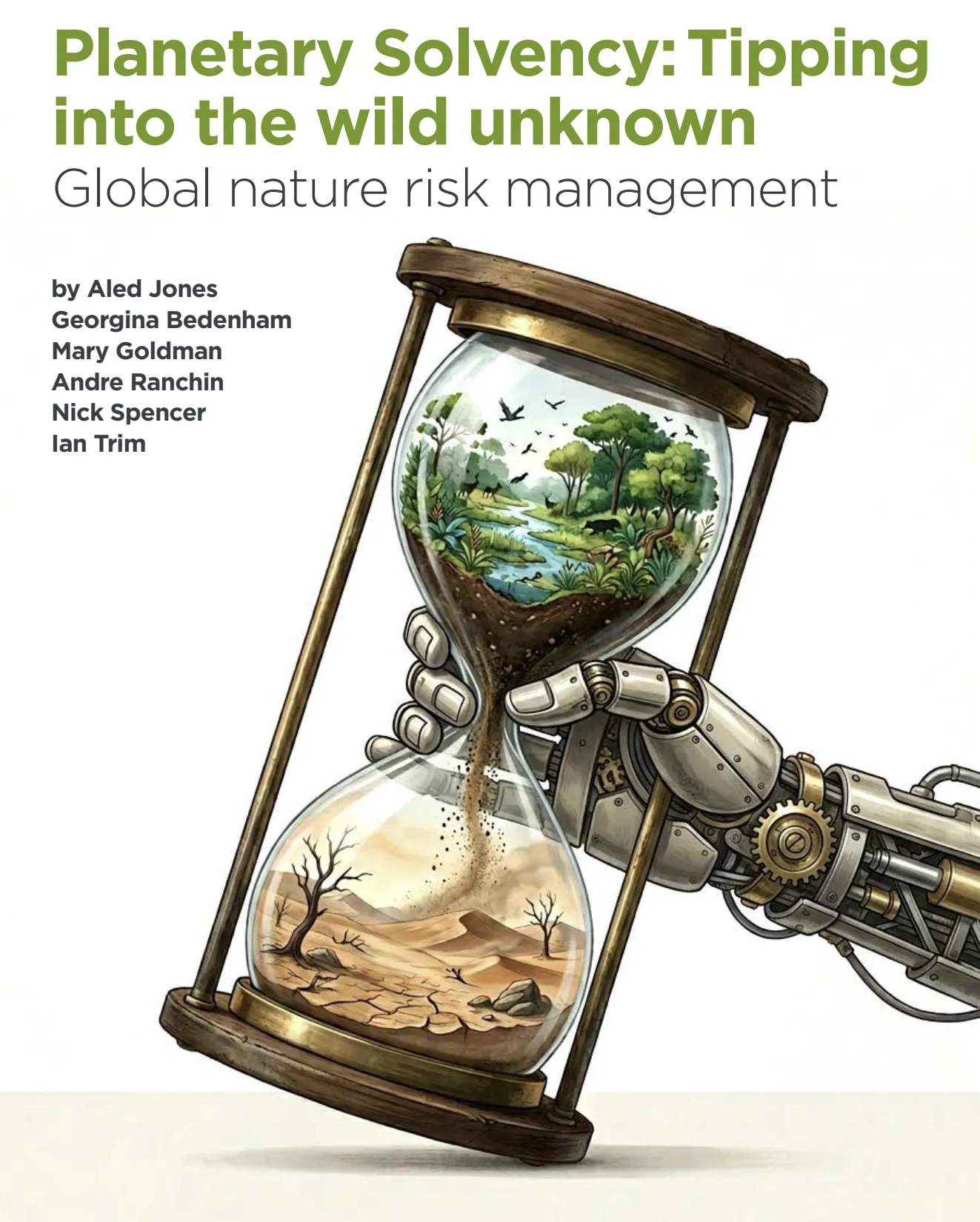
It is a report of a global nature, of course including New Zealand but not specifically about New Zealand. Despite the naysayers, climate change is like the Internet. It is everywhere. (My apologies to Tina from Turner’s).
There are six authors, led by Aled Jones.
Executive summary:
“Our societies and economies fundamentally depend on nature for food, water, climate regulation, disease controls and materials. However, recognition of the criticality of these services is poor and they are rarely treated as critical infrastructure nor as national security threats”
“Failure to take into account nature related risks represents a failure to understand and manage risks to individual organisations, as well as almost certainly magnifying the risks of ecosystem collapse and the consequent societal impacts.”
The authors discuss the planetary solvency dashboard, a concept from Prof Johann Rockstrom (2009) from the Stockholm resilience centre.
The dashboard consists of nine planetary boundaries.
- Climate change.
- Biosphere integrity.
- Land-system change.
- Freshwater use.
- Bio geochemical flows.
- Ocean acidification.
- Atmospheric aerosol loading.
- Stratospheric ozone depletion.
- Novel entities not yet quantified.
In 2009, seven boundaries were assessed and three had been crossed. In 2015, seven boundaries were assessed and four had been crossed. In 2023, nine boundaries were assessed and six had been crossed. In 2025, nine boundaries were assessed and seven had been crossed.
The actuaries’ comment that “while nature has a remarkable capacity to recover, there are limits. Nature is not a luxury; it is our most fundamental form of critical infrastructure; the risk is not volatility it is irreversibility”.
There are short-term and long-term risks. These are discussed in the articles under 10 year and 50 year timeframes. These include food system risks and Zoonotic diseases. “Throughout history, the capacity of Zoonotic diseases to develop into pandemics has created devastation. Changes in land use are estimated to have caused more than 30% of new diseases reported since 1960”.
There are tipping points, where change occurs which is not reversible:
- Coral reefs.
- Greenland ice sheet.
- West Antarctica ice sheet.
- Permafrost thawing in the Arctic.
- Changes in the Atlantic Meridional Overturning Circulation (AMOC).
- Changes in the sub polar (Antarctic) Gyre current.
- Southern Ocean current overturning.
- West African monsoon changes.
- Deforestation (Amazon and Indonesia).
- The pollinator crisis.
- Marine tipping points.
A couple of quotes from the report:
“If global warming, ocean acidification, overfishing and pollution continue on their current trajectories, the economic and social consequences are likely to be severe”
“Nature and climate crises are interconnected risks”
The details of the report are available online, with very good illustrations. Their final statement is “the planetary risks will only change if there is sufficient collective action to do so”.