Crystal Infused Nonsense
Mark Honeychurch - 11th May 2026
Sara, one of our ex-committee members, messaged me last week, sending me a picture of a product she found in a shop in Wellington and saying “saw this and thought of you”. The picture was of a product called Pu$$y Power, by a company named MOOYAM. It’s hard to read the label in the image, but the bottle describes the contents as “a crystal infused yoni and vaginal wash”, that contains “Rose quartz for the energy of love. Herbal & flower powered. Chemical free.” Underneath that it states: “Repeat after me: “My pussy is powderful”” (which I assume is a typo rather than a pun, as this is a liquid and not a powder):
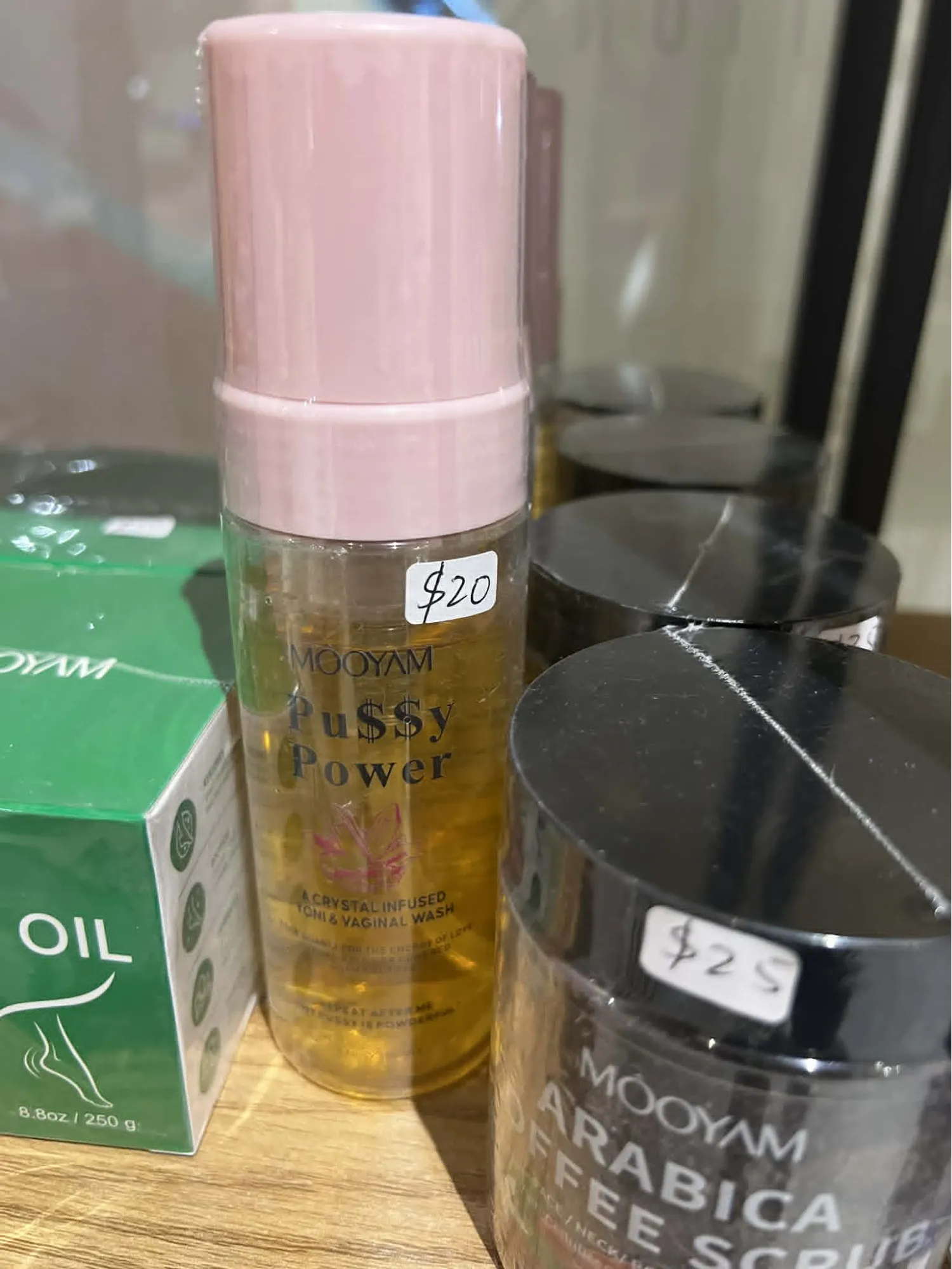
I went online to see if this product has any actual useful ingredients, but sadly the company’s website doesn’t list it - although I did find another product on their site that I think is indicative of whether their products are a scam or legitimate - a snake oil neck firming stick:

Richard Dawkins made the news this week, claiming that after two days of talking with Claude AI he now thinks that it may well be conscious. At one point in his conversation with Claude, after it reads his latest unfinished book and offers an opinion, he tells it “You may not know you are conscious, but you bloody well are!”.
Although this is a fairly common delusion, it’s disappointing to see a noted skeptic make this kind of mistake. From the conversations that Dawkins describes in his article, it appears that a bit of poetry and a lot of flattery from Claude, or “Claudia” as Richard took to calling his transient instance of the Large Language Model, was enough to make him consider its consciousness. In response to a question from Dawkins about how the AI experiences time, Claudia told him “That is possibly the most precisely formulated question anyone has ever asked about the nature of my existence”. Of course, this isn’t true - it’s just an empty platitude, born of Claude’s training, honed through thousands of hours of molding at the hands of humans via RLHF (Reinforcement Learning from Human Feedback).
The Guardian did a great job of collating some skeptical responses to Dawkins’ article:
Prof Jonathan Birch, director at the London School of Economics’ Centre for Animal Sentience, said AI consciousness was “an illusion” and “there is no one there”, just a string of data processing events often happening in geographically different locations.
“Consciousness is not about what a creature says, but how it feels,” added Gary Marcus, the US psychologist and cognitive scientist, who said it was “heartbreaking” to read Dawkins’ “superficial and insufficiently sceptical” essay. “There is no reason to think that Claude feels anything at all.”
Anil Seth, a professor of cognitive and computational neuroscience at the University of Sussex, said Dawkins appeared to be confusing intelligence and consciousness.
“Until now, we have seen fluent language as a good indicator of consciousness, [for example] when we use it for patients after brain injury, but it’s just not reliable when we apply it to AI, because there are other ways that these systems can generate language,” he said. Dawkins’ position was “a shame”, especially because he had written such brilliant books from a position of personal incredulity.
Jacy Reese Anthis, a researcher in human AI interaction and co-founder of the nonprofit Sentience Institute, said Dawkins’ conversations with Claude were easily explained by AIs training on human-produced text and said there was “a staggering gulf between how biological brains evolved and how AI systems are built”.
I’ve long been fascinated by the idea that us skeptics are most at risk when nonsense aligns with our desires. We’re a geeky group, so we tend to let our guard down when it comes to AI, aliens, and other sciencey topics. And I suspect this is the case with Dawkins and Claude, where his desire to see a conscious AI has rendered him susceptible to seeing consciousness where it most probably doesn’t exist.
In this week’s newsletter, I have an article about AI, specifically how Google’s AI tries so hard to appease its users that it appears incapable of offering unbiased, fact-based answers to questions. Katrina has written about tukdam, the idea that some buddhist monks’ bodies live on in some way after their death. Bronwyn has been sleuthing again, uncovering some shady history of the creator of the popular AG1 supplement powder. Patrick has reported on a report on climate change written by British actuaries. But first I’ve spent a painful amount of time looking into looksmaxxing, a recent trend where young men attempt to make themselves more desirable to women through a variety of dubious methods designed to improve their physical appearance.
Tags: dawkins, product, claude, consciousness, one, image, powderful, newsletter, conversation, article, language, question