Good news and Bad news
Patrick Medlicott - 28th April 2026
For my discussion this week I will consider two articles, one of which is the good news and the other the bad news.
I often have discussions with older friends who keep telling me that climate change is simply the normal variation and has nothing to do with CO2 and is not caused by humans.
The bad news
The first article is from The Climate Brink and is headlined by Andrew Dressler. Andrew Dressler was born in 1964 and is a climate scientist. He is professor of atmospheric sciences and director of the Texas Centre for extreme weather. His research subject areas include climate impacts, global climate physics, atmospheric chemistry, climate change and climate change policy.
He discusses an article by a gentleman, Dean Rovang. Dean Rovang is a retired research engineer from Sandia National laboratories. He notes that much of his career was spent working with fusion scientists and high energy physicists on experimental capabilities for the Z machine. His focus is now on climate change science and the global move to clean energy.
The title of the article is Human-caused climate change is unmistakably distinct from earth’s natural climate variability, and it starts off saying:
“This post presents two figures that are the culmination of an extended effort to build the strongest possible empirical case. The palaeoclimatology record shows about CO2 and temperature. They draw on five independent regression fits across poor independent archives and 66 million years of geological evidence. The argument stands on its own merits”
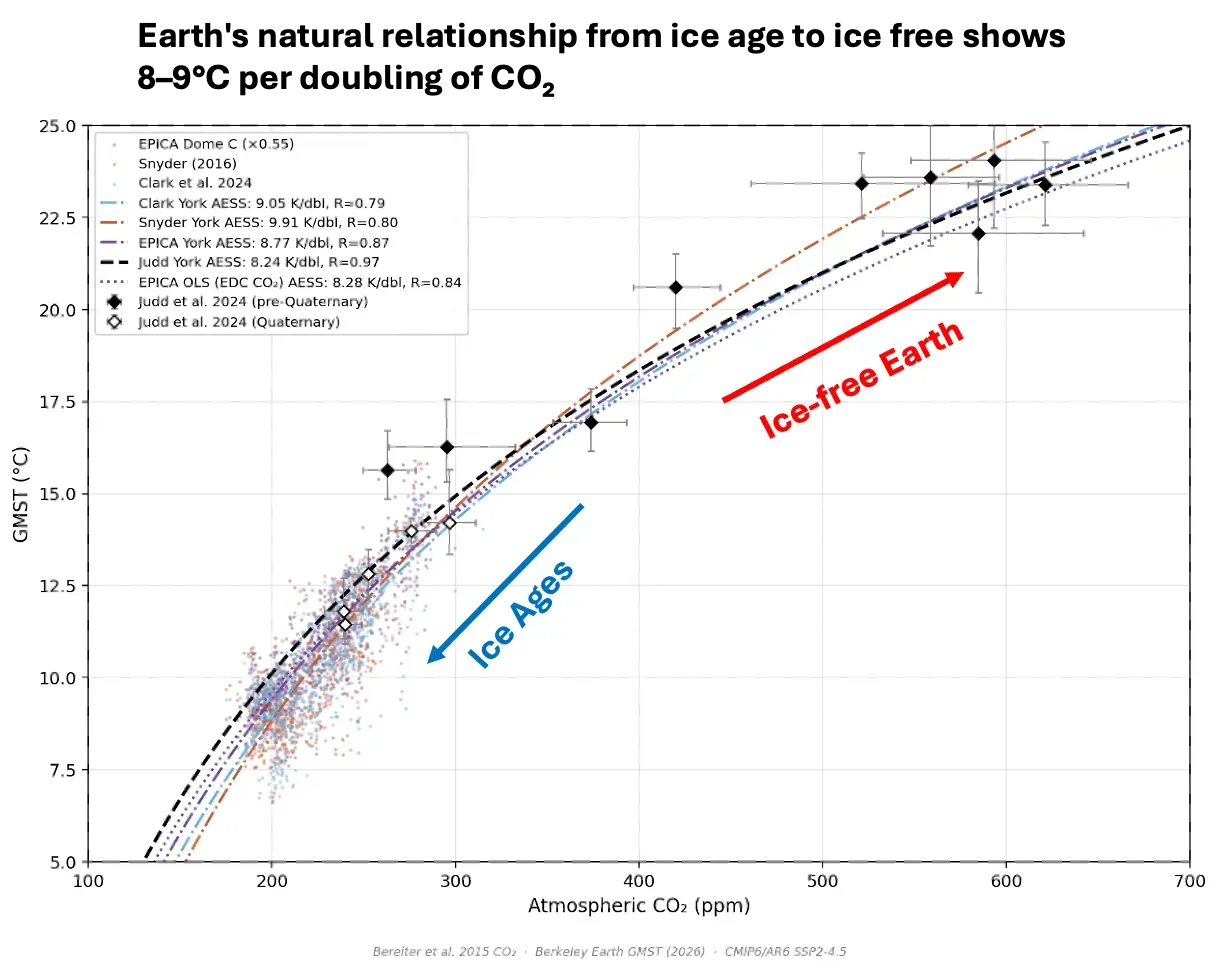
His first graph shows earth’s natural climate relationship, including both ice age and ice-free periods and this shows 8 to 9°C per doubling of CO2. “Three completely independent temperature reconstructions — the EPICA (European Project for Ice Coring in Antarctica) Dome C ice core, the Snyder (2016) Bayesian stack of 61 marine sediment cores, and the Clark et al. (2024) area-weighted reconstruction of 111 marine sediment cores — are plotted against the same CO? record on common axes.”
Five regression fits are shown. All five land between 8.24 and 9.9 3K/doubling of CO2 - the same tier regardless of dataset, CO2 source, or regression method.
His next graph is labelled: The 1850 hinge point: where modern climate change departs.
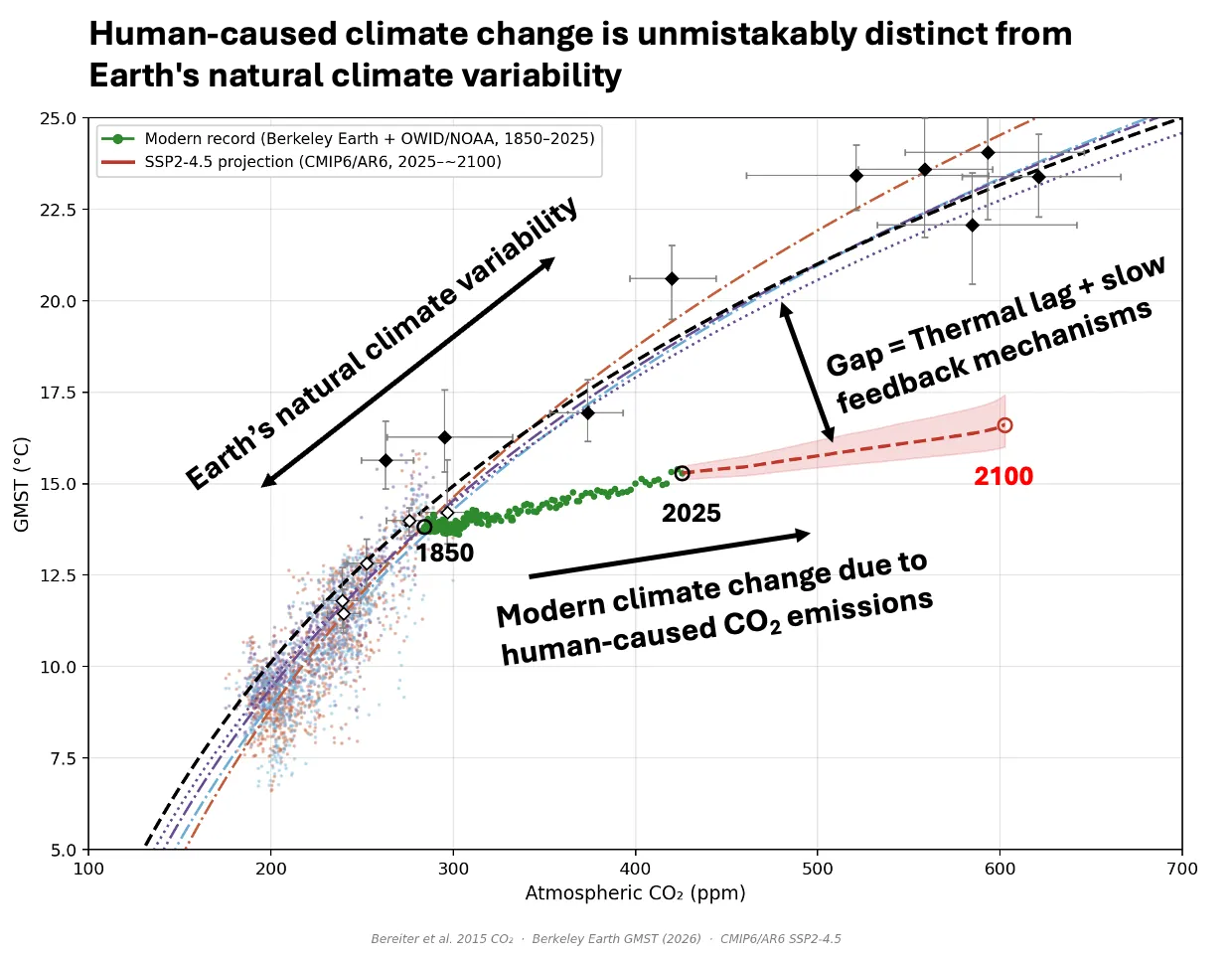
In 1850, the modern record begins exactly where the natural relationship sits. From there CO2 rises rapidly while temperature lags, driving the system into a region of CO2 temperature space with no analogue in the natural record.
He raises the question whether these changes are reversible. Will the system eventually return to the equilibrium curve? He notes that sea level rise, driven by slow ice sheet dynamics, will continue for centuries, regardless of when emissions reach zero. These are physical consequences already set. The modern trajectory does not move towards the equilibrium curve. The gap keeps growing as CO2 rises faster than temperature can follow. It is likely that the decisions made in the next few decades will lock in temperature change and may persist for thousands of years. The physics does not negotiate on timeline. It only responds to others in the atmosphere.
The bottom line.
Five independent fits of earth natural CO2 temperature relationship derived from different archives, different methods and different timescales all land in the same tier. That relationship holds from the depths of the ice ages to warm greenhouse climates with no continental ice, across 66 million years of earth history. The modern trajectory departs from about 1850 and has not looked back. The departure is not subtle, not a matter of interpretation, and not an artefact of any single dataset or method. It is unmistakable.
This is certainly not good news.
Perhaps the good news
The next article I will mention is from Bill McKibben. This is from his Substack post this morning. I read it while radio New Zealand announced that Donald Trump was going to obliterate Iran at midday New Zealand time.
Bill McKibben is an American environmentalist, author, and journalist who has written extensively on the impact of global warming. He is the Schumann distinguished scholar at Middlebury College, and leader of the climate campaign groups 350.org and the Third Act movement. He is one of the greatest names in the climate change movement.
It is entitled Night into Day.
I will quote from his first sad paragraph. “I am beyond heartsick at the war and America’s role in it- there was a remarkable piece of reporting and the times this morning showing the technology we’ve been spending our money and talent on. Apparently, there is a brand-new missile, from Lockheed, called PrSM pronounced “prism” a precision strike missile short range ballistic missile, designed to detonate just above its target and blast tungsten pellets outward. And on the first day of the war, when we were blowing up that girl’s school in Minab, we apparently detonated one of these things just above the sports hall where there was a girls volleyball turnaround underway, and 21 people died”.
He, like myself, is appalled by the civilian casualties in this war.
He believes however that the conflict may drive people in countries towards renewable energy. He adds “but God, not at this price”.
His article is about batteries. He begins with the history of the motor vehicle. In the early days it was noted that electric vehicles were superior to the gasoline counterparts being quieter, cleaner and cheaper to run - however the trouble was always the battery. It was hard to store more than a few miles of driving, whereas a tank full of gas had its energy more concentrated, and could drive very much further. Henry Ford and Thomas Edison tried to work on a better battery, but at that time with that technology it was not possible. Enter the internal combustion engine. Bill McKibben notes that there was little change in battery abilities until the 1970s. Then some electric cars were built in small volumes by Exxon, and appeared briefly in 1977 as a motor show. The concept was dropped by the oil company.
Other people however kept working on the concept. The first commercial vehicle using a battery was in 1991, and the first EV with a lithium-ion battery good for 124 miles of range was the Nissan Leaf. The gentlemen involved in developing this, John Goodenough, Akira Yoshino and Dr Whittingham, shared the Nobel Prize in physics for this development.
Since then, steady improvements have been at the heart of energy storage. Batteries have become cheaper and lighter. The price for storing four hours of electricity is now well below $100 US a megawatt, even as oil surges above the $100 dollar a barrel line.
Many of the early changes and developments came from China, but the United States is now catching up with the battery revolution - despite climate change being a “hoax” according to President Trump,
Lithium-ion batteries are likely soon to become replaced by sodium-ion batteries. The development of these batteries is happening both in China and in Finland. The Donut Lab in Finland is leading.
Bill McKibben: “if, as a thought experiment, we plug Donut’s nominal values into the battery of a current model year Tesla model three long-range, we get a mid-size EV sedan with a normal range of 870 miles.”
Nobody knows yet whether donut has “cracked the case”, but similar solid-state batteries are not far off. Changan Automobile claims to be developing a solid-state battery that can deliver over 1500 km driving range. Chery, another Chinese manufacturer, is also claiming they will be able to do this later this year. Developments are also going on in South America (Chile) and in the United States itself.
It is not so much for EV drivers, but if the sodium ion battery is developed then the energy from the sun stored during the day can be used during the night hours, as sodium is a lot cheaper and easier to get than lithium. This is already occurring in California, and combined with wind means that renewables can in fact replace gas, oil and of course coal. I believe these developments are exciting. These developments are turning nighttime into sunny noon! Bill McKibben believes that over the next decade or two the problem of no sun and no wind may be solved at night. Recently in California batteries reached 42.8% of grid demand at 7 PM in the evening. He notes this is equivalent to the output from 15 to 20 combined cycle gas plants, six Hoover Dams and more than the all-time peak demand of Portugal or Greece. More than 90% of California’s battery fleet was built in the last five years.
Developments are proceeding at pace even in countries where climate change is regarded as a hoax (the US) and in those such as China where solar and batteries are well-established. Why New Zealand needs to consider liquefied natural gas or perhaps even pumped hydro certainly needs to be looked at carefully, before we tie ourselves to further fossil fuel dependence - which is of course now apparent during the closure of the Strait of Hormuz.
There are also developments in Australia of what is called a fast-charging quantum battery. This technology is too advanced for my scientific understanding, but more later.
Bill McKibben and I agree on one thing, however. It is all about politics, and who has the ear of politicians and who is metaphorically “Stuffing their pockets”. As to whether we can move to the judicious use of renewable energy, or whether we continue in the present model of profligate fossil fuel use because, as Margaret Thatcher and our finance minister say, “there is no alternative” - THERE IS!