Has NASA found alien technology in our skies?
Katrina Borthwick - 13th April 2026
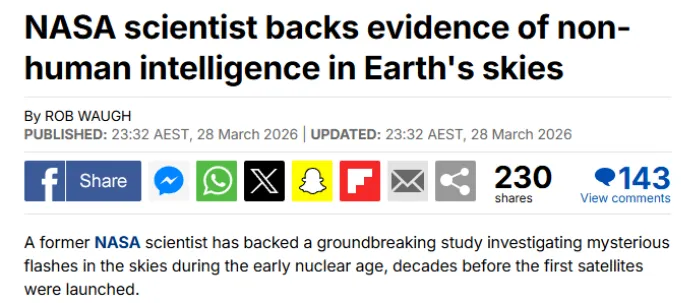
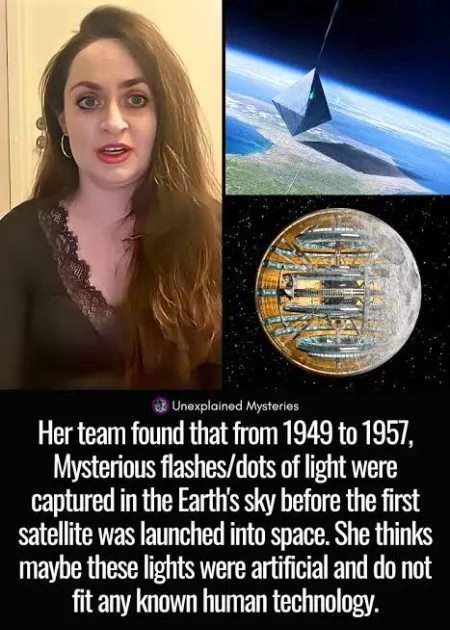
What a headline! MSN and the Daily Mail Online report that a former NASA-affiliated scientist, Ivo Busko, supports claims that unusual light flashes seen in 1950s sky photographs could indicate “non-human intelligence.” They report that his argument builds on earlier research by astronomer Beatriz Villarroel, who identified mysterious “transient” lights in archival images taken before satellites existed. This suggests the phenomenon is real and not a data error. Some of these lights appeared reflective or rotating, leading to speculation they could be objects in orbit. Because the observations predate the 1957 launch of Sputnik, proponents argue they cannot be human-made and may point to extraterrestrial technology. Here’s that headline:
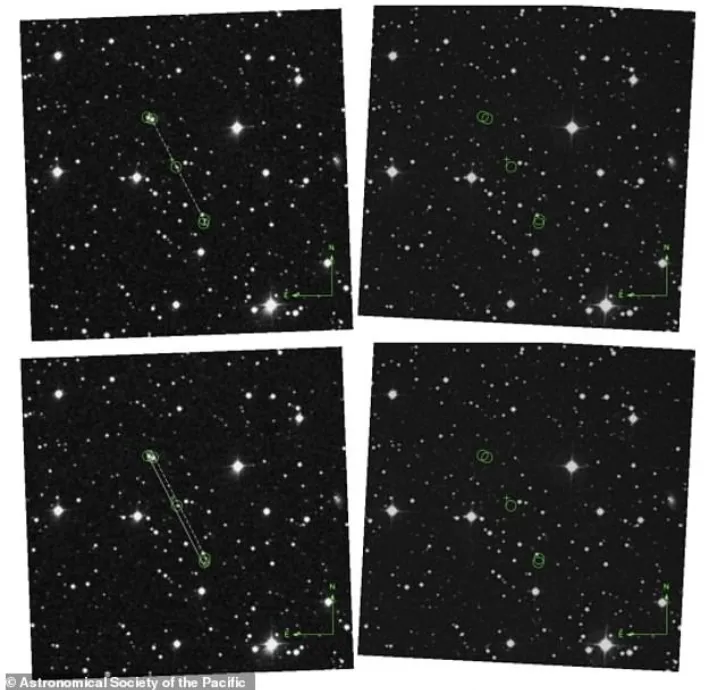
The flashes are real, and the following images show those light flashes appearing and disappearing over time.
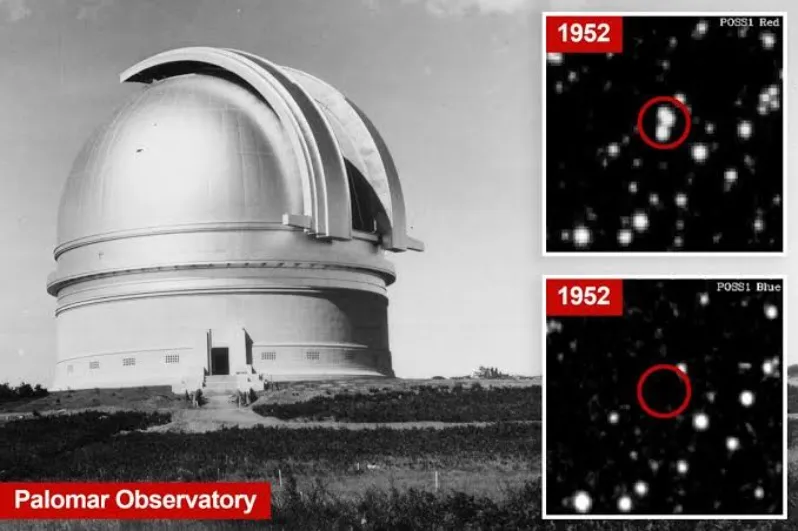
The claim is that this work validates observations from the Palomar Observatory Sky Survey in the 1950s, which show mysterious, short-lived flashes of light, or “transients” that appear as star-like dots. These are often interpreted as reflections from flat, rotating objects in orbit around Earth. You may have heard them referred to as the “Palomar Lights”. In this recent study old photographic plates taken by the Hamburg Observatory in Germany at the same time as the Palomar images were analysed and show the same transient flashes.
VASCO Project
The Vanishing & Appearing Sources during a Century of Observations (VASCO) project, led by Beatriz Villarroel, is a citizen-science initiative searching for stars that have disappeared or appeared across a 70-year timespan. By comparing old photographic plates (1950s) with modern surveys, it seeks to find natural, unknown astrophysical phenomena or potential extraterrestrial technosignatures.
VASCO is a legitimate astronomy research initiative, focused on searching for unusual astrophysical phenomena - specifically objects that appear, disappear, or change unexpectedly in sky surveys taken over decades. Its main goal is to discover rare or unknown cosmic events, such as unusual stars, transient phenomena, or even potential signs of advanced astrophysical processes.
The volunteers for the project have identified hundreds of candidates, and many are likely transient brightenings as opposed to permanently vanished stars.
The VASCO project is not fundamentally a UFO project, though some of its findings have been discussed in that context. Some researchers involved - most notably Villarroel - have explored whether certain unexplained observations (like short flashes or aligned light sources in old photographic plates) could hypothetically be consistent with artificial objects in space. This has led to speculation about UFOs or non-human technology, especially in media coverage. Information on the research Villarroel has been involved in can be found here.
Ivo Busko
The author of the recent study in question, Ivo Busko, is a professional astronomer and software specialist known for his work in astronomical data analysis and telescope instrumentation.
He has been associated with major research institutions such as the Space Telescope Science Institute (in NASA), which operates the Hubble Space Telescope. His work has focused heavily on developing tools and methods for processing and calibrating astronomical data, especially spectroscopic data (using wavelengths of light to study physical properties of celestial objects). He has expertise in spectroscopy, data reduction and calibration, and the development of scientific software.
Busko is a credible, established scientist in astronomy, primarily known for technical and data-analysis work - not a UFO researcher, even though some of the research he’s contributed to has been interpreted that way in public discussions.
Busko’s paper
The recent preprint paper, with the less than eyecatching title of “Searching for Fast Astronomical Transients in Archival Photographic Plates”, reports an independent detection of fast optical transients - very brief flashes of light - in 1950s astronomical photographic plates from the Hamburg Observatory. By comparing pairs of images of the same sky taken about 30 minutes apart, the study identifies transient sources that appear in one exposure but not the other.
It is important here to note that a ‘preprint paper’ is a complete, draft version of a scientific paper that is shared publicly on an online repository before it has undergone formal peer review by a scientific journal. Peer review is an important process to make sure the science is sound before publishing.
A key scientific result in this preprint paper is that these transients have systematically narrower image profiles (FWHM) than normal stars. This indicates they are extremely short-duration flashes (sub-second), rather than continuous sources blurred by long exposures.
The findings independently confirm similar results from earlier Palomar surveys, suggesting the phenomenon is real and not dataset-specific. This suggests the signals are unlikely to be caused solely by local defects or errors in a single archive.
The authors propose that the flashes are consistent with sunlight reflecting off flat, rotating objects near Earth, though no definitive origin is established. Overall, the study shows that archival data contain previously overlooked transient phenomena requiring further investigation.
The study explores possible explanations, including natural astronomical sources, atmospheric effects, and instrumental artifacts. However, it does not definitively identify the origin of the transients.
Overall, the paper concludes that archival sky surveys may contain previously overlooked transient phenomena, and further systematic analysis of historical data could help determine whether these events are natural, artificial, or artifacts.
It’s been worth tracking down the source research. You will notice the study doesn’t talk about this being evidence of non-human intelligence at all!
Possible explanations
The VASCO research also explored statistical correlations between these transient events and other phenomena.
The researchers observed that transients appeared less frequently in parts of the sky that would have been in Earth’s shadow. They interpreted this as possible evidence that the flashes came from objects reflecting sunlight in orbit. Based on the exposure time of the photographic plates (about 50 minutes), they further suggested that these objects might have been stationary relative to Earth - similar to modern geostationary satellites.
One major alternative explanation involves nuclear testing itself. High-altitude nuclear explosions can inject charged particles, debris, and radiation into the upper atmosphere. These effects could produce brief flashes of light visible to telescopes, appearing as point-like sources rather than streaks. Historical evidence supports this theory, as nuclear tests have previously disrupted satellites and altered the space environment. One study found that transients were about 45 percent more likely to occur within a day of nuclear weapons tests. UFO/UAP reposts also went up at the same time. Indicating possible electromagnetic effects causing lights in the sky.
Another plausible explanation is solar activity. Bursts of radiation from the Sun, such as solar flares, can interact with Earth’s atmosphere and produce transient luminous effects. These could also appear as short-lived points of light in astronomical images.
High-altitude balloons are another candidate. During the Cold War, balloons were frequently used to monitor nuclear tests. These objects, reflecting sunlight, could resemble stationary points of light when viewed from Earth.
Astronomical phenomena themselves offer additional explanations. The universe is full of transient events, including supernovae, gamma-ray bursts, and variable stars. Some of these can produce sudden flashes of light that might be captured on photographic plates. In fact, the discovery of gamma-ray bursts in the 1960s came from instruments originally designed to monitor nuclear explosions, illustrating how unexpected cosmic phenomena can mimic human-related signals.
Perhaps the simplest explanation is that many of the transients are not real objects at all but artifacts of the photographic process. Dust, scratches, chemical imperfections in the emulsion, or even radioactive contamination could create spots or flashes that resemble celestial sources. These kinds of errors are common, especially when dealing with older or imperfectly stored materials. Although the photographic plates comparison suggests this is not the case.
Critics also note methodological concerns. For example, the researchers have not yet demonstrated that their detection method can reliably identify known objects - such as modern satellites - in similar data. Without this validation, it is difficult to determine whether the identified transients represent real phenomena or processing artifacts.
One of the papers was not accepted by the arXiv preprint server, which indicated that it did not meet sufficient scholarly standards. This adds to the skepticism within the scientific community, and underscores a need for further verification.
In this short video we hear from VASCO lead Villarroel herself explaining the possible causes, and to me it comes across more as her putting extraterrestrial intelligence out there as an exciting possibility, rather than actually advocating for it. She does think the effects observed are light reflecting off artificial objects, but stops short of saying they are alien. She also speculates about the correlation with nuclear tests and UFO/UAP sightings.
Conclusion
Within the scientific community these ideas, while interesting, are considered highly speculative. Alien structures are only one of many possible explanations - and not the most likely one. The observed patterns in the data are real in the sense that they appear in the images, but their origin remains uncertain. Most scientists favor explanations grounded in known physics, instrumentation, or environmental effects.
There is no direct evidence linking VASCO findings to UFOs or extraterrestrial intelligence. Such extraordinary claims require strong evidence. This is a clear example of the tabloid media taking legitimate research and bonafide researchers and blatantly misrepresenting their findings for a good headline.
I’ll leave you with some of the comments on the Daily Mail Online article.