Going on a Yeti hunt: Sir Edmund Hillary and the 1960 - 1961 Silver Hut Expedition
Bronwyn Rideout - 13th April 2026
It all started in 1958 when Hillary and the British physiologist and mountaineer Griffith Pugh questioned whether Everest (29,031 ft or 8,848.86 m) could be climbed without supplemental oxygen, possibly achieving this by acclimatising at 20,000 ft for several months. Hillary surmised that the prolonged period required for acclimatisation meant that this trek would be far more costly than his first Everest climb. This was a fair assumption to make, as the expedition with which he made his first summit is said to have cost between £15,000 and £30,000, and took seven weeks to reach the summit, including leaving Kathmandu, and acclimatising over a period of weeks at multiple camps up the mountain. Cost was just one of several barriers to climbing Everest in the 1950s. By the time the Silver Hut Expedition set off, just 7 other people in 3 different expeditions had summited Everest between Hillary’s first success and September 1960. Further, these expeditions are the only expeditions that are believed to have even occurred during this time. This time, Hillary estimated that this experiment could cost up to $120,000 USD.
Another obstacle to this climb was diplomatic, as the Chinese government declined Hillary’s request for two bases on the mountain. Tibet had been annexed by China in 1950/1951. An agreement maintaining a “friendly” relationship between China and Nepal was signed in 1956. In 1957, a group of Chinese athletes travelled to the Soviet Union to learn mountaineering. That same year, the Soviet Union would then propose a joint Everest summit with those athletes. The trip was planned for May 1959, but postponed to 1960 due to the Tibetan uprising. 1960 would be the year when the border negotiations between Nepal and China were set to occur, thus making the summit a matter of national and diplomatic importance. However, worsening tensions between the Chinese and Soviets led to the latter withdrawing their cooperation, and their equipment, from the expedition. The Chinese would continue, albeit $700,000 poorer as they needed to purchase new equipment from Switzerland to kit out their 214-person strong crew.
Without access to Everest, the location of this study shifted to summiting the nearby Makalu (27,790 feet or 8,470 m), but funding issues persisted until 1959. Hillary had won Explorer of the Year from Agrosy Magazine, and along with the $1000 prize came the opportunity to speak at a banquet. In the audience was John Deinhart of World Book Encyclopedias, who invited Hillary to visit their headquarters in Chicago. The Wikipedia page for the expedition suggests that Hillary added the Yeti search when pitching the expedition to Deinhart, although Dr Michael Gill implies that it was a deliberate strategy by Pugh and Hillary to hook Deinhart and his employers at Field Enterprises. Norman Hardie, writing in the Himalayan Journal in 1960, states that the Yeti search was included at the request of those sponsors. In any case, it was an inspired move; it both captured the public’s attention and helped Hillary and Pugh secure approximately $125,000 in financial support.
So why make the Yeti the focal point of their PR campaign, rather than the pretty cool science they were going to achieve? The Yeti is part of Tibet’s cultural history, but it wasn’t until the early 19th century that it began to capture the imagination of adventurers and small children. At that time, it was Western visitors like naturalist Brian Hodgson who were recounting the stories told by porters and Sherpas. The only visible evidence reported to exist was footprints, which Western explorers like Hodgson and Laurence Waddell dismissed as made by a bear or an orangutan. The 20th century brought more mountaineers to the region seeking to scale the mountains, as well as increased military and political interest in the terrains and borders. Explorers were bringing cameras to document their treks, and to capture proof of any successful ascent. While pictures of summits were rare, stories of Yeti sightings and photos of supposed Yeti footprints were becoming legion.
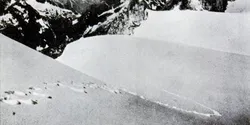
Source - A Frank Smythe photo of Yeti footprints from 1937 that was printed in Popular Science in 1952

Mount Everest was not free from Yeti fever. When Eric Shipton visited in 1951 as part of the British reconnaissance expedition, he found footprints at 20,000ft (6,000m).
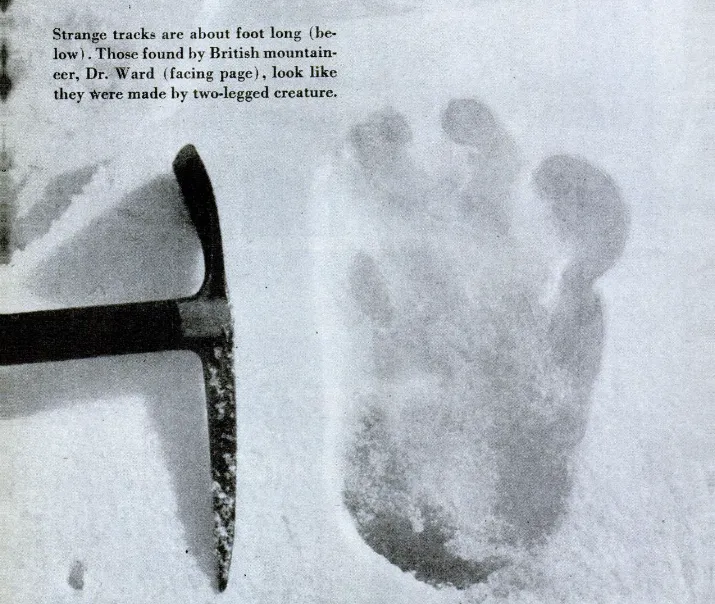
Source - Eric Shipton’s photograph from 1951

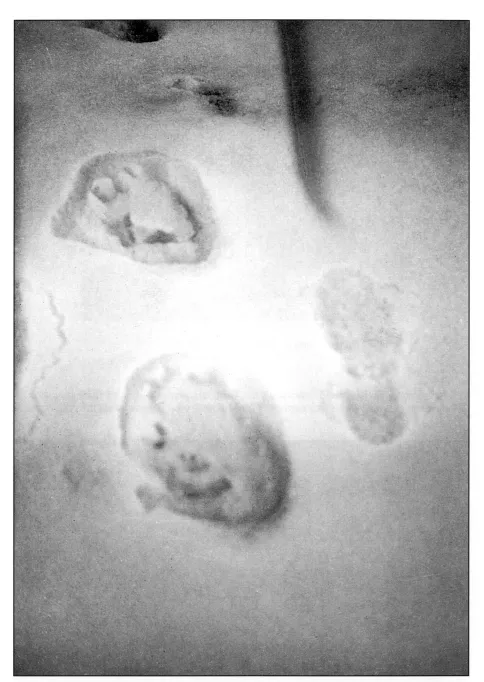
Source - Shipton’s yeti track photos from the Rongbuk Glacier from 1935.
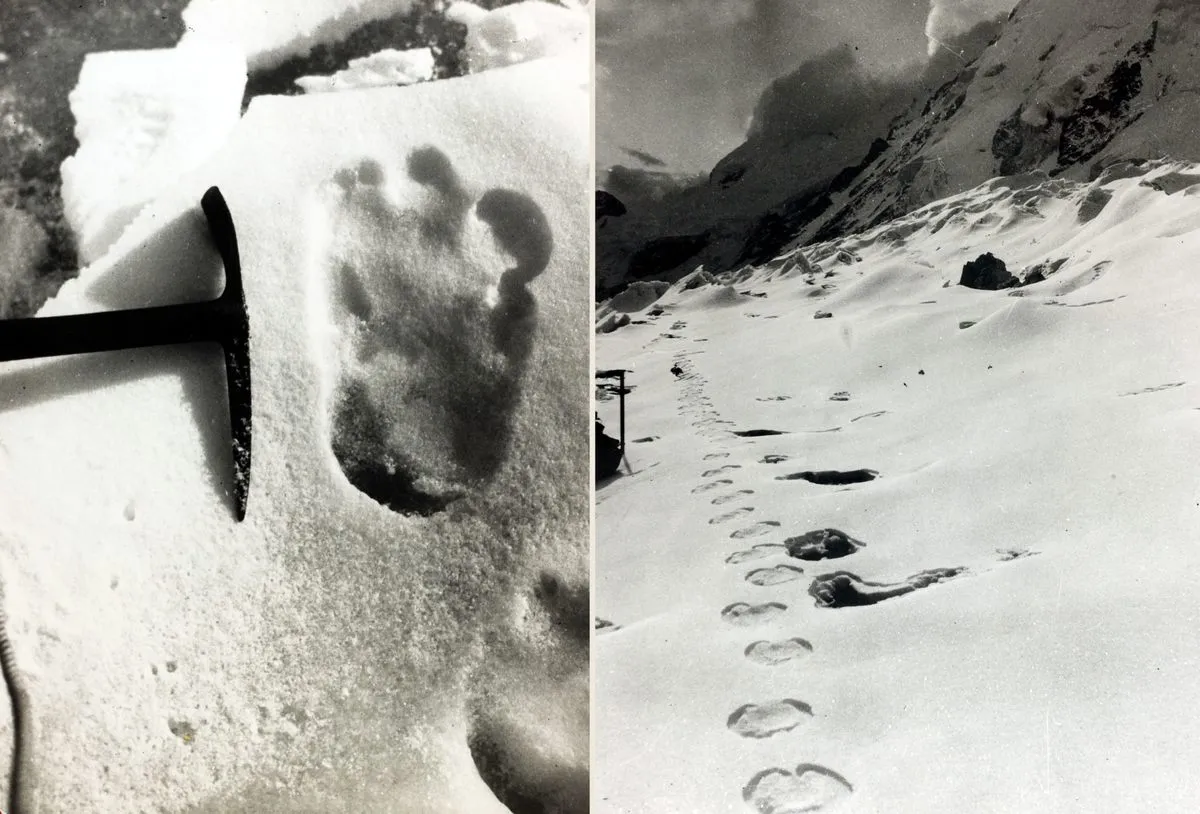
Source - Shipton’s photos
Edmund Hillary was also involved in this expedition, and is noted as an early skeptic. According to Peter Gillman, Hillary noticed a difference in the appearance of the single footprint and the track of footprints. When Hillary queried Shipton about the discrepancies, Shipton was said to have been evasive. Gillman wrote about the photograph in 1989 for The Sunday Times and he had obtained the original photo of the single footprint. He noted that it appeared significantly different from the second footprint, which is often cropped out in publications. He believed that Shipton straight out fabricated the footprint using a glove or a pick-axe, and when he presented his hypothesis to Hillary, Edmund agreed that he thought Shipton was capable of such a hoax:
“He definitely liked to take the mickey out of people,” Hillary told me. “He might have tidied it [the footprint] up, made it look fresh and new and photographed it.” As for Shipton letting the story run, Hillary said: “He would think that was quite a good joke.”
However, Gillman’s theory has not been proven, and the images remain a subject of fascination and study.
Reports of large footprints recurred throughout the 1950s, on Everest and other mountains. When Hillary returned to Everest in 1953, both he and Tenzing Norgay saw large footprints. Various expedition teams were able to obtain hair specimens from what was allegedly a Yeti scalp, which with the laboratory testing available in 1954 was inconclusive as to the species of origin, but likely a hoofed animal with coarse hair. Ted Slick led multiple expeditions to Nepal in the late 1950s, securing not only Yeti poop but also a Yeti hand in 1958. The hand, known as the Pangboche hand, was an artifact from a monastery that had a similar appearance to a mummified primate hand. In a story that feels like an episode out of the Twilight Zone, a member of Slick’s team, Peter Byrne, stole bone fragments after monks refused to release it (although Mike Allsop of Weta Workshop reported that Byrne told him that he legitimately paid the monks for the bone). Then the bone was smuggled to India, where actor Jimmy Stewart (of It’s a Wonderful Life fame) smuggled it to the United States. The missing bone was replaced with human bones (which came from who knows where). This would not be Byrne’s final brush with cryptids, as he moved to the United States and became a famous cryptozoologist specialising in Bigfoot.
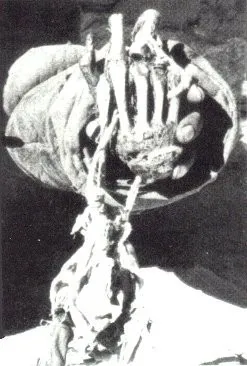
Source - The Pangboche hand as it appeared in 1958
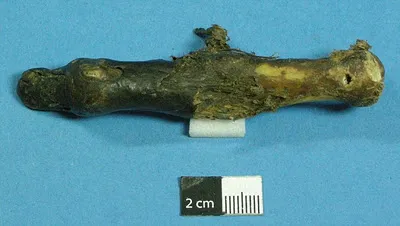
Source - The finger that was smuggled out of two countries
Concurrent to the scientific interest in Yetis was the growth in the visibility of the Yeti on the big screen, in which the Yeti serves as a menacing figure - although the 1961 Bugs Bunny short The Abominable Snow Rabbit, and the character of Bumble in the 1964 stop-motion film Rudolph the Red-Nosed Reindeer, provided sillier takes.
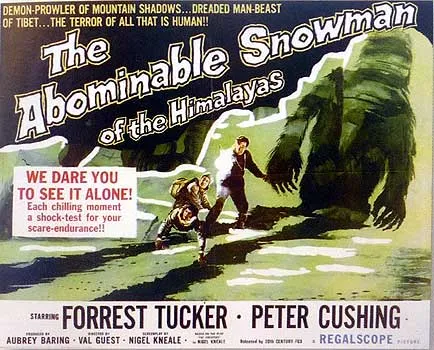
Source - Hammer Horror’s 1957 The Abominable Snowman of the Himalayas
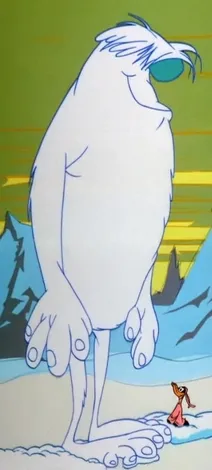
Source - Hugo from The Abominable Snow Rabbit
So, yeah, despite his skepticism, Hillary’s legacy nevertheless includes several goofy photos of him holding pictures and artifacts about the Yeti. But for the time, it could be seen as something of a win for critical thinking and investigation. The climbing part of the expedition was plagued by bureaucratic and health issues, but the scientific work was pioneering and, to some, has yet to be surpassed or refuted.
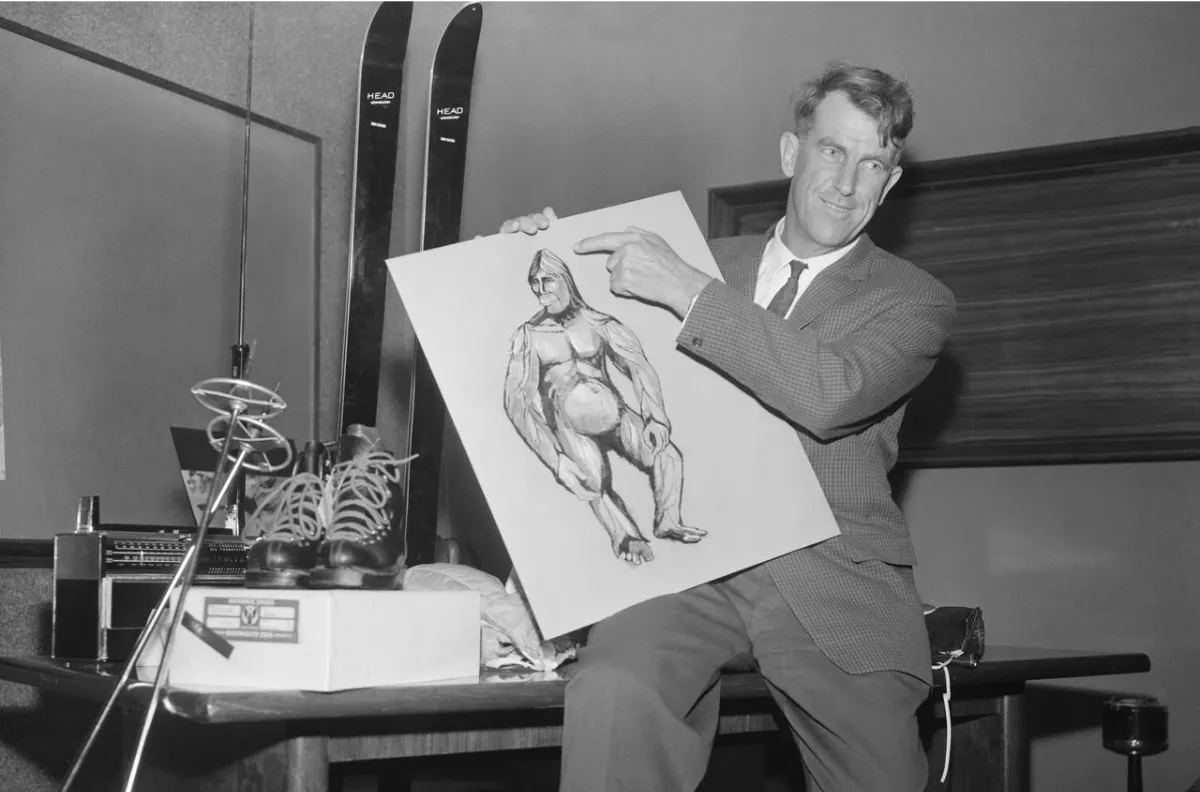
Source - Hillary at a 1960 news conference before commencing his expedition.
As for the abominable part of the expedition, Hillary was clear from the outset that he didn’t believe that the Yeti existed, but even he struggled to rationalise some of the items he collected during his investigation. Tom Ward, writing for Mother Jones, suggested that deference to the Sherpa communities might have made him less publicly dismissive of the items they collected and treasured compared to his statements about Shipton. Hillary publicly stated that he found the scalp convincing, but noted that they needed to be examined by experts. Unlike the alleged thievery of Slick’s expedition, Hillary facilitated the removal of a Yeti scalp from Nepal with the agreement that the scalp was accompanied to the overseas labs by a Sherpa and that it would return to its home village within 30 days. The scalp would go to labs in Paris, Chicago, and London and, in return, Hillary was asked by village elders to build a school. This request marked the beginning of a new humanitarian project of Hillary’s, The Himalayan Trust, which continues to this day.
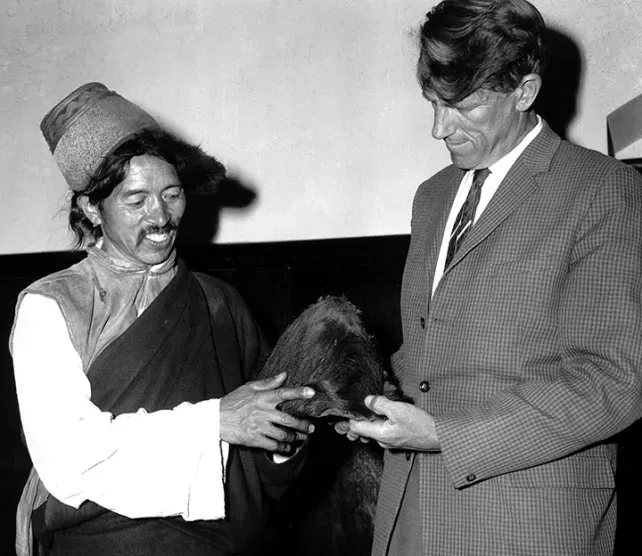
Source - Sherpa Khunjo Chumbi and Hillary with a scalp. Chumbi would be the scalp’s chaperone.
Fortunately (or unfortunately, depending on your perspective), scientists agreed that the scalps were likely fake and made from the skin of a serow, a goat or antelope-like animal. Hillary also debunked the Yeti hand kept at Pangboche. Even with the switched-out bone, Hillary and his team thought most of the bones in the hand belonged to a woman or a young lama.
The tale of the Pangboche hand does not end here, and while Hillary exits stage left at this part of the story, New Zealand plays an interesting part in its conclusion.
The finger that Byrne had bought/stolen was taken to London for study. One scientist who examined the bone declared it was human, but there were doubts. The bone disappeared for over a decade before it was found in the Royal College of Surgeons’ Hunterian Museum, although records at the museum indicate that Osman Hill - Primatologist at the Zoological Society of London, friend of Tom Slick’s, and the first western scientist to examine the finger - had made the donation himself. In 2011, the bone underwent DNA testing and was found to be human.
Byrne had also kept a portion of skin, which was examined on the TV show Unsolved Mysteries. That investigation proved inconclusive, but it brought unwelcome attention to the Pangboche Monastery. Soon after the episode aired in 1991, both the remaining hand and a Yeti scalp were stolen and have never been recovered. The theft left the monastery without its main source of income for over a decade. An Air New Zealand pilot and mountaineer named Mike Allsop heard this story and was inspired to make a replica to help the monastery replace what it had lost. He was eventually introduced to Richard Taylor at Weta Workshop, who did produce a replica scalp and hand. The replicas are said to be on display in a protected case at the monastery.
Tags: hillary, yeti, expedition, wiki, importance, footprints, images, source