A Bit Miffed
Mike Joy - 13th April 2026
In a recent Skeptics Newsletter, I was a bit miffed about what I see as a lack of scepticism around the so-called ‘energy transition’. Patrick highlighted a blog projecting that global investment in renewables would soon be more than spent on fossil fuels. And then there was the link to rewiring Aotearoa. I think it’s important for us to be a bit skeptical about this so-called energy transition - which isn’t happening, despite all the hype. There has indeed been addition of renewable energy, but no transition because we keep using more energy (from 2021 to 2024 fossil fuel additions still outstripped renewables 2.6:1).
It’s not just in this newsletter, it’s everywhere, triggered recently by the proposed LNG terminal and Iran war. Many pundits, academics, some politicians and NGOs have joined in saying we should replace LNG with renewables, and overwhelmingly the solar PV option has been championed.
I’m totally opposed to LNG imports and all fossil fuel use, but what this revealed to me is that there seems to be a deeply held belief that there are no planetary biophysical limits to growth. I didn’t hear a single mention of the option of reducing consumption. The view seems clear that if one energy source runs out, we can simply grab another, and if GHG emissions are less then it’s clean. There was also little or no mention of the problem of the intermittency of solar PV.
The intermittency problem of renewables, especially solar, is because we expect electricity to be available 24/7 but more than half the time the sun isn’t shining and in winter it can all but disappear for days. This shortall is known as the capacity-factor, and for solar PV in New Zealand in winter months this often drops below 10%. Thus, to cover this shortfall you must install 10 times as many panels and/or build in storage.
For most people the glib response to this intermittency problem is – easy just install batteries. Never a mention of the material, human and environmental toll of producing batteries or pumped hydro or any other balancing option. Or the fact that the materials required are rare and becoming rarer (more on that below) and that these materials are required in ever greater amounts for a raft of other technologies aiming to reduce fossil consumption (EVs for example).
I completely understand the attraction with renewables (rebuildables), the idea that we can replace polluting fossil fuels with clean green renewable energy is of course incredibly appealing.
The problem is we want it so much it seems we wilfully put blinkers on and block our ears to the fact that while energy from sun and wind is renewable the infrastructure to capture and share it is far far from renewable, or clean or green.
I’m sure commentators will remind me just how fast the associated technology is advancing and becoming more efficient. I want to point out three problems with that idea that are growing as fast or faster than technology improvements:
- The materials needed for the transition are becoming rarer, so more energy (mostly diesel) is required to mine more and more of the earth to get the ever-diminishing minerals (with growing environmental impacts). It’s not just the mining - in many cases the real harm comes in the processing, the toxic, complex, and energy-intensive process of chemically un-bonding the 17 rare earth elements from one another.
- The fossil energy used to do all the mining and processing and transporting is on a similar trajectory, the amount of energy required to get the fossil energy has been increasing for decades as all the easy-to-get coal gas and oil is gone. This phenomena also known as the energy cost of energy (ECOE) is climbing rapidly. This means more fossil fuel mining to get the same amount of energy. So crucially these two in combination - declining ore concentrations and rising energy cost of energy means the critical materials can only get more expensive.
- Finally, as fast as we come up with new technologies to capture energy we also come up with new ways to consume more energy. We keep increasing electricity consumption with for example AI and data centres. This means that despite all the technological advances and the installation of massive amounts of renewables we are no closer to catching up, in fact we are going backwards -fossil fuel consumption is increasing faster than we add “clean energy”.
This graphic from a comprehensive UN report assessing the life cycle of electricity generation options compares the material footprint of the different options (gas, coal, hydro, nuclear, wind and solar PV and puts paid to the “clean energy” label at least for materials.
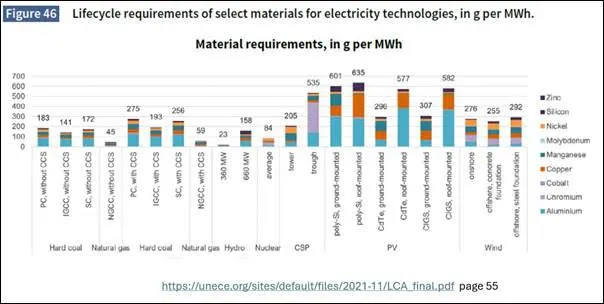
To put this footprint of materials into perspective this peer reviewed paper revealed that the current Net Zero 2050 plans for renewable energy would require quantities of rare earths, graphite, silver, and cobalt exceeding their annual production by 38, 61, 40 and 81 times, respectively. And the required quantities of silver and cobalt are 1.724 and 1.711 times greater than the corresponding estimated global reserves.
Given the declining ore concentrations the amount of mining to achieve this goal would be incredible.
Even if we did manage to ‘electrify everything’ regardless of the source of the electricity it would not mitigate all our other existential crises, in many cases it would exacerbate them.
Electrifying chainsaws, logging trucks, and ships will not stop deforestation and land-use change and the associated biodiversity loss and social harm.
Electrifying fishing boats will not stop fisheries collapse. Electrifying our current agricultural systems will not in any way address out planetary carrying capacity overshoot, biodiversity crash, 700% increase in the biomass of humans and the animals we eat since industrialisation.
Electrification won’t reduce the pollution of freshwater and oceans with plastic PFAS and other emerging contaminants, it won’t limit soil erosion and land degradation, energy negative food, over extraction of groundwater loss of wetlands, peak phosphate, freshwater eutrophication, oceanic dead zones, and invasive species infiltration, the decline of insect populations.
All of these existential crises not mitigated by renewable and climate change are not problems needing a solution they are symptoms of overshoot (see the graphic below). This overshoot was enabled by excess energy and no matter how clean the energy is continuing to supply it can only lead to disaster.
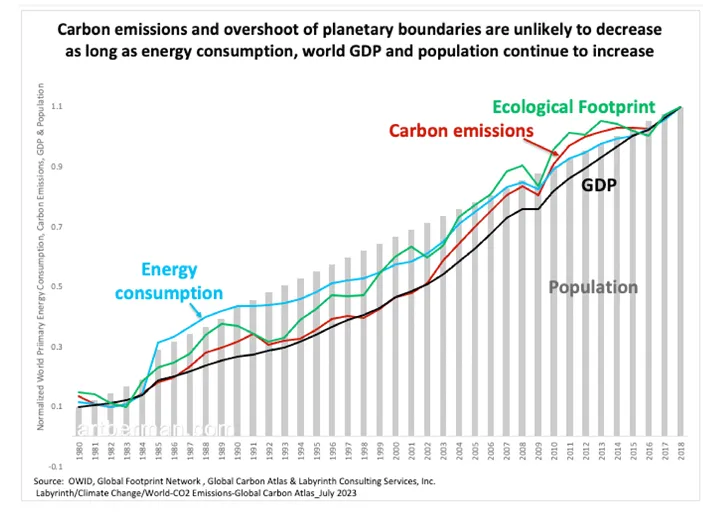
I’m not for a second saying we should continue with fossil fuels, and there is no doubt that emissions are lower for renewables. If we lived on a limitless planet and climate change was our only crisis then the choice would be easy. But the climate crisis is far from our only crisis, we face a bunch of them and all like the climate crisis included are symptoms of overshoot.
There is always the ‘less harm’ argument put forward - the idea that we turn a blind eye to the harm because it is less. I tried to point out the flaw in this thinking here, put in a nutshell with this quote from the historian and philosopher Hannah Arendt: “Those who choose the lesser evil forget very quickly that they chose evil.”
I have no doubt that renewable energy will be part of our future, but that future will have to be one of much reduced consumption, otherwise we will destroy what is left of the life-supporting-capacity of our only planet while trying to maintain the unsustainable (our wealthy world current lifestyles).