Youth with a Mission (YWAM)
Bronwyn Rideout - 30th March 2026
Since 2019, the Korean-based Christian sect of Shincheonji has repeatedly landed itself in news headlines for its recruitment on university campuses in New Zealand and Australia. The most recent of these stories was published in February 2026, when a chaplain at the University of Canterbury (UC) in Christchurch raised an alarm about the group’s “dodgy practices”. This made me reflect on my own time at UC as an international postgraduate student, and what I observed in relation to religion-based student groups in universities and polytechnics across New Zealand.
Something that still sticks with me to this day was an Olympic opening ceremony brunch that was advertised as planned by an institution’s international diversity council, but was actually hosted by one of the well-established campus Christian groups. While I had been tipped-off about this prior to the event (and, in my typical stroppy atheist fashion, strongly advised my contact at the student association that this be made clearer in the advertising), it wasn’t revealed to the remaining attendees until an hour after the event started; it was time to say mealtime grace, and a representative of the student association asked that the hosts say a few words.
And there was no way this group was going to go for a simple “thank you for the food” style prayer. Whether my “…but actually…” made any difference as to how much soft recruiting was on display is debatable (and I have no high ground here, since I did eat the pancakes), but suffice to say that dodgy recruitment tactics abound on university campuses.
Anyways, I’ve been toying with an idea about deep diving into cult/religious recruitment on New Zealand university and polytechnic campuses for a while. I still haven’t reached the critical mass of research necessary for one of my articles just yet, but the YouTube algorithm did work in my favour when recommending a video I had watched over a year ago. My favourite YouTube channel, Fundie Fridays, posted its deep dive into Christian Missionary Organisations where they discussed Samaritan’s Purse, which runs Operation Christmas Child (I wrote about this evangelistic activity in 2021), as well as Youth with a Mission, aka YWAM. And colour me intrigued, because I knew of YWAM and its activities in general, but I didn’t know anything about its operations or history. I can’t even pinpoint when I first became aware of the organisation. Once my research turned up a significant New Zealand connection, I knew my attention would be thoroughly taken away from my original plan.
What is YWAM?All credit to a thorough PhD thesis by Allison Kach-Yawnghwe for the historical information provided in this article. YWAM, as it exists today, is an interdenominational Christian mission organisation with 10,000 to 20,000 staff members working in over 130 countries. It was founded in 1960 by the late Loren Cunningham. Between 1955 and 1957, while studying at a midwestern bible college, Cunningham performed with multiple gospel quartets and ministered to Assembly of God (AOG) churches. While touring the Bahamas with a gospel quartet called The King’s Magnifiers, in 1956, Loren had a vision in which young people were preaching the word of Jesus and covering the continents like waves. After graduation, he worked as an assistant pastor in California for two years before founding YWAM.
The organisation’s early growth relied heavily on the network of family and friends who were missionaries, as well as the global circuit of AOG and Pentecostal churches in which Loren ministered as an itinerant evangelist. The first YWAM program, called “vocational volunteers”, was launched in 1961 with assignments lasting 1 to 2 years, compared to the 5-year commitment made by traditional missionaries. Amongst the early applicants was a nurse called Darlene Scratch, whom Loren would marry in 1963. Darlene brought to the marriage her own extensive network, from the Pentecostal Assemblies of Canada, that would be leveraged to further the YWAM mission. The couple would travel across the US and introduce short-term missions and domestic activities to engage youth with restrictive school holiday schedules. They collaborated with other organisations, and had amassed a very good reputation outside of the AOG, but conflict arose with the AOG leadership in 1964. While the Assemblies of God wanted YWAM to operate under its structures, Loren sought greater freedom to run it as he saw fit. The Cunninghams officially withdrew from the AOG and started to develop YWAM into the independent organisation that we know it today.
So, what’s the kiwi angle here?
YWAM’s entry into New Zealand occurred in 1967, just over two years after the Cunninghams broke with the AOG - making it the second foreign country where YWAM established its ministry (Canada came first in 1966). An opportunity emerged through connections Loren and Darlene had made with David Wilkerson and his ministry, called Teen Challenge. Founded in 1961, Teen Challenge sought to resolve teen delinquency and moral decay. Today, it provides residential rehabilitation programmes for youth experiencing addiction, but has garnered a reputation for abuse and racism as a cornerstone of the ‘troubled teen industry’. Wilkerson was an early supporter and promoted YWAM extensively, with the ambition of making the youth who signed up for Teen Challenge part of YWAM as well. In turn, YWAMers worked in Teen Challenge centres.
The Teen Challenge centre in Auckland was founded in 1965, by Jim and Joy Dawson. Along with Neville and Dorothy Winger, they were involved in the Massey Faith and Order Conference of 1964 and in the Charismatic renewal movement in New Zealand at the time. Thus, there was both a burgeoning youth movement, and an influx of new converts in Aotearoa who were seeking some sort of higher calling. It would be the Wingers’ daughter, Gayle, who set things in motion. She and her husband met Loren while studying at a bible college in Minneapolis, and they invited Cunningham to speak at a Christian youth camp her parents owned. The Wingers had purchased an 800-acre farm on Great Barrier Island in 1963, and used the property for conferences, school camps, and ministry. Called Orama, the property continues to operate today with involvement from the Winger family.
Loren arrived in New Zealand in January 1967 with plans to recruit for their New Zealand crusade with the assistance of his sister Janice and her husband Jim Rogers. The Rogers had already rented a property at 69 Ponsonby Road, established local networks, and created a mailing list. They also collaborated with the Dawsons and used the Auckland Teen Challenge centre for YWAM outreach activities. Loren would spend over a week at the camp, making strong friendships with both the Wingers and the Dawsons (who were also in attendance), and sharing his vision for YWAM with the 150 campers. During his time at the camp, Loren claims to have picked up some new practices from his kiwi hosts when it came to submitting to the holy spirit:
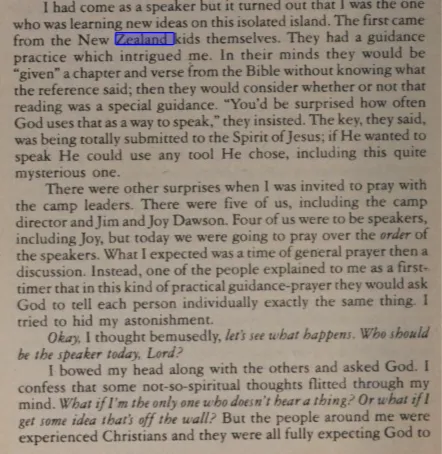
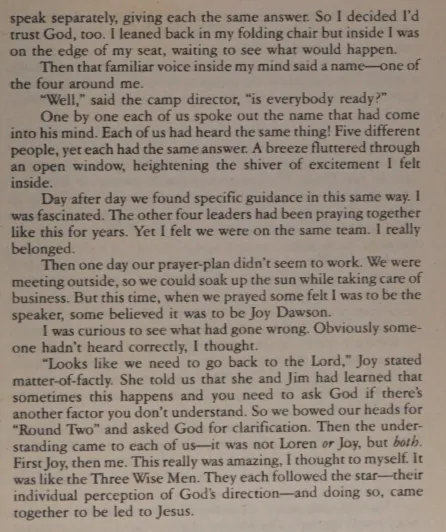
Excerpt from Loren Cunningham’s Is That Really You, Lord?
After the camp Loren went to Auckland, and while he was supposed to jump into recruiting for the crusade he apparently received a message from God that told him to withdraw from people for seven days and fast.
I’m not too sure what his sister and brother-in-law really thought about that! But it was a transformational experience, according to Loren, in which he confessed to all of his sins and wrote several letters seeking forgiveness from people who harmed him. This radical spiritual surgery would become the mainstay of YWAM programming, as discussed later in this article. When Loren finished his fast, he began meeting some of the youth who were active in the Auckland ministry. He would stay for six weeks and fully establish YWAM in New Zealand.
Kach-Yawnghwe writes that the New Zealand recruits, like many early YWAMers, were already Christians and not fresh converts to Christianity. Also, the kiwis were the first non-pentecostal recruits, which would have a significant influence over how YWAM evolved as early members like Ross Tooley, Barry Austin, and the Fountain brothers (Jeff and Warren), grew up and led missions, as well as taking on high-level leadership roles in YWAM governance both here and abroad. New Zealanders continued to take on significant leadership roles, with Frank Naea, an Aucklander of Samoan and Maori descent, serving as international president for three years between 2000 and 2003.
One of those youths Cunningham met was Kalafi Moala. Moala had come from Tonga on a scholarship to study at a Methodist seminary, but also admitted to being a troublemaker. However, his spiritual life was taking a more evangelistic turn, and he was willing to give up his education to work with YWAM. Moala would go on to help organise YWAM’s first campaign in Tonga, which occurred during the coronation of their new king. He also created informal networks that allowed YWAM to grow their mission in the Pacific and form its Australian ministry, and he was the founder of YWAM Japan. However, Kalafi also faced a lot of personal struggles and at least one scandal during his time in YWAM, and is presented as the prodigal son in Cunningham’s book Is That Really You, Lord?
New Zealand continued to play a part in the expansion of YWAM, but it wasn’t always a setting for success. In 1972, Cunningham and his team were preparing to lead an outreach event at the Olympic Games in Munich. The activities of this outreach can be seen in the documentary, Revolution of Love.
During those preparations, Loren received another vision of obtaining a ship for missions of mercy and disaster relief. He didn’t have to wait too long after the games before an opportunity arose in New Zealand. The inter-island ferry named Maori was for sale. YWAM agreed to pay the Union Steamship Company a deposit of $72,000 (although New Zealand newspapers reported that just $48,000 was paid) by September 4th, 1973, and the rest within 30 days. They renamed the ship Agape and made their plans for the ship known. Much like their evangelism during the Olympics, the new ship would be a key piece in their efforts to proselytise during the upcoming Commonwealth Games in Christchurch by bringing people over from California and travelling to ports around New Zealand. However, by October 22, they had not paid the balance remaining on the $480,000 price tag. Despite securing a sponsor in Manila, delays and excuses in getting the money to NZ pushed YWAM to seek extensions. At the time, a contingent of staff and crew members had permanently relocated to Wellington to help prepare for the journey, and they were even allowed to start refitting the ship.
While a final extension was given until November 1973, no further access to the ferry was allowed. In newspaper articles published throughout November, Loren was convinced that God would provide the money “…when we are spiritually prepared”. However, the arrangements finally collapsed in mid-December 1973. Loren has since written that this failure was a lesson about how he forgot about Jesus in his pursuit of the glory the ship would have brought. It would be another 5 years before the Mercy Ship ministry would finally get into the water, in 1978, when YWAM finally purchased its first ocean liner, the MV Anastasis.
The next time New Zealand appears to rock the YWAM history books is the success of the Impact World Tour in 2004. Impact was a campaign that connected with teens through youth culture, skateboarding, and feats of strength. Their visit to New Zealand reached 315,000 people, with 23,000 converting. A book about this tour is available to purchase online.

How do you become a YWAMer?
The main audience for YWAM is the 18-30 demographic, although there are special programmes and Discipleship Training Schools geared towards families, married couples, and retirees. Within YWAM are multiple ministries such as King’s Kids (directed towards involving children, teens, and families) and a health care ministry network called YWAM Ships (formerly YWAM Mercy Ships, which has since spun-off into its own organisation). When it comes to recruitment, the word of YWAM is shared through church youth groups, Christian colleges/student housing, social media, and the occasional missions or career expos.
A big part of YWAM’s work is in missions and, according to the FAQs, a person can join a mission as a student, staff member, or volunteer. However, the distinction between staff and volunteers is a bit blurry on the surface (or outright obliterated if you look at the YWAM Queenstown website). YWAM does not pay wages to either staff or volunteers; anyone who joins YWAM is expected to fundraise their own support through savings/family/friends/home church. Other funding options, like scholarships, discounts for students from certain countries, and targeted donations from the general public, can help cover any incidental costs that may occur during your mission; some former members have stated that taking on a job during your mission or pre-mission training is prohibited.
What differentiates volunteers from staff is the fuel of many controversies and criticisms that YWAM currently faces. Volunteers go on short-term trips to help establish missions under the Mission Builders ministry, sometimes for as short as a couple of weeks or as long as a year. Volunteers do not have to complete any additional training. Staff, on the other hand, must complete Discipleship Training School, or DTS. DTS is a 5-6 month course that starts with approximately 3 months of training in which students attend lectures and church, and are trained in evangelism. These are held in what is called a base, which is just a property on which YWAM’s activities are held in that particular city or country. The remaining time is spent conducting Outreach or on a mission, during which students generally travel overseas.
Each base offers a unique schedule of themed schools. Te Ao Mārama YWAM Auckland focuses on Māori and Pasifika communities, whereas YWAM Queenstown and YWAM Oxford offer a combination of sports and spirituality-focused schools (I love a good slogan, and Oxford has a good one for their Winter Pursuits DTS: Bringing hope to the slopes for Jesus). This variety is made possible because YWAM was designed as a decentralised organisation, with the expectation that it would give individual bases greater flexibility to operate as they saw fit, as a way to meet community needs. But, like other organisations that pride themselves on their decentralisation (Looking at you, ISTA), YWAM has experienced problems. Sometimes, a base might outgrow YWAM and become its own organisation, i.e. Fire and Fragrance and Mercy Ships. At other times, accusations of financial or spiritual abuse have emerged, leading to a mass deflection from current YWAMmers or alumni in the form of, “Not all bases are the same” and “plausible deniability” from leadership, according to researcher Olivia Jackson in The Guardian. Without any intraorganisational accountability process or regulatory body to oversee missionary organisations, misbehaving missionaries can continue to work in the field and even form their own organisations, as is alleged of former YWAM Maui directors Tom and Cindy Bauer, who now run Surfing the Nations.
Paying to serve
DTS is also… not cheap. Fees to your YWAM base alone can be over 10k. The Winter Pursuits DTS at Oxford charges $7,900 for the lecture phase, and between $6,000 and $8,000 for the outreach phase, depending on location. The Classic DTS at YWAM Queenstown is $7,600 for the lecture phase and $6,000 to $10,000 for outreach. Te Ao Mārama YWAM Auckland is cheaper, at $5,000 for the lecture phase and $5,000-$7,000 for outreach; this base is also forthcoming regarding possible discounts. These fees do cover quite a bit, including housing, food, some activities (like lift passes) and educational costs, as well as travel for mission or DTS reasons. However travel to and from your home country, visas, and personal expenses like toiletries and snacks must be covered by the student. To put the cost into context, the 2026 fees for the University of Auckland’s Bachelor of Medicine and Bachelor of Surgery is approximately $19,531.20 for domestic students, while a Bachelor of Arts can cost between $7,600 and $8,800. All in all, a young New Zealander staying in this country for DTS for 5-6 months can have out-of-pocket costs equivalent to 1 year at medical school, or 1-3 years of an arts degree at a local university/polytechnic.
That’s a lot of money to shell out for the opportunity to have an unpaid staff position that you then have to continue to fundraise for, for the duration of your time at YWAM. Most bases ask for a minimum of two years. Shorter contracts are available, and it is also not unusual to hear of staff who work with YWAM for longer. But, due to the aforementioned allegations of abuse and possible spiritual mismatch between incoming students and YWAM’s core doctrines or principles, there are also many who do not become staff, or who even leave DTS partway through.
The size of the DTS can vary based on the base. A small base like YWAM ZION/Northland may take about 15-25 students, while larger centres can have 50 students in a DTS and may be running multiple schools at the same time. There is substantial money flowing into the bases. If a base runs a single school with 25 students paying just $5000 for the lecture phase and $5000 for the outreach phase, the gross would be $250,000 for six months before expenses. If those 25 students were doing a $17k DTS, then the gross intake would be $425,000 for six months. There is little to no transparency about how student money is allocated. A more sporty DTS with lots of skiing would incur additional costs when it came to lift tickets and the like, but anecdotally one ex-YWAMer was told that it went to cover the expenses of international speakers.
What happens after DTS?
Students can leave YWAM behind and never look back. If they wish to stay with the organisation, they can become a volunteer for a mission, such as providing free medical care in the Pacific through YWAM Ships Aotearoa, ripping phone books and using your head to break bricks with Team Xtreme, or applying for a staff role at any base (as long as they have the skills the base needs). Students can also throw more money by attending a ‘Secondary Level School’. These programmes build on what was learnt in DTS, but promise more specialised pathways, including counselling and theology. As with DTS, these programmes can vary depending on the base, and are advertised less frequently.

A final option is to go to the University of Nations (UofN). DTS is a prerequisite for attendance and students can apply for credits if they attended a second-level school. However, there is nothing to be said about whether the second level schools or DTS work could be applied to any of the major New Zealand Universities/polytechnics, or if it is even recognised by any of the Christian colleges. Neither YWAM or UofN appears on the NZQA approved provider list. On the other hand, New Zealand tertiary institutions do offer alternative pathways for homeschooled students, including portfolio or other assessments as required. While recognition of prior learning may not be formalised, there are other ways for these students to utilise their YWAM education to gain admittance to an accredited school.
What are the core beliefs of YWAM?
While YWAM’s initial vision was non-denominational, it is a blend of Pentecostal and charismatic traditions that will not sit well with many, and is more appropriately described as interdenominational. Their values are outlined on the main website and include, among other things, the Bible as the authoritative word of God. Unsurprisingly for a missionary organisation, YWAM practices dependence on God for financial provision, but says to also give one’s talents to God without expectation of remuneration.
There is the standard boilerplate about God’s intention for holy matrimony to be between one man and one woman, but how some YWAM bases respond to this and other sins is where accusations of the organisation being a cult and taking advantage of vulnerable, isolated young people become much louder. In a 2025 article by Shanti Das for The Observer, one interviewee recounted how Australian YWAM staff performed an exorcism on a male student who had admitted to having sexual relations with other men. Such confessions occur during the lecture phase of DTS, either over a day or longer depending on the number of students; one redditor even called it Plumbline Week and, in the same thread, another redditor wrote that it was called Forgiveness and Repentance Week. During these sessions, students would be coerced into either confessing their darkest secrets or making up fake ones to just get it over with. But, once a confession was extracted, there would be prayer or the casting out of demons, as the case may be. This is connected to YWAM’s core belief in intercessory prayer and its value in overcoming Satan. You may recall that Loren went through a similar process when he first visited New Zealand in 1967, only he could maintain his dignity because he could do it privately and then choose to write letters; DTS students on the other hand might be forced to do this with an audience of 15 or more people. The video below describes how one such session played out at a YWAM base in Perth:
https://www.tiktok.com/@thatsilkymama/video/7351160504968138015
In popular retellings, Loren Cunningham, along with Bill Bright, is cited as an originator of the Seven Mountains Mandate (7MM), an ideology in which Christians are to take over 7 areas or mountains that influence our society - arts and entertainment, business, government, education, family, media, and religion. Alternative perspectives suggest that Cunningham and Bright were starting to formalise a concept of Christian dominionism that had actually begun to percolate in the early 20th century. 7MM does not play a big part in YWAM’s outward image, but it is a cornerstone of the University of Nations.
Are there informal beliefs?
This is where things get tricky when researching, because one must rely on social media and stories that we presume are shared by genuine ex-YWAMers. The accurately named subreddit r/exywam is laden with yes/no stories about what happened at certain bases. In one thread, a mother is concerned about her daughter’s mental health and restricted phone access during her outreach mission, especially since the daughter claimed that the leaders took everyone’s phones. The responses ranged from reassuring to really worrying. There was general agreement that withholding property from adults was a red flag, and it was noted that at some schools, staff had deliberately limited communication or tried to discourage talking with family members because they might tempt you into rebellion. One respondent who had participated in the outreach phase in the same country reported that their phones had not been taken away during their DTS.
There were mixed experiences about YWAM’s attitude towards medication. Some commenters shared that staff on their DTS did not support students who discontinued or disposed of vital medications, and were adamant that God would never tell anyone to do that. YWAM Asheville reminds its students to pack extra medications if they can’t refill their prescription at their DTS location. Others, of course, had conflicting experiences where they were coerced to stop medicating as a demonstration of one’s faith in God’s healing, or because illness is a sign of demonic possession. One testimony on the YWAM Louisville website champions the strength of one individual’s faith in God in choosing to no longer take her life-extending medication.
In this video, TikToker Holls talks about what happened when a fellow YWAMer broke her glasses after getting swept up in the belief that God would heal her eyesight:
https://www.tiktok.com/@holl2801/video/7073138062032702766?q=YWAM%20cult&t=1774695757749
Another TikToker, Sarah (aka thatsilkymama), has a series of videos about YWAM and shares a double-whammy of poor medical practices with her Australian-based DTS. Not only were she and other attendees told to pray and have more faith during illnesses, during her outreach she was also expected to provide nursing care despite not having appropriate training - and she was only given one pair of medical gloves.
https://www.tiktok.com/@thatsilkymama/video/7350363706439519518
https://www.tiktok.com/@thatsilkymama/video/7351869327915699486
In the context of YWAM’s Pentecostal and Charismatic roots, some ex-attendees who didn’t grow up in those denominations do express criticisms towards the demonstration of spiritual gifts (miracles, speaking in tongues, prophecy, healing, etc) and forced fasting, if those practices occurred at their base. Prophecy or hearing the voice of God can be used to manipulate students, and can cause trauma or feel heretical, as these videos by Betsy Gentry, Faith Robinson, and a volunteer named Leah elaborate on:
https://www.tiktok.com/@betsygentryy/video/7065673496436755758
Final Thoughts
Today, there are 6-7 bases operating in New Zealand, including YWAM ships. There are anonymous allegations of abuse occurring during DTS held here in NZ that I found scattered throughout social media and hidden away in the comment section of multiple videos and shorts. As empathetic as alumni were to those who experienced spiritual abuse during DTS, there is still a sense of “I got mine” in their responses. There is a rush to say “not all bases” instead of seeking accountability from all bases to move the dial to “no bases whatsoever”. The lack of transparency around finances prevents me from concluding whether the bases are thriving, or if their potential customer base is hemorrhaging to other, more youthful mission programmes. The death of Loren in 2023 has (allegedly) been followed by the UofN and the international leadership of YWAM attempting to standardise what happens within a DTS. Your mileage may vary on whether this is a good idea. There are already three different missionary organisations that have split from YWAM in order to do their own thing, while retaining many of YWAM’s core values. This fracturing may make it more difficult to get YWAM to address deep operational issues if some of the problems resolve on their own.
Learning more about YWAM
If you are interested in learning more about YWAM and other controversies that I have not been able to cover here, please consider these videos. They come from ex-YWAMers, commentators and Christians who are critical of YWAM.
- Cultish: Looking into YWAM Part 1 and Part 2
- Noah Proclaims: My Experience in YWAM
- Leaving the Message:
Youth with a Mission or Youth Without a Future - Pop Cults with Cassie: Amanda’s story - The dangers and secrets of YWAM and NIKO Costa Rica Part 1 and
Part 2