Is climate change making extreme cold more common?
Patrick Medlicott - 30th March 2026
I must admit I had believed climate change due to anthropogenic (man-made) effects meant that parts of the planet became hotter and wetter, and parts became colder. In other words, summers were hotter and winters could become colder.

Zeke Hausfather, a well renowned climate scientist, has republished on his newsletter, The Climate Brink, an article from a year ago written for “the carbon brief”. He makes the point that unusually cold events are often portrayed as being because of climate change. The possible causes for this were thought to be due to increased variability or disruption of the “Polar vortex”, allowing Arctic air to descend South more commonly.
He says there is still significant debate in the scientific community whether warming and sea ice loss could disrupt atmospheric circulation and lead to cold air outbreaks. He’s done an extensive analysis, together with multiple charts, and the bottom line is that very few places in the world have seen an increase in extreme cold days over the past 55 years.
“If climate change is influencing atmospheric circulation, any effects on extreme cold appears to be more than compensated by the rapid winter warming the world has experienced.”
In his opinion, the data does not support this at this moment. He mentions 33 studies examining extreme cold events. Of these studies, 24 found that the extreme cold was made less likely due to climate change, 6 found no discernible human influence, and 3 found insufficient data to say either way. He says that only 1 extreme event attribution study in the database found that a cold extreme - severe frost in Western Australia in 2016 - was made more likely due to climate change.
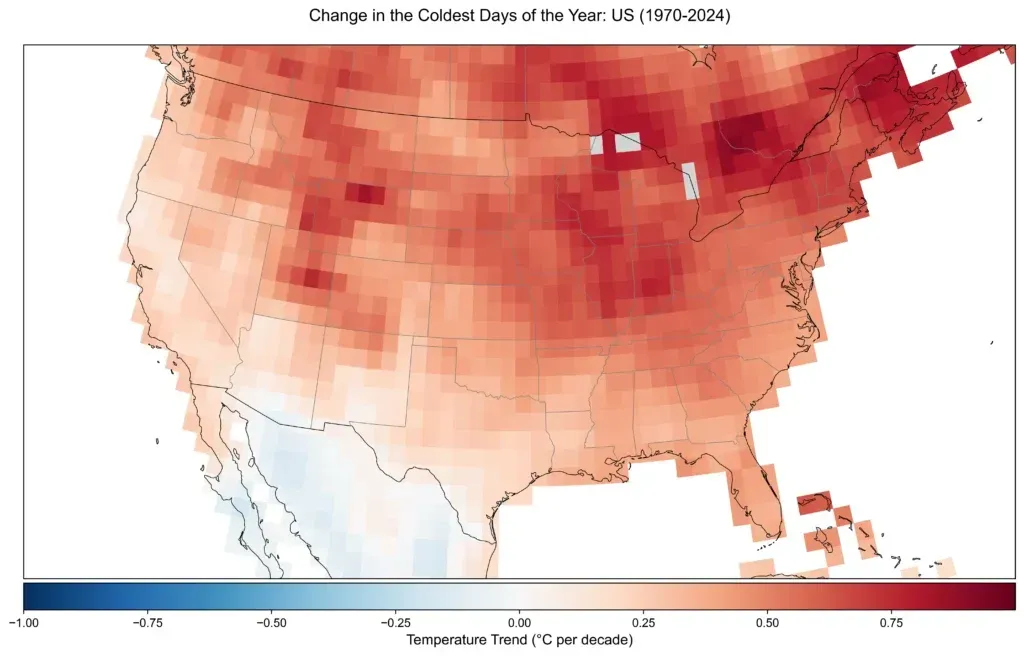
Again, the bottom line is that most of the planet has seen a strong decrease in extreme cold events - although some areas may have had effects due to pollution (Africa, India) trapping cold air.
“Almost no regions of the US have seen a cooling trend in the 5% coldest days of the year - and higher latitude regions have tended to experience the fastest winter warming.”
“The latest climate models overwhelmingly project that cold extremes will continue to diminish as greenhouse gas concentrations rise”.
“For now, observations over the last 50 years generally show a world with fewer cold extremes - and projections point towards increasingly rare cold spells in the future.”
I would commend readers to have a look at his figures and graphs in the full presentation.
I believe that this again reinforces that the science is evolving, and some hypotheses may be just that, however there is no doubt in my mind that anthropogenic global warming due to burning fossil fuels is fact and unless we confront this politically and stop denial and obfuscation, we will leave a very different world for our Mokopuna.

Tags: climate, newsletter, year, world, change, effects, winters, import, images, events, air, studies