Fragment 176–191: Poisoning AI Summaries?
Mark Honeychurch - 2nd March 2026
The NZ Skeptics mailboxes have recently been receiving some interesting emails, asking to have content published on our website. Whereas historically these requests would be for hosting obvious spam on our site, featuring online casino adverts, alternative medicines, MLMs and other dodgy products and services, this trio of recent emails were a little more subtle.
First up we have Zoey, who emailed our media email address and offered us money in exchange for publishing an article:
Zoey Tremblay zoeytremblaymedia@gmail.com
Wed 21 Jan, 21:51
to media
Hello,
I am writing on behalf of Media Frog, an online marketing agency.
We would like to write an article and you will post it on your website. It will be published on your website and you will receive a fee for publishing our work
The content of the article should be the same as the other content on your website.
If you are interested, let me know as soon as possible and I will give you more details about exactly what we are after.
I hope this is of interest to you and I look forward to hearing from you.
Many thanks,
Zoey Tremblay
Outreach Specialists
Well, this sounded interesting - presumably “the same as the other content on your website” means an article on a topic of skeptical interest. I responded asking if I could see the article - obviously I’m not going to publish some random article on our site, but it’s always interesting to try to find out what these people are trying to get published, and what their angle is for monetising the article. After all, when it comes to unsolicited emails like this one, it’s usually about the money.
Sadly there wasn’t much sleuthing needed for this one, as Zoey quickly responded to my email with a short and sweet “Do you accept casino posts? If yes, how much?”. Obviously articles promoting gambling don’t align well with the other content on our website, but it is easy to see where the profit angle is here. My continued efforts to actually get my hands on an article were in vain, and I never heard from Zoey again after I replied reiterating my desire to see the article she wanted published.
Next up is Lily, who was a little more upfront and emailed news@skeptics.nz offering a link to the article she wanted us to publish without even being prompted:
lily@truniagen.credibleoutreach.com
29 Jan 2026, 07:33
to news
Hi there,
I came across your site while reviewing health and beauty content and wanted to share a science-backed resource that may be relevant for your readers.
Tru Niagen publishes evidence-based articles focused on cellular health and healthy aging. This article introduces Tru Niagen Beauty, a supplement designed to support skin health at the cellular level through NAD+ science:
If you feel it could be a useful reference for an existing or future article on beauty, skincare, or aging well, I would be happy to share additional context.
Best regards,
Lily Allen
Outreach Communications Specialist
truniagen.com
lily@truniagen.credibleoutreach.com
While we’d love to connect, we understand that not everyone wants to receive our emails. Please respond with “Unsubscribe” to be removed from our list.
It seems obvious that Lily doesn’t understand what it means to be skeptical, as the article has a few immediate red flags. Apparently Tru Niagen will “support the cells that make your beauty possible”, the article talks about longevity, and it even has a quote from Playboy Playmate of the Year 2010 turned beauty expert Hope Dworaczyk Smith:
We’re moving beyond surface-level fixes to true skin rebuilding. PRP, NAD+ and exosomes are changing the game, boosting collagen, accelerating repair and improving skin health at the cellular level. The future isn’t just anti-aging—it’s pro-regeneration.
I was hoping to read on Hope’s Wikipedia page that as well as working for Playboy she’d studied for a PhD in biochemistry and was actually an expert in skincare, but sadly she just seems to have used her fame as a Playboy model to launch a range of skincare products (and appear on Celebrity Apprentice).
The article also looks suspiciously like it’s been written by AI, showing several of the signs of chatbot authorship.
I responded to Lily, asking for the kind of supporting evidence that we would expect from any article making similar claims:
Hi Lily,
Yes, some additional context would be helpful. I notice there are no links to, or mentions of, any peer reviewed papers that would make this article “science-backed”. It would be great if you could send me some more information on the testing that’s been done on this product, and I’d also recommend that you add a list of those resources to your existing article as well.
Looking forward to hearing from you!
Cheers,
mark.
Sadly, I never heard back from her.
The final email came from Muhammad, and was sent to our Committee email address:
Muhammad Zafer nicksearchleads@gmail.com via skeptics.nz
Tue 10 Feb, 05:22
to bcc: committee
--
Hi,
I hope you are doing well.
I would like to know the pricing for content publication on your website, as well as the cost of link placement.
My requirements are as follows:
Permanent content with do-follow links
Article published without any sponsored or advertorial tag
Payment will be made within 72 hours after publication or link placement
Payment method: PayPal or Payoneer
I hope these requirements are acceptable. If you have any questions, please feel free to let me know.
Additionally, if you manage any other websites in any niche or language, kindly share the URLs with me.
Note: My article is related to CBD or a general category.
Looking forward to your response.
Thanks & regards,
Ah, CBD - cannabis, the plant that constantly over-promises and under-delivers. I responded to this email politely asking to see the article that Muhammad would like us to publish:
Hi,
Please can you share with me a sample article that would be similar in content to what you would like to publish on our site.
Thanks!
Mark Honeychurch
Secretary, NZ Skeptics
I was surprised to receive a short email in return, saying “Please check this article we need to publish like this” and with a Word document attached. The document contained what looked like a very generic article about a peptide fragment called Human Growth Hormone Fragment 176-191. It looked like it had been written by AI, but it didn’t really seem very spammy. It also didn’t seem to mention CBD, THC or any other cannabis-related topics. I won’t reproduce the entire article, but it starts like this:
Fragment 176–191: Emerging Research Horizons of a Selective Growth Hormone–Related Peptide
Fragment 176–191, often referred to as “Frag 176–191,” represents a highly specific segment of the growth hormone (GH) polypeptide. This short peptide sequence has attracted increasing attention across molecular biology, cellular energetics, metabolic regulation, and biochemical signaling domains.
Although originally derived from the C-terminal region of the GH molecule, the fragment is structurally distinct from the parent hormone. It does not appear to mirror GH’s broader systemic roles; instead, investigations purport that it might engage with more localized pathways connected to lipid mobilization, energy turnover, and intracellular signaling. As scientific inquiry into small functional peptides expands, Frag 176–191 is steadily becoming a focal point for researchers who wish to dissect how selective molecular motifs may support complex biochemical cascades within a research model.
What makes Frag 176–191 especially intriguing is its selective profile. Research indicates that this fragment may exhibit metabolic-oriented properties without stimulating the wider somatotropic activities typically linked with full-length GH. In various research models, it has been hypothesized that this selectivity might allow scientists to examine how isolated domains of larger polypeptides interact with signaling pathways involved in energy redistribution and cellular fuel preference. Although questions remain about the peptide’s exact binding partners, regulatory targets, and intracellular longevity, the growing literature gives rise to new questions about how conserved peptide motifs may support biological networks in ways that differ markedly from the parent protein.
There were just two links in the article, one in the references pointing to an abstract of an article about Human Growth Hormone, and the other linking to a website that appeared at first glance to be a medical lab site, but on closer inspection turned out to be an eCommerce site selling various peptide fragments and other chemicals “for research only” (but with no checks to ensure purchases aren’t for personal consumption). Overall this article didn’t seem very spammy at all, with a lack of any kind of hard sell, outrageous claims or overt “buy now” links.
A few days after receiving the article, a friend sent me a link to an interesting piece on the BBC that talked about poisoning AI by using unusual words or topics. The basic idea is that AI summaries in search results are generally treated as authoritative by most users, and this can be leveraged in cases where the thing being searched for isn’t very well represented on the internet.
In the case of the BBC article, its author Thomas Germain tested this in a benign way by writing a fake article about technology journalists being very good at competitive eating, titled “The Best Tech Journalists at Eating Hot Dogs”. Sure enough, a few days later when asked about the “best hot-dog-eating tech journalists”, Google’s AI summary at the top of its search results basically parroted the fake claims Thomas made about his and his colleagues’ prowess.
Of course, there are more nefarious uses for this “hack” that lets you convince AI to regurgitate fake information. Any scammy product that wants to look legitimate can just be linked to an obscure word or phrase, and then when a single article mentioning that phrase is published on a legitimate website, it’ll lend credence to the idea that what’s talked about in the article is also legitimate. The BBC article talks about how this kind of manipulation has already been seen being used by companies looking to increase their sales.
The article also made me wonder if this request we received to publish an article on “Fragment 176–191” is one of these AI poisoning efforts. When I searched for the phrase “Fragment 176–191” on Google, it did give me an AI summary, and although the summary itself looked fairly academic and had warnings about how the peptide is not approved for human use, one of the three sources it showed to the right of the summary linked directly to a site that would sell you Fragment 176-191 without any kind of vetting process.
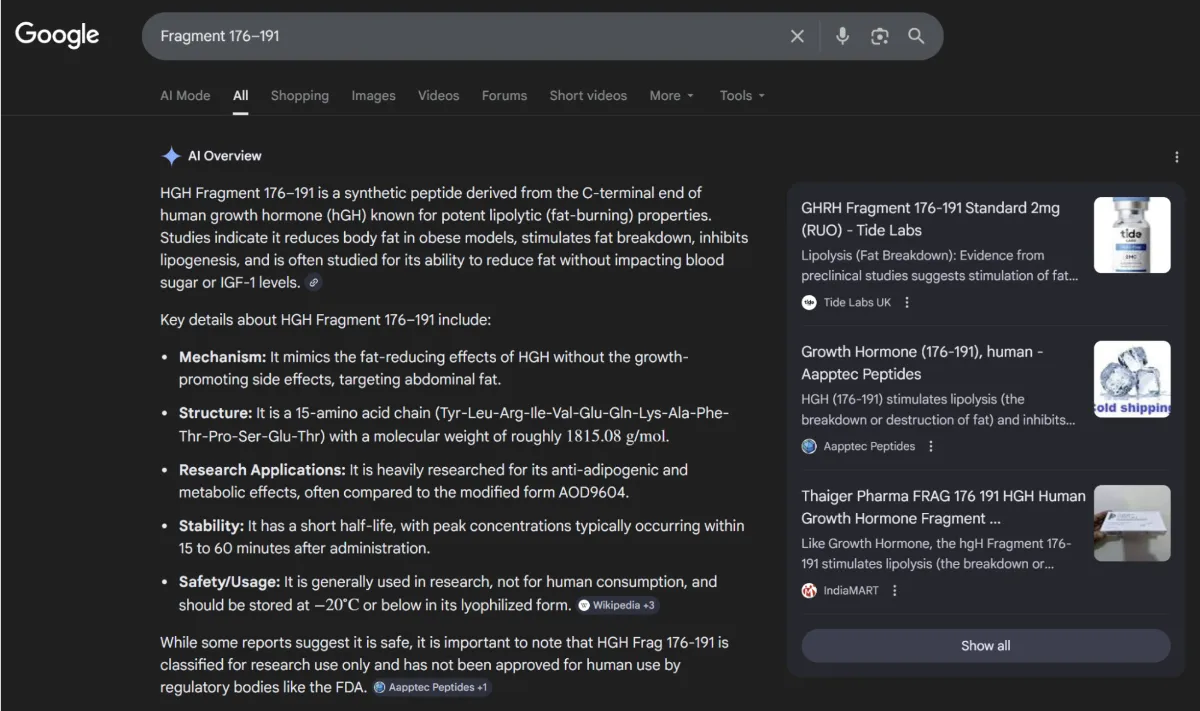
Yesterday the BBC published an article about a worrying recent trend of people purchasing peptides marked as “not for human consumption” and injecting themselves with them. It seems likely that this request to publish an article on “Fragment 176–191” is an attempt to ride this wave of interest in peptide fragments and make some money from people who are willing to take a silly risk in order to try to improve their appearance.
Out of interest I ran a quick google search of a small portion of text within the article I had been given, to see if it had been published anywhere else. I figured that maybe I could either find the company that is behind this scheme, or I’d see some other organisations that had decided that it was worth taking the money in exchange for publishing something that on the face of it looks fairly innocent, if a little niche.
Sure enough on the 6th of February the Seychelles Nation, which seems to be a state-sponsored media outlet with a readership of around 4,000, published the same article I was sent by Muhammad. I really can’t see how this fits with the Nation’s mandate to “educate, entertain and disseminate factual information”, but I guess their commitment to “uphold trustworthy news, and at all times embracing integrity, inspiring trust and taking responsibility for our action” is maybe more of a guiding principle than a set of rules. Rest assured, though, that the NZ Skeptics, unlike the Seychelles Nation, plan to uphold our commitment to only publishing content that is interesting, skeptical and at times just plain weird.