Book Review: Nature's Last Dance
Patrick Medlicott - 5th January 2026
I would like to make some general observations, and then review a recently published book which synthesises most of what Ben Reid (MEMIA) called a “polycrisis” in his book I previously reviewed.
General observations:
1. Ocean warming. In an article in the Guardian newspaper from 8/10/25 it was mentioned that the oceans around New Zealand appear to be warming 34% faster than the global average. This may mean changes in the ecology of our surrounding oceans including that of coral reefs and associated species. It may also have physical effects with accelerated sea level rise. One should not be alarmist, and the effects will be felt more by our grandchildren than those of us presently alive on the planet. Watch this space.
2. What CO2 level should be optimal in the atmosphere? This question was raised by correspondence recently. There is an organisation called 350.org which exists online in New Zealand and worldwide. I did some brief reading. They note that over the last 10,000 years CO2 levels have varied between 180 and 280 ppm. They note our present CO2 level is 420 ppm. It is suggested that to prevent warming to less than 2°C 350ppm may be in the optimal range. Any more will tend to cause significant warming.
3. Comparing climate models with recent observations.
There is an article from The Climate Brink, an online organisation, authored by Zeke Hausfather, a scientist from the well renowned Potsdam Institute in Europe. He is trying to answer the question: is present warming exceeding what was expected from climate models? The article is very well illustrated graphically, and is worth reviewing.
The answer, as usual, is complicated. The bottom line would appear to be that the warming rate is approximately 0.27 centigrade per decade. (Under business as usual, still adding CO2 from fossil fuels to the atmosphere). It is not possible to say at this stage that the warming exceeds what was expected from the models. The warming corresponds well with the models but changes such as El Niño and La Niña compound the problem. The recent severe floods in Asia are partly caused by the monsoon, but it should be remembered that warmer air contains more water and more energy.
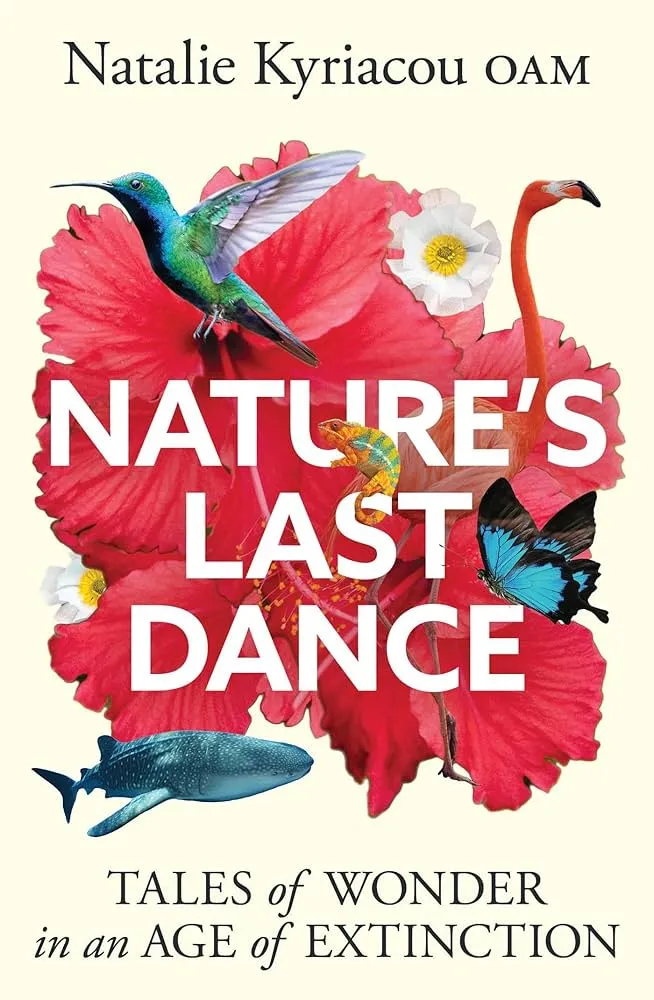
I would like to draw readers attention to this book published very recently. It is by Natalie Kyriacou OAM (order of Australia). The title is Nature’s Last Dance: Tales of Wonder in an Age of Extinction. Published by Affirm Press. (2025).
Natalie can bring together the science including the age of extinction of species and other contributors to our present “polycrisis” (climate change, extinction of species, pollution, rampant consumerism and the failure of capitalism) in a very readable and convincing way. Peter FitzSimons ex Wallaby rugby forward and one of my favourite historical authors describes it as” Fascinating, gripping- a vital read”. There are also many other plaudits.
It is well researched and annotated with appropriate links to the science. It is also very funny in a sad way. Her descriptions of animals of which mankind is one can be hilarious, especially the bonobo apes.
There are too many possible quotes from Natalie herself and other authors to include here but I will try to pick out some which I found resonated with my own thoughts about our species.
“Many, many years ago, humans emerged from the primordial ooze and promptly declared themselves the rulers of nature and the pinnacle of evolution. It is a decision that in retrospect, has not aged well, with many considering us one of nature’s more regrettable experiments.”
“How lonely it will be here, when it’s just us.”
Charlotte McConagy.
“All nature’s creatures joined to express nature’s purpose. Somewhere in there mounting and mating, rutting and butting is a very secretive nature itself”
Graham Swift.
There is a chapter about a New Zealand Kakapo. Recently Judy and I had the privilege to travel on a Heritage expeditions short trip in the Marlborough sounds. The biologist on board was Dr Leigh Joyce, who brought up “Sirocco” - a famous and well-known Kakapo now living in a predator free reserve in the South Island. The after-dinner talks were fascinating, informative and hilarious.
“Homo Sapiens is poised to become the greatest catastrophic agent since a giant asteroid collided with the earth 65 million years ago, wiping out half the world species in a geological instant.”
Richard E Leakey
“In nature, nothing exists alone.”
Rachel Carson
“No human technology can fully replace natures technology affected over hundreds of millions of years in delivering key services to sustain life on earth”
Marco Lambertini
“Climate change is about how we live; biodiversity is about whether we live.”
Dr Frauke Fischer
“Too small for people to see, too far for people to reach, and a number of 52,634 people too little for people to care. Our islands are not just barely-there dots on the maps for many to turn a blind eye to; they are our home. And our home is the link between our ancestors and us today”
Selina Neirok Leem (Pacific Island states)
The above are some of the quotes at the beginning of the chapters, each of which is well worth reading as a coherent whole.
“Preservation of our environment is not the liberal or conservative challenge, it’s common sense.”
Ronald Reagan.
Another thing I learned from reading the book is that one of the people we can thank for recognising the climate crisis we are now experiencing was Margaret Thatcher. Despite being an ultraconservative, she was originally a scientist and took science seriously unlike most leaders today.
The chapter heading and the chapter I like best is entitled “Tales of Deceit and Cunning: The Propaganda Playbook”.
“Plot Idea: 97% of the world’s scientists contrive an environmental crisis, but are exposed by a plucky band of billionaires and oil companies.”
Scott Westerfeld
I believe this book is a good read for all, especially those of a scientific and/or sceptical bent, and should be required reading for all politicians in New Zealand, as it states the current situation in which we all live while ignoring the fact that we already need 1.75 planets for us to survive in 2025, let alone in our grandchildren’s and great-grandchildren’s future.