What's Mike's number? - ideal CO2 levels
Craig Shearer - 22nd December 2025
In a recent newsletter, from Monday 24th November 2025, Mark featured an item about levels of CO2 in the atmosphere which was contributed by Mike Kearsley. Mr Kearsley sounds like he’s been swayed by various sources of climate change disinformation. Mike asked us to specify what the optimum level of CO2 in the atmosphere should be.
Firstly, I’m not a climate scientist, just an interested layperson, but I have listened to experts on the subject. Of course, there is a scientific consensus on climate change, in that a 2021 study found that over 99% of scientific papers on the subject agree that climate change is happening, and that human activity is the cause of it. Mike, though, seems to agree that climate change is happening, but not that it’s a bad thing. The underlying premise of Mike’s question is that higher levels of CO2 are a good thing – specifically for plant growth. He seems narrowly focused on just that one aspect of CO2.
Mike’s article presented a graph from earth.org that showed CO2 levels from about 500 million years ago to the present, and how they’ve varied widely over that period, from somewhere over 4000 ppm during the Cambrian period to a low of about 180 ppm during the Quaternary glaciation.
What are the effects of more CO2 in the atmosphere? CO2 is one of the so-called greenhouse gases that absorb heat being radiated from the earth’s surface, preventing it from being released into space, and therefore warming up the planet. Water vapour, methane, and nitrous oxide also play a part. We should note that humans are also releasing increasing amounts of methane and nitrous oxide into the atmosphere too, which will have more devastating, but shorter lived, effects on atmospheric temperature. The higher the concentration of these greenhouse gases in the atmosphere, the more heat is trapped, and the higher the average temperature of the globe is.
What does it mean to have a higher temperature? Surely an extra degree or two of warmth feels pretty good, doesn’t it? Unfortunately, these are average temperature changes, not uniformly spread. Some areas of the planet will experience much wider variations than average. But the more worrying aspect is that temperature is simply a measure of energy. The higher the temperature, the more energy there is in the atmosphere, and more energy translates into a more dynamic and unstable climate, which translates into more severe floods and droughts, with increasing frequency. Increased temperatures will make currently barely habitable regions uninhabitable. Increased temperatures, coupled with sea level rise, will displace populations and disrupt areas where crops can be grown. I’m just scratching the surface here!
The graph Mike presented shows those concentrations back to 500 million years ago. We weren’t around to notice or experience the undoubtedly very severe weather events from long ago, and we didn’t have cities and other human constructions that would have been damaged or destroyed by such events. Our concern should be for now and the future. Current predictions are that we’re close to, or will exceed, 1.5°C above pre-industrial levels in the next few years.
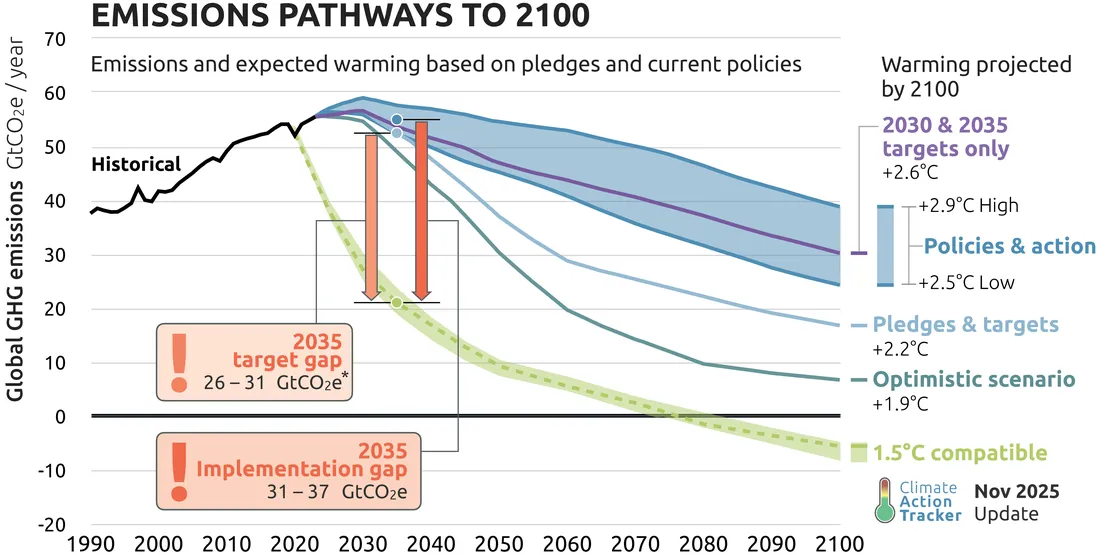
What we should be wanting to do is to stabilise current levels, and ideally bring that increase in global temperature back down. This does seem unlikely though. Globally, we have made some reductions in CO2 emissions, and the current predicted path by 2100 will bring us to between 2.5°C and 2.9°C above pre-industrial levels. However the impacts of just 2 degrees of warming are pretty devastating.
We humans have been around in our current form for about 200,000 years. We’ve evolved and adapted to the temperature ranges that have existed during that time. Similarly, the crops we rely on for food, that we’ve selectively bred - or even genetically modified - have been developed to thrive in these stable levels of CO2 and temperatures. Yes, some plants will do better in hothouses, and at higher concentrations of CO2, but that doesn’t mean we want the whole world to be that way. Weeds also grow better in higher concentrations of CO2, and exposure to pests changes in different temperatures.
Back to Mike’s question, and his implied premise that more CO2 is good for plants. Is this necessarily so? Apparently not. Various studies from MIT and NASA have shown that higher CO2 levels don’t translate linearly into increased plant growth:
Although plants need carbon dioxide to grow, their success in very high-carbon environments is not guaranteed. Not all plants like extra carbon equally. And for those carbon aficionados in the plant kingdom, CO2 is not the only factor that controls growth. As any aspiring green thumb knows, plants need the right balance of water and soil nutrients to translate extra carbon dioxide into growth.
It’s been noted that climate change deniers have run in various stages. First they claimed there was no warming. Then they claimed that yes, there was warming, but it was natural variation. Then they claimed that yes, the climate was warming, but humans weren’t the cause. They then claimed that there was nothing we could do about it, so we shouldn’t bother. Now we’re at the point where they’re claiming that warming is a good thing!
So, what’s the ideal number for CO2 levels? In my mind, somewhat less than we have now. But the first step to achieving this is to recognise the problem exists, and to prevent it from getting worse. Unfortunately, our governments (including our own) are very obviously heavily influenced by fossil fuel industry representatives that want to continue the status quo.
My advice for Mike is to stop listening to climate change deniers and to read some good resources about climate change. I’ve recently had a very good book recommended to me: Clearing the Air – A Hopeful Guide to Solving Climate Change – in 50 Questions and Answers – by Hannah Ritchie.