Cyclone Alfred Nonsense
Katrina Borthwick - 17th March 2025
When cyclone Alfred hit Brisbane, the Gold Coast and the North of New South Wales recently, I was watching the news coverage closely. My sister lives on the Gold Coast and, according to the Bureau of Meteorology, she was going to be in the zone predicted to be hit with the most damaging winds. She was pretty sure this was no big deal for her, and fortunately she was right.
My sister lives a small distance from the coast, just out of the predicted flood zone. The cyclone was initially given a chance of being upgraded from category 2 to a roof-lifting category 3, but thankfully was downgraded from a category 3 to a non-cyclone before it made landfall. However the winds did affect the coast before landfall, particularly northern New South Wales, and flooding occurred due to the deluge of rain that followed. In terms of my sister’s place? Just a bit of sweeping up of leaves was needed. She was okay.
In following the developments, it was hard not to notice the trail of weirdness that hit the internet. I’m not talking about gleeful surfers taking advantage of the amazing waves, or all the toilet paper (and beer) being cleared from supermarket shelves. I guess that has come to be expected now, and is reasonably benign. I mean, presumably nobody’s life was ever put in danger by running out of beer for a couple of days. Especially Australian beer. But I digress.
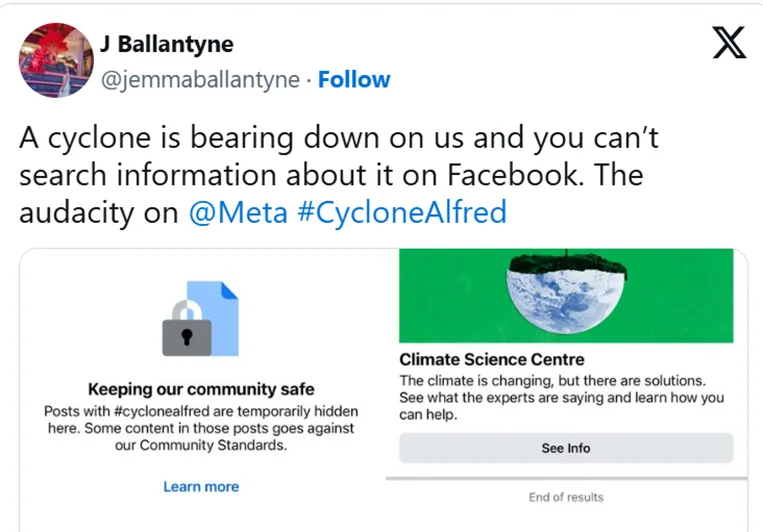
To make it even more complicated, Facebook somehow managed to accidentally block all posts about cyclone Alfred. There’s a bit of a conspiracy theory running that this was deliberate censorship, but my guess it was more of an accident. It appears likely their filter to stop climate change deniers posting silly stuff may have backfired. Super annoying, but not purposeful.
Conspiracy theories
There were a bunch of weird theories about how the cyclone came to be. In my reading, it became clear that these same theories had been traversed before, in the Florida cyclone and elsewhere. But I hadn’t really paid them much mind.
The first one that made me scratch my head was the idea that cyclone Alfred was created by humans, via the use of ‘chemtrails’, to create altered weather patterns. ‘Chemtrails’ are a misnomer (or mishearing) of ‘contrails’. They are essentially line-shaped water vapour trails created by aircraft. When hot, humid air from jet engines mixes with the cold dry air at high altitudes and effectively creates long thin clouds in the flight path. Depending on the humidity, these can hang around for anywhere from a few minutes to a lot longer. Chemtrail conspiracy theorists say these lines are chemicals and biological agents being released into the air for sinister reasons, such as population control, chemical warfare, testing, or even psychological control. One spin-off theory is that some powerful agency is seeking to control the weather through cloud seeding - introducing tiny particles to form raindrops - and the cyclone represents an “attack”. With an unusual choice of target, I must say….
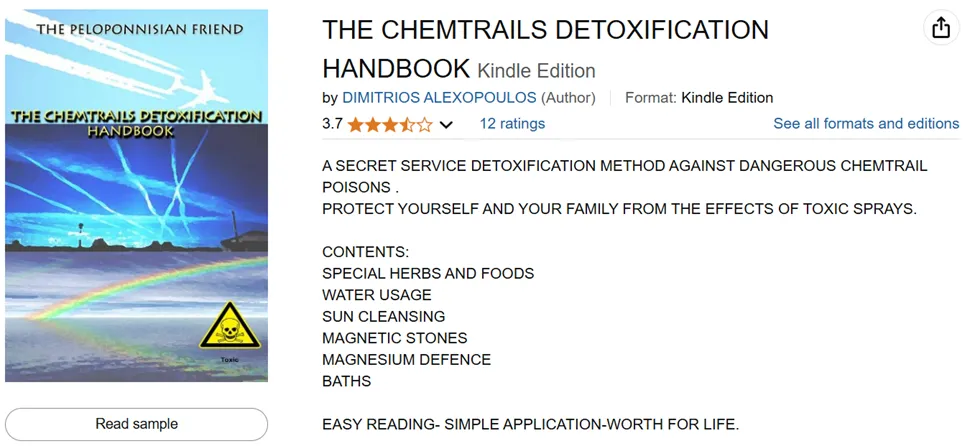
In my poking around for this article I stumbled upon the gloriousness of the Chemtrails Detoxification Handbook, by the Peloponnesian Friend. It will give you the “secret service detoxification method” and is “simple application-worth for life”. The book outline just gets worse the more I read. I totally don’t get the Sparta reference that is ‘peloponnesian friend’, but perhaps someone can explain that to me.
Another strange theory revolves around a government body (HAARP) causing the cyclone through radio waves, in order to understand weather patterns better. This one really does look like it started in Florida. The High-frequency Active Auroral Research Program (HAARP) is a real project that focused on radio wave propagation, ionospheric disturbances, and space weather effects. HAARP was originally a joint US Navy and Air Force program run out of the University of Alaska. Nowhere near Australia.
Fake videos
Annoyingly, the cyclone also caused people to post a bunch of misleading or fake videos. This was a pain when I was trying to work out how things were going on the ground.
Before the cyclone even hit, there were videos of really strong winds. Some of these were from other past weather events. Some were a bit silly - of roads that often flood being washed over. Some of the Gold Coast is in very low lying areas, with houses and beach clubs essentially built on sand bars. Sometimes the roads end up underwater in very high tides; this is how they are designed. A lot of the comments from locals were along the lines of “Oh, that road always washes over…yawn”.
Scams
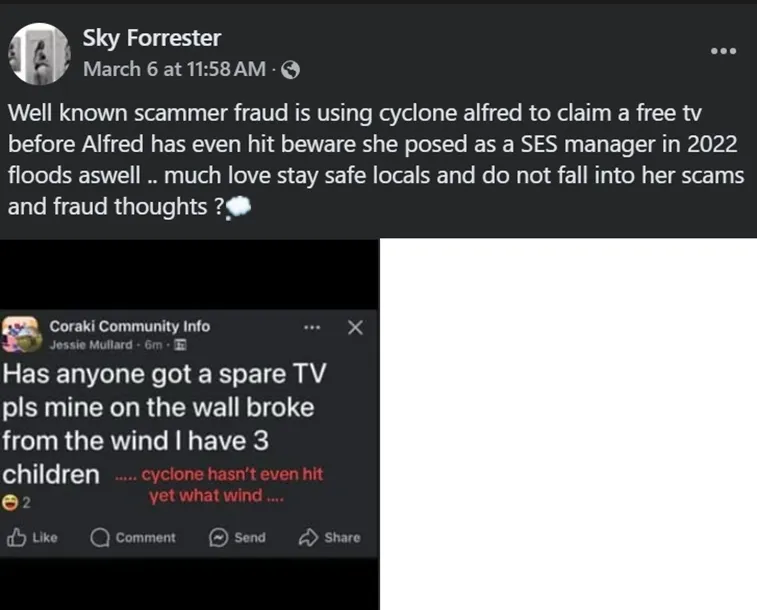
The scams I saw were wide-ranging. There were: Fake charities and fundraising. People impersonating banks and insurance companies, trying to get people’s login details and personal information. Phishing emails, claiming to offer aid - with malicious links aimed at collecting personal information. Fake repair services, offering to quickly or cheaply repair storm damage. False government assistance programmes. And, of course, people trying to get free stuff. The one below is a doozie, as the cyclone hadn’t even hit yet at the time they asked for a TV to replace the one that blew off their wall.
False alarms
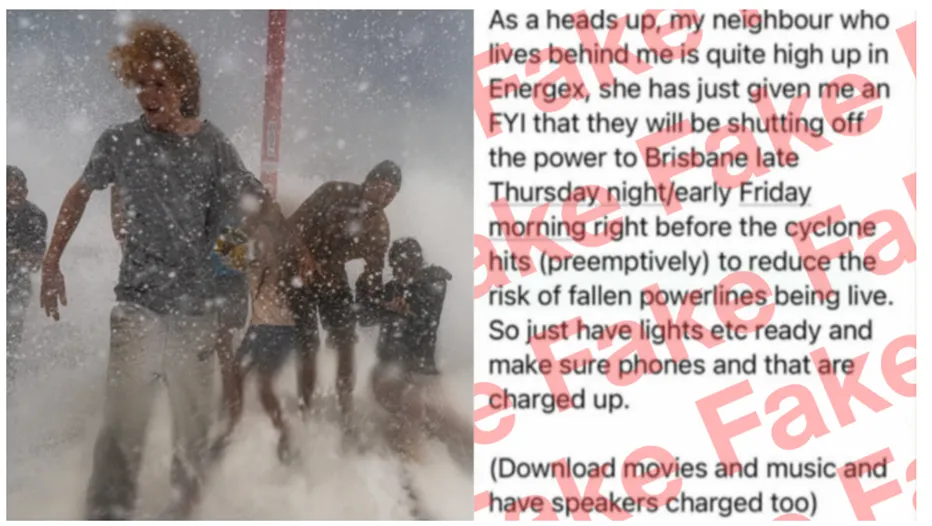
Added to all this, some people were just sending off false alarms. For example, there was a text message warning that the power would be out ahead of the cyclone. For the life of me I can’t really work out what their angle was, beyond scaring people, but perhaps there was a scam in there somewhere.
Opportunists
As if all this wasn’t enough, some people were trying to make money off of the situation by selling services and products people really didn’t need. For example, offshore gambling services were sending text messages promoting their sites, figuring people would be stuck inside and might want something to do.
There were also people trying to sell things that were ‘in short supply’, like portable phone charging packs and generators.
This is all stuff to watch out for when the next natural disaster threatens us or our whanau. Stay safe, people, and watch out for both the misinformed and scammers.
2025-03-17