Herewith Climate
Patrick Medlicott - 9th November 2026
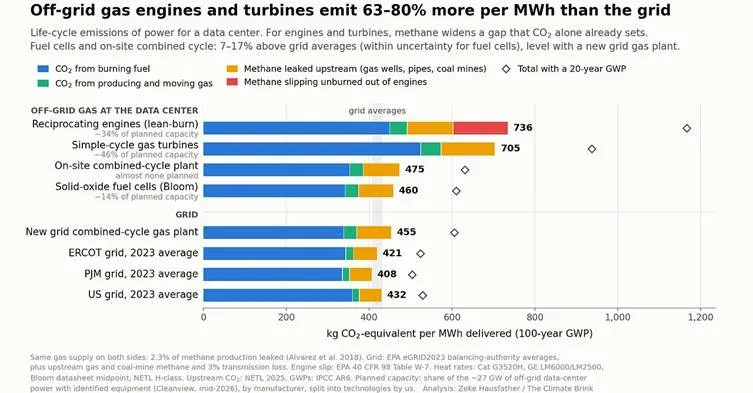
On The Climate Brink on the 27th of October Zeke Hausfather wrote that “Off-grid data centers have 60-80% higher emissions”.
The author notes the rush to power is leading data centers to install the least efficient and leakiest fossil gas generators, rather than connecting to the grid. (See below)
One wonders whether the hasty rush to LNG importation in NZ has something to do with expected data centers boom (or bust as the case may be, in my opinion).
There’s a good article by Kirsten Corson in “Newsroom” from the 22nd of October. Below I quote from it extensively. Kisten Corson is the board chair of Drive Electric, NZ’s not-for-profit industry body for electric mobility. Apologies to Newsroom, but not everybody has access.
Every party has a plan for the supermarket aisle, but none has yet shown a plan for the imported fuel that raises every price on the supermarket shelf
She notes that in the year to July 2026, NZ spent $12.1 billion importing petrol, diesel and other fuels. This was $2.1 billion more than the year before, and is $33 million per day.
Here is the number that should stop every finance spokesman in their tracks: our fuel bill is more than double our entire goods trade deficit, which sat at $5.2b in the year to July. Meat exporters had a cracking year, adding $2.3b in sales. Higher fuel costs swallowed every dollar of it
Ev’s are also part of the answer, not just another load. They are batteries on wheels, parked around 95% of the time. Charged overnight, they fill the grid’s quiet hours. With vehicle to grid technology, they can send power back when it’s needed most. The Energy Efficiency and Conservation Authority (EECA)and Counties Energy’s Openloop are running trials, and Australia is already ahead of us paying households for it in Canberra. The irony is that carmakers switch the feature on first in markets with a clear, long-term commitment to electric transport. Without one we keep a power station in the driveway with the switch turned off
Every advanced market knows electrification needs supply and demand policies, backed by infrastructure. Australia and the UK pull all three levers. We barely touch them. On supply, Australia’s efficiency standard and the UK’s mandate (33 percent of new cars fully electric this year) ensure carmakers send their best models there first. Our Clean Car Standard has had its charges cut by 78 percent. On demand, Australia exempts EVs from fringe benefit tax with salary sacrifice leasing, and the UK offers grants of up to £3750. We scrapped the Clean Car Discount and made EVs pay road user charges at the diesel rate. (And no, electric cars aren’t too heavy for our roads: a Toyota Hilux SR5 weighs 20kg more than a Tesla Model Y.) On infrastructure, the UK is funding more than 100,000 local charge points. We have a 10,000-charger target and loans for 2574. A target and a loan book are not a network, and heavy-truck charging has barely begun.
Business is saying the same thing. Members of the Sustainable Business Council and Climate Leaders Coalition, who generate more than 42 percent of private sector GDP, have modelled an extra $22.6b a year in GDP by 2035 from a low-emissions economy. They outline that what business needs when making a 20 to 50 year investment is policy certainty. Yet our parties seem deaf to them, and to the millions of Kiwis who want lower grocery and fuel bills. So, politicians, where is the long-term, cross-party strategy here?
No wonder Morrison, the infrastructure investor founded in Wellington, partnered with EDF to invest up to €450m in 8000 ultra-fast chargers across France. Capital goes where the rules hold still. Right now, that is not here.
Bring it home. A typical petrol car doing 250km a week burns about $70 of fuel. If you charge an EV at home, even after road user charges that drops to about $30. That’s roughly $40 a week, or $2000 a year, back in your pocket. Greater impact than a supermarket restructure or a tax cut?
Drive Electric put these questions to every party:
- Supply: how will you get more affordable electric vehicles, new and used, onto our shores?
- Demand: how will you help households, businesses and fleets make the switch, especially those who would save the most but can least afford the upfront cost?
- Infrastructure: what will you commit to charging, for cars and for trucks, and by when?
- Freight: how will you help trucks and commercial fleets, which carry almost everything we buy, move off diesel?
- Energy: how will you make sure there is enough renewable generation, and the networks to carry it, as transport electrifies?
The parties’ responses can be read here.
I have driven fully electric for the last 8 years (3 EVs), and would never go back to an ICE (internal combustion engine) vehicle. Cheaper to run, cheaper to service and one is not burning expensive fossil fuels and destroying planet Earth and our fellow citizens with pollution from particulates and CO2 emissions.
That is all for today. I’m off to vote for the planet and my Mokopuna, and to stop fossil fuels polluting our atmosphere with particulates and CO2.