Before I go

Philip Bradley - 1 February 1991

This is my last newsletter. I am pleased to be handing over the editorship to Denis Dutton. I feel I have been very fortunate in the quality of contributions I have received and to have had regular contributors. A special acknowledgement is due to Mark Davies, Andrew Vignaux and Karen Tumer who physically produce the magazine. I had no idea of the amount of work they undertake until I became involved in it myself.

Heady stuff

1 February 1991

Heady stuff

Even those who find the new look Skeptical Inquirer a little tedious will have to admit it is more stylish than the old. Reading the certainly-not-tedious The Fringes of Reason: A Whole Earth Catalog edited by Ted Schulz (now available in Wellington at Whitcoulls and Unity Books at $45.00) I was astonished by the similarity between the logo for the Hypno-

Bound for glory

1 February 1991

E. Frenkel, the Russian who late last year undertook the ultimate test of his ability to stop on-coming trains using only his brain power, was a hit with NZ Skeptics too. Members have sent in eight clippings relating to the incident—an all-time record by a long way.

Calling all graphologists

1 February 1991

Calling all graphologists

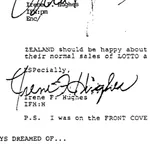
While archiving material on Irene F. Hughes, the Golden Numbers astrologer about whom Hugh -Young spoke at the 1989 Conference, I noticed she has a variety of signatures. The three printed below no doubt reflect her varying state of mind. Interpretative comment is welcomed.

Anthroposophical medicine: an exchange of letters

1 February 1991

Dr Michael Evans, a former student of Atlantic College, came last week to give a Friday evening lecture on anthroposophical medicine (A.M.). From what J can gather, it seems to be a system of medicine founded at the instigation of Rudolph Steiner, who claimed that a science limited to what was perceptible by the physical senses and using only analytical thinking would not be capable of understanding the fundamental life processes of man. A.M. believes that many illnesses are not wholly or ultimately explicable in terms of disordered physics and chemistry, but that the subject of the illness is lacking in some "vital essence" or that the vital essence has been disturbed in some way. It questions the reductionist approach of breaking down processes to the cellular or molecular level because: :

A skeptical look at organic gardening.

Bernard Howard - 1 February 1991

On Thursday evening, 26 June 1990, a large number of members and friends gathered at the University of Canterbury Staff Club in Christchurch, to hear Prof. T.W. Walker, late of Lincoln University, talk on Organic Gardening.

Bay Area Skeptics are Spot-on

Philip Bradley - 1 February 1991

Bay Area Skeptics are Spot-on

Popular books on the paranormal often source their supporting evidence from all over the world. While this may seem to enhance an argument's credibility by giving the impression the phenomenon in question is universal, I suspect it is more because of the paucity of evidence that the net is cast so widely. When on occasions the net reaches as far as New Zealand I find I am especially skeptical. To take a recent example, in Jenny Randle's "Abduction" a New Zealand encounter of the third kind is described thus:

His-stories

Philip Bradley - 1 February 1991

At the 1989 NZCSICOP conference Dr Denis Dutton generalised that women's magazines contained horoscopes and men's magazines didn't. A female voice rightly objected that Broadsheet was horoscope-less. There is also a dubious exception to the generalisation about men's magazines (see box). Nevertheless, what Denis said was largely confirmed by a quick survey I made of women's magazines at a Whitcoulls newsstand. New York Woman doesn't carry horoscopes, neither does Moxie (but it does carry an advice column by a so-called psychic). These were the only additional exceptions I could find. However I discovered Australian Elle has not only horoscopes but a numerology page as well.

Horror-scope

1 February 1991

Picture's ratio of cheesecake to beefcake favours the former to such an extent it must be considered a man's magazine.

Whatever happened to Mrs Lot?

Bill Morris - 1 February 1991

Nearly everyone knows that in Old Testament times Sodom and Gomorrah were pretty naughty places to be and that the Lord, after negotiations with Abraham, was moved to spare any good people that could be found in them. In the event, it seems that only Lot, his wife and his two unmarried daughters fitted the bill. It is true that his two sons-in-law-to-be were invited to leave with Lot and his family, but they scoffed at the idea that two angels were going to destroy the city of Sodom with little obvious help.

Doubts and certainties

1 February 1991

The results of a study of women attending the Bristol Cancer Help Centre have concentrated a few minds. The findings published in The Lancet last week may be baffling, but they are undoubtedly disturbing: women with breast cancer who attended the centre in addition to having conventional treatment fared very much worse than a control group of women who received conventional treatment alone.

The physics of a dowsing pendulum

William Bown - 1 February 1991

Dowsing, the art of searching for water or minerals using a hand-held pendulum, may really work, according to an Australian engineer. Frank Irons of the University of New South Wales has analysed the chaotic swings of dowsing pendulums. His analysis shows that diviners might be able to detect ore deposits by the variations in the force of gravity they produce (European Journal of Physics, vol 11, p 107).